Find out first
Test annually for total coliform bacteria, nitrate, total dissolved solids and pH, through a state-certified lab.
Well water: what to test for, how often, and what the numbers mean
A USGS study found water from about one in five private wells contained a contaminant above a human-health benchmark. EPA, Private Drinking Water Wells
Updated
Does this apply to you?
Around 15 percent of the country, more than 43 million people, drink water from a private well. If you are one of them, the important sentence is EPA's own: the quality and safety of water from private wells is not regulated by the federal government under the Safe Drinking Water Act, and nor is it by most states. There is no utility, no annual report, and no one taking samples. You are the water system.
That is the whole of the applicability question, and you already know the answer. The real question is what YOU should test for, and there is no lookup for that either. What belongs on your list depends on what sits around your well, which no agency holds by address. What EPA does publish is the mapping from nearby conditions to substances, and it is a checklist you can run in ten minutes standing in your own yard.
Everyone on a well tests the same four every year. The rows below are what to add.
What to add, based on what is around you
- Intensive agriculture nearby
- Nitrate, nitrite, pesticides and coliform bacteria. Fertiliser and animal waste move through groundwater and run-off, and nitrate is the one on this page that can hurt someone quickly.
- A septic system, yours or a neighbour's
- Coliform bacteria and nitrate. EPA names effluent from septic leach fields as a route for microorganisms into a well.
- A landfill, junkyard, factory, gas station or dry cleaner nearby
- Volatile organic compounds, total dissolved solids, pH, sulfate, chloride and metals. Add VOCs on their own if you can smell fuel or there are buried tanks around.
- Mining or gas drilling nearby
- Metals, pH and corrosion for mining. For gas drilling, EPA lists chloride, sodium, barium and strontium.
- Your region is radon-rich, or indoor radon is high
- Radon in water is a separate test from radon in air, and water can carry it into the house through showers and taps. Check radon first
- Scaly residues, and soap that will not lather
- Hardness. It is a nuisance rather than a health issue, but it is on EPA's own list of reasons to test, and it decides how long your appliances last. What hardness costs you
- Lead pipes or lead solder in the house
- pH, lead and copper. On a well this is plumbing rather than the water main, and corrosive water pulls more of it out of the pipes.
- Recurring stomach upsets in the household
- Coliform bacteria, immediately and not at the next annual test. EPA lists recurring gastro-intestinal illness as a reason to test on its own.
Rows condensed from the conditions-and-substances table in EPA's Protect Your Home's Water. If two or three apply to you, the extra tests go on the same sample run as the annual four, which is cheaper than sending twice.
How to find out
One rule matters more than the rest: for coliform and nitrate, the test that counts is done by a state-certified laboratory. A strip kit from the hardware shop is a screen, useful for hardness, iron and pH, and it is not what you act on when the question is whether the water is safe to drink.
What it costs to find out
- Home screening kit, strips or a bottle test
- $9 to $35 Home Depot listings
- The annual four at a state-certified lab
- Price is set by the lab, and there is no national figure EPA certified lab directory
- A state-certified drinking water laboratory
- EPA maintains the contact list for every state certification programme. Call first: they send the bottles, and how you fill them decides whether the result means anything.
- Your state private well programme, and your county health department
- EPA keeps a directory of state well programmes. The health department is also the fastest way to learn what is already known to be common in your area's groundwater, which tells you what to add to the annual four.
What makes a well sample worth paying to analyse
- 01
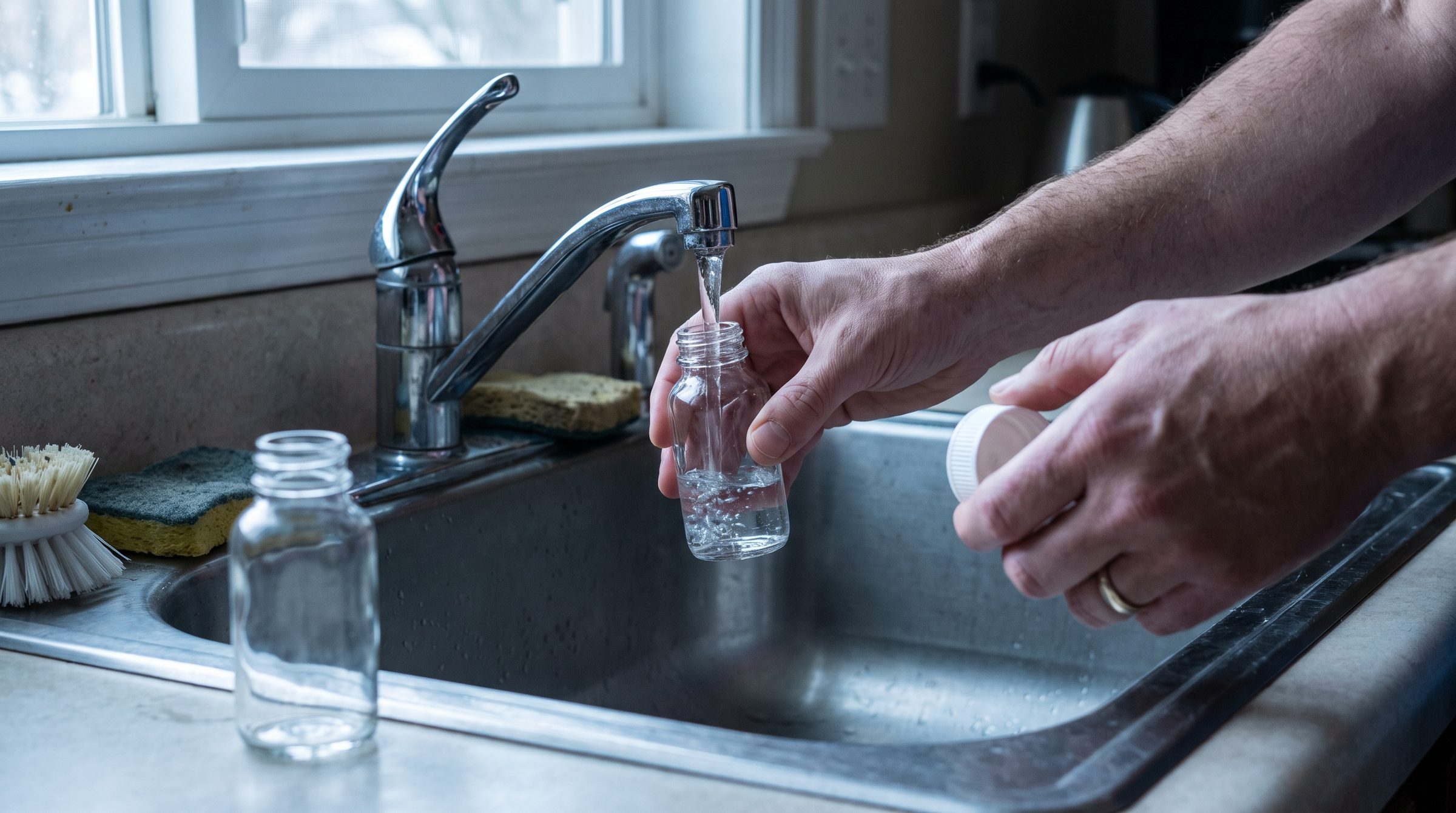
Use the lab's bottles, and their instructions, not a jar
A coliform bottle is sterile and often contains a preservative. Anything you supply yourself contaminates the sample, and a false positive costs you a well disinfection you did not need.
- 02
Sample from a cold tap with the aerator off
The aerator collects bacteria whatever the well is doing, so it is the one part of the plumbing most likely to answer for the well. Take it off first.
- 03
Get it to the lab inside the holding time
Bacteria samples are usually good for a matter of hours, chilled. Posting one on a Friday is how a result comes back rejected or wrong.
- 04
Test the same tap each year, and keep the sheets
A well is a trend, not a snapshot. Two results five years apart from the same tap tell you whether something is moving toward you, and that is worth more than any single number.
Reading your result
Four numbers come back from the annual panel. Two are health limits EPA enforces for public systems, and two are nuisance guidelines. On a well, none of them is enforced on anyone, which is exactly why the thresholds are worth knowing.
| Result | What it is | What to do |
|---|---|---|
| Total coliform: any detection | EPA sets the health goal at zero. Coliforms are not usually harmful in themselves; they indicate that something else may have got in. | Treat the water as unsafe to drink, find how it is getting in, disinfect the well, and retest until it is clean. E. coli means faecal contamination and it is urgent. |
| Nitrate: 10 mg/L as nitrogen | The EPA limit. Comes from fertiliser, septic systems, sewage and natural deposits. | Above it, infants under six months must not drink the water or have formula made with it. Do not boil it: boiling concentrates nitrate rather than removing it. |
| pH: below 6.5 or above 8.5 | A nuisance guideline rather than a health limit. Low pH is corrosive and tastes metallic; high pH is slippery and leaves deposits. | Low pH matters most where there is lead or copper plumbing, because corrosive water pulls metal out of the pipes. Test for lead too if it is low. |
| Total dissolved solids: 500 mg/L | Another nuisance guideline. High TDS shows as hardness, deposits, colour, staining or a salty taste. | Not a reason to stop drinking. It is the number that explains why the kettle furs and the appliances die early. |
Bands and thresholds from EPA drinking water standards.
Two things worth holding onto. The dangerous results here are invisible: nitrate and coliform do not change how water looks, smells or tastes, which is the whole reason an annual test exists. And a clean result is a fact about the day you sampled, not a property of the well.
Some results are a stop-drinking-it result, not a shopping list
Most of this page is a maintenance job. These four are not, and the reason to state them plainly is that a well owner with a bad result usually gets a sales call before they get advice.
- E. coli present
- That is faecal contamination in your drinking water. Stop drinking it, use bottled or boiled water for drinking and cooking, and call your health department the same day.
- Nitrate above 10 mg/L with an infant in the house
- EPA is unusually direct: infants under six months who drink water above the limit can become seriously ill and, untreated, may die. It develops over days rather than years. Boiling makes it worse.
- A filter is not a fix for a well that is being contaminated
- If the cause is a cracked casing, a failing septic field or surface water reaching the well, treatment at the tap manages a symptom while the source keeps delivering. Find the route in first.
- Shock chlorination without a retest proves nothing
- Disinfecting a well is a normal step and it is not evidence. The retest a couple of weeks later, after the chlorine has cleared, is the evidence.
If it comes back bad
Treatment is chosen from the result, and this is the part where a bad test gets sold against. A UV lamp handles bacteria and does nothing for nitrate. Reverse osmosis handles nitrate and arsenic at one tap. Carbon handles taste and some organics. Anyone quoting a whole-house system before they have read your lab sheet is quoting a catalogue, not your well.
- Whole-house filtration sized for well water
- $800 to $4,000 installed HomeGuide
- UV disinfection, which is the bacteria answer
- $350 to $1,500 installed HomeGuide
- Reverse osmosis under the sink, the usual nitrate and arsenic answer
- $300 to $950 HomeGuide
- Reverse osmosis for the whole house
- $4,800 to $8,000 HomeGuide
- Under-sink activated carbon, for taste and odour
- $180 to $550 installed HomeGuide
Every figure here is published by the source named beside it. We do not average them into a number of our own.
The checks that have no symptom are the ones people forget
One email a month, seasonal, and this is exactly the kind of thing it carries: the quiet checks that never announce themselves until they are expensive.
When to test again
This is the one condition on the site where an agency names a plain annual interval, and the events that override it matter more than the interval does.
- Every year, the same four
- Total coliform bacteria, nitrate, total dissolved solids and pH. More often if there are small children or elderly adults in the house, or if someone is pregnant or nursing.
- Immediately, if conditions near the well have changed
- EPA names flooding, land disturbance, and new construction or industrial activity. A well that was fine last year is a well that had a different neighbourhood.
- Immediately, after any work on the well system
- Replacing or repairing any part of it. Opening a well is the moment things get into it.
- Immediately, on any change in taste, smell or colour
- It is the one signal a well gives you, so it is worth acting on even though the dangerous contaminants give no signal at all.
- Immediately, if there are known problems in your area
- Your health department knows what is common in local groundwater. That call is also how you learn what to add to the annual four.
Retest guidance from EPA, Protect Your Home's Water. Annual is the floor rather than the schedule: four of the five entries above are events, and events do not wait for the anniversary.
Also asked
- How often should I test my well water?
- Every year for total coliform bacteria, nitrate, total dissolved solids and pH, per EPA. Test immediately as well after flooding, land disturbance or nearby construction, after any repair to the well system, and on any change in taste, smell or colour.
- Does anyone test private well water for me?
- No. EPA states that private well water is not regulated by the federal government under the Safe Drinking Water Act, nor by most states. There is no utility and no annual report. The household is the water system.
- What should I test my well water for?
- Coliform bacteria, nitrate, total dissolved solids and pH every year. Add tests based on what is near the well: nitrate and pesticides for nearby agriculture, VOCs for a gas station or dry cleaner, metals for mining, radon in a radon-rich region.
- Is well water safe to drink without testing?
- There is no way to tell. A USGS study cited by EPA found water from about one in five private wells contained a contaminant above a human-health benchmark, and the two that matter most, nitrate and coliform, do not change how water looks, smells or tastes.
- Can I use a home test kit for well water?
- As a screen, yes, and it is useful for hardness, iron and pH. For coliform and nitrate the test that counts is done by a state-certified laboratory, because that is the result you would act on.
- Does boiling well water make it safe?
- It deals with bacteria and it makes nitrate worse, because boiling evaporates water and concentrates what is dissolved in it. Never boil water for infant formula to address a nitrate result.
- What does a well water treatment system cost?
- HomeGuide puts whole-house filtration sized for well water at $800 to $4,000 installed, UV disinfection at $350 to $1,500, and an under-sink reverse osmosis system at $300 to $950. Which one you need is decided by the lab sheet, not by the house.