Find out first
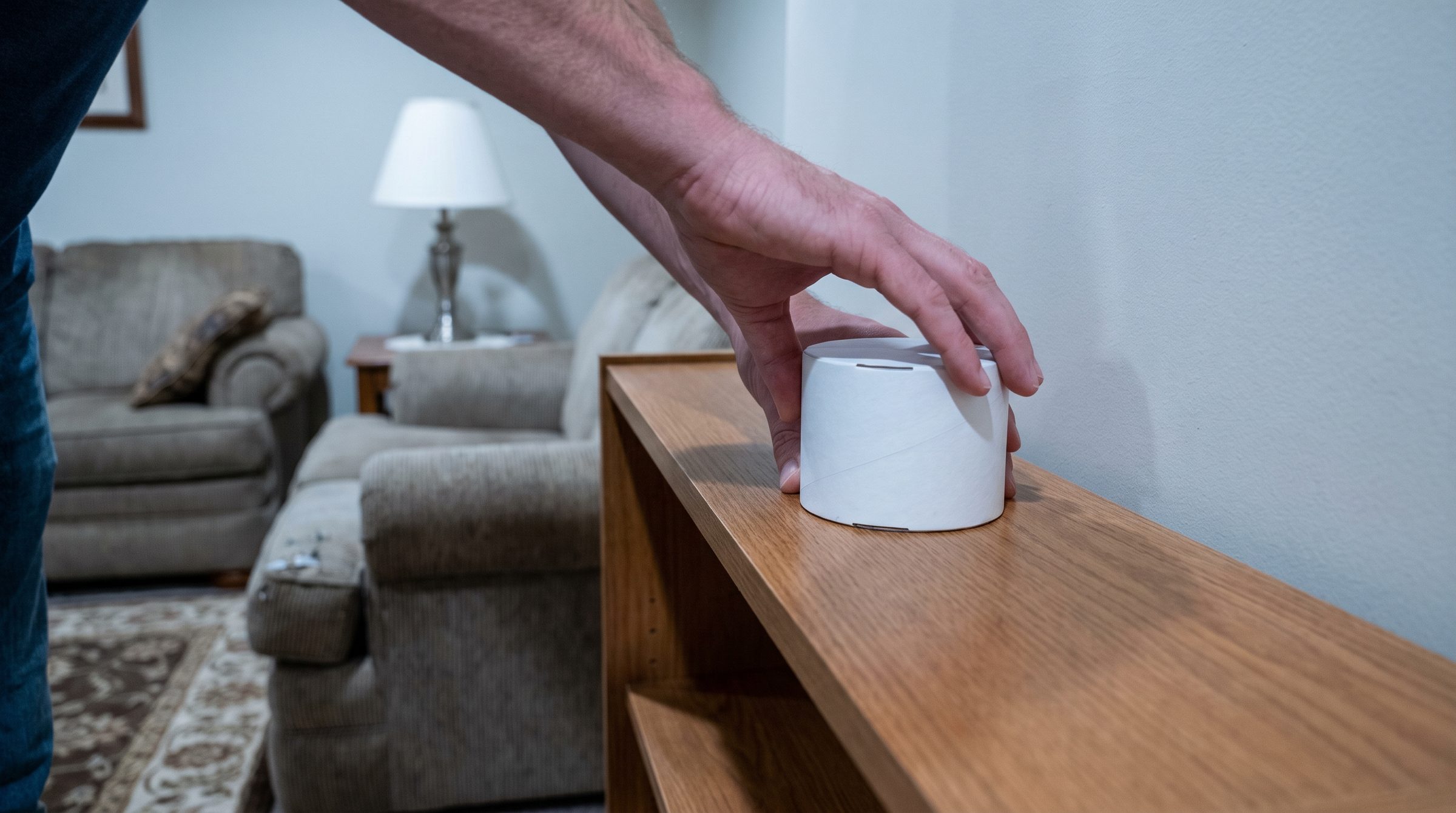
Put a $10 to $25 test kit in the lowest room you actually use, and close the windows for twelve hours first.
Radon: how to test your house, and what the number means
Nearly 1 out of every 15 US homes is estimated to have an elevated radon level. EPA, A Citizen's Guide to Radon
Updated
Does this apply to you?
Radon comes out of the ground. It is produced by uranium decaying in soil and rock, seeps up through cracks in the slab, construction joints, gaps around service pipes and the sump pit, and then your house holds it in. That is why the answer depends on what is under you rather than on how old or how well built the house is.
EPA mapped that potential county by county in 1993 and publishes the result. It is worth knowing, and it is worth knowing what it is for: the map exists so that governments and building-code programmes can target their resources. It was never meant to tell one household whether to test.
ZIP codes are matched to counties using the Census ZCTA relationship file, so a ZIP that crosses a county line shows every county it touches. Zones come from EPA's published county spreadsheet.
How to find out
There is no symptom to look for. Radon has no colour, no smell and no taste, and at the levels that matter it does nothing you would notice. A test is not the thorough option here, it is the only option, and the cheap version of it is the one most people should buy first.
What it costs to find out
- Short-term kit, charcoal, 2 to 7 days
- $10 to $25 HomeGuide
- Long-term kit, alpha track, 90 days to a year
- $25 to $50 HomeGuide
- Continuous monitor, plugs in, reads on an app
- $150 to $300 HomeGuide
- Professional test, whole house
- $125 to $400 HomeGuide
- Your state radon office, first
- Free kits are sometimes available from state radon programmes and county health departments. It costs one phone call to find out, and it is the cheapest version of this whole page.
- National Radon Program Services, Kansas State University
- Kits to buy online, or 1-800-SOS-RADON. Listed by EPA as a source alongside some state American Lung Association chapters and home improvement stores.
Where you put it decides whether the number means anything
- 01
Lowest lived-in level, not the lowest level
The basement if you actually use it, otherwise the first floor. A test in an unfinished crawl space nobody enters measures a room nobody breathes in.
- 02
A room you use, but not the kitchen or the bathroom
Living room, den, playroom, bedroom. Humidity and cooking fumes in the other two throw the reading.
- 03
At least 20 inches off the floor, away from drafts and exterior walls
Not on the windowsill, not next to the dehumidifier, not on top of a heat source, and somewhere it will not be moved or dusted for the duration.
- 04
Close the windows and outside doors twelve hours before you start
And keep them closed through a short test. Recirculating heating and air conditioning fans are fine. Anything that pulls air in from outside is not.
- 05
Not during a storm or unusually high winds
A two or three day test taken in severe weather is measuring the weather as much as the house.
- 06
Two short tests, or one long one
Radon moves with the season and the day, so a short test is less likely than a long one to give you the year-round average. If you need an answer quickly, EPA allows a short test followed by a second short test.
Placement rules from EPA, A Citizen's Guide to Radon.
Reading your result
The number comes back in picocuries per litre of air, written pCi/L. There are three bands worth knowing and only one of them is an instruction.
| Result | What it is | What to do |
|---|---|---|
| 4 pCi/L or higher | EPA action level. | EPA recommends fixing the house. Confirm with a second test first. |
| 2 to 4 pCi/L | Above the national average, below the action level. | EPA recommends you consider fixing, because there is no known safe level of exposure. |
| Below 2 pCi/L | The average US home sits at about 1.3 pCi/L. Outdoor air is about 0.4. | No action recommended. Test again in future, and retest if you start using a lower floor. |
Bands and thresholds from EPA action level guidance.
Radon is the leading cause of lung cancer among people who have never smoked and the second leading cause overall, which EPA puts at about 21,000 deaths a year, roughly 2,900 of them among never-smokers. The risk is from years of exposure rather than from a bad week, so a result above the action level is a job to book rather than a reason to leave the house.
Above 4 pCi/L, the fixing part is not a DIY job
Testing is yours. Mitigation is not, and this is one of the clearest DIY boundaries on this site: a system that is built wrong can leave the reading unchanged while everyone in the house believes it has been dealt with.
- The system is a sealed pipe and fan under negative pressure
- Sub-slab depressurisation draws air from beneath the foundation and vents it above the roofline. Getting the suction point, the pipe run and the fan sizing right is the entire job, and it is measured rather than judged by eye.
- Sealing cracks on its own is not mitigation
- It is part of a system and it is not a substitute for one. Sealing alone has a poor record of reducing levels and it is the cheap step that most often gets sold as the whole answer.
- A fan venting anywhere below the roofline is a defect
- Discharging at ground level or under an eave puts the gas back where it can be drawn in again, through a window, a vent or the neighbours.
- A post-mitigation test is not optional
- The only evidence a system works is a test after it is running. Ask for it in the quote rather than after the invoice.
- Radon in well water is a separate test and a separate fix
- Water can carry radon into the air when you shower or run taps. It is not covered by an air test and it is treated at the water, not under the slab.
If it comes back high
Most houses are fixed for about the cost of an ordinary home repair, and the systems work: EPA says some reduce levels by up to 99 percent. The published figures below are for the common case, and the range is wide because it depends on the foundation you have rather than on how bad the reading was.
- Active soil depressurisation, the usual system
- $1,200 to $2,000 installed HomeGuide
- National average across all systems
- $1,600 HomeGuide
- Full published spread for a mitigation system, low to high
- $500 to $8,000 HomeGuide
- Drain-tile suction, where a perimeter drain already exists
- $900 to $1,800 installed HomeGuide
- Sealing the sump pit and fitting a cover
- $900 to $2,500 HomeGuide
Every figure here is published by the source named beside it. We do not average them into a number of our own.
The checks that have no symptom are the ones people forget
One email a month, seasonal, and this is exactly the kind of thing it carries: the quiet checks that never announce themselves until they are expensive.
When to test again
This is the part a calendar is better at than a memory, and it is the reason the monthly exists. EPA does not ask for an annual test on an ordinary house. It names specific moments.
- Every two years, if you have a mitigation system
- EPA's own guidance for a fixed house: retest every two years to be sure levels have stayed down. Most systems have a monitor on the pipe, and a monitor is not a measurement.
- When you start using a lower floor
- Finishing a basement, moving a bedroom or an office down there, or simply spending time in a room you used to walk past. Test on that level.
- After work that changes the foundation or the airflow
- New slab, new windows, a tighter envelope, a new ventilation system. Any of them can move the number in either direction.
- Before you sell, if the last test is more than about two years old
- EPA's buyer and seller guidance says a buyer may reasonably ask for a fresh test when the last one is not recent, so an old result is often redone anyway.
- Sometime, even if you were below 4
- EPA suggests testing again in future regardless. Below the action level is not a permanent state of the house.
Retest guidance from EPA. The two-year figure is EPA's guidance for a house that already has a mitigation system, not a blanket schedule for every house.
Also asked
- How do I know if my house has radon?
- You test. Radon has no smell, no colour and no symptom at any level, so nothing about the house tells you. A short-term charcoal kit costs $10 to $25 according to HomeGuide and takes two to seven days.
- What is a dangerous radon level?
- EPA recommends fixing the house at 4 pCi/L or above, and recommends considering fixing between 2 and 4, because there is no known safe level. The average US home is about 1.3 pCi/L.
- Are cheap radon test kits accurate?
- A charcoal kit read by a lab is a real measurement, and the usual reason a result is wrong is placement rather than price. Lowest lived-in level, a room you use, 20 inches off the floor, windows closed for twelve hours beforehand, and not during a storm.
- Does my radon zone mean I do not need to test?
- No, and EPA says so directly: the Map of Radon Zones should not be used to decide whether an individual home needs testing. Homes above the action level have been found in all three zones. The map is a targeting tool for governments.
- How much does radon mitigation cost?
- HomeGuide puts the usual active soil depressurisation system at $1,200 to $2,000 installed, with a national average of $1,600 and a full spread of $500 to $8,000 depending on the foundation.
- Can I install a radon mitigation system myself?
- This is one to hire out. The suction point, pipe run and fan sizing are the job, the discharge has to be above the roofline, and the only proof it worked is a test afterwards. A system built wrong leaves the level unchanged while everyone believes it is handled.
- How often should I retest for radon?
- Every two years if you have a mitigation system, per EPA. Otherwise when you start using a lower floor, after work that changes the foundation or the airflow, and before a sale if the last test is more than about two years old.