Find out first
Half-fill a clear bottle from the cold tap, add ten drops of washing-up liquid, cap it and shake hard. Thin lather over cloudy water means hard.
Hard water: how to find your actual number, and what it costs you
Hardness is not on the EPA list of regulated contaminants, primary or secondary, so nobody is required to tell you what yours is. EPA secondary drinking water standards
Updated
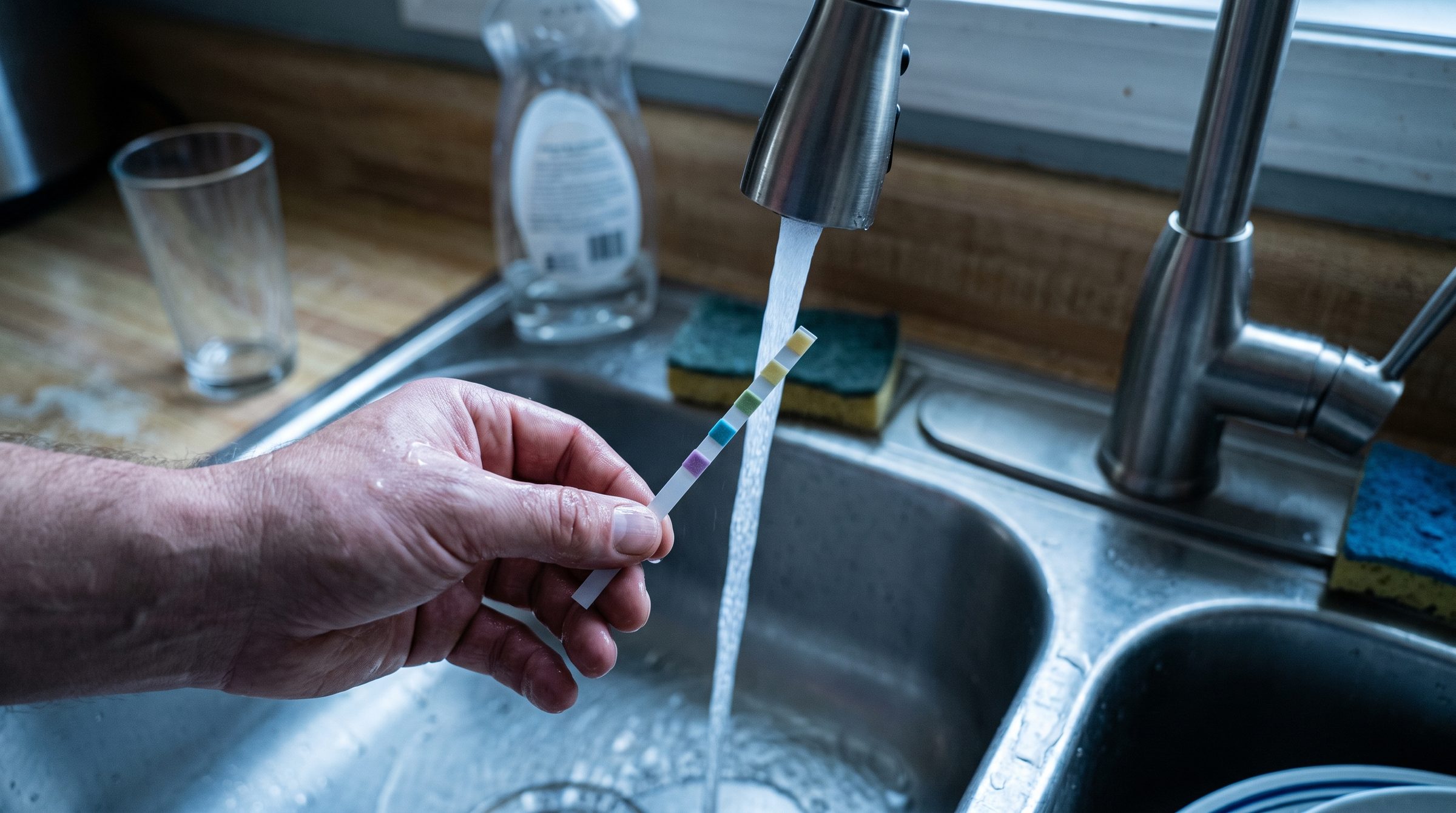
Does this apply to you?
Hardness is dissolved calcium and magnesium, picked up as water moves through soil and rock, which is why it depends on where your water comes from rather than on the house. Groundwater is the usual source of a high number, and a well or a utility drawing on an aquifer is more likely to be hard than one drawing on a river.
We do not have a lookup for this and it is worth saying why. Hardness is not a regulated contaminant, so no agency collects it house by house. The map that every "water hardness by ZIP code" page reproduces is a USGS map of mean hardness at stream-monitoring sites during the 1975 water year. It is a real map of real measurements and it describes rivers fifty years ago, not the water arriving at your kitchen tap.
Which leaves three things that do answer it, in ascending order of effort, and the first one is free and takes a minute.
What the house is already telling you
- Soap will not lather, and the water goes cloudy when you try
- The bottle test at the top of this page is the same thing done deliberately. Calcium and magnesium bind with soap instead of foaming, so hard water eats detergent and leaves a scum rather than bubbles.
- White crust on the kettle, the shower head and around the taps
- That is scale, and it is the same deposit forming inside pipes and on anything that heats water. If you can scrape it off a tap, it is also somewhere you cannot see.
- Spots and film on glassware straight out of the dishwasher
- Clean glasses that dry cloudy is the classic reading. So is skin that feels tight after a shower, and laundry that comes out stiff.
None of the three is a number, and a number is what you need before spending anything. That is the next section.
How to find out
Two of these are free and the third is about the price of a takeaway coffee. The order matters: check what has already been published about your water before you buy anything, because for most households on public water it is a two-minute look rather than a purchase.
What it costs to find out
- Hardness test strips or a home test kit
- $9 to $35 Home Depot listings
- Your utility's annual water quality report
- Free EPA, required annually
- Your water supplier's Consumer Confidence Report
- EPA requires every community water system to send customers an annual drinking water quality report by 1 July, and EPA runs a search tool for finding yours. Read this one carefully: the report has to cover regulated contaminants, and hardness is not one, so many utilities publish it voluntarily and some do not publish it at all. If it is not there, phone them and ask. They will know.
- A strip, if you are on a well or the report is silent
- Well water is not covered by any of the above, because nobody tests a private well but its owner. A strip is also the only way to know whether a softener that is already installed is doing anything.
Four things that make the number mean something
- 01
Test the cold tap, and let it run first
Water that has been sitting in the pipes or the heater is not what the system is delivering. Run it for a minute, then fill.
- 02
If you already have a softener, test both sides of it
One sample from an outside tap or another line ahead of the unit, one from the kitchen. Two similar numbers mean the softener is not working, and that is the single most useful test on this page.
- 03
Do not accept a free in-home test from someone selling softeners
It is the oldest arrangement in this trade: the person measuring the problem is the person quoting for it. A strip you bought yourself costs ten dollars and answers to nobody.
- 04
Write the number down with the date
Hardness changes when a utility changes source and when a well changes with the season. One reading is a fact about one day, and two readings a year apart are worth far more than one.
Reading your result
Results come in milligrams per litre as calcium carbonate, or in grains per gallon, and softener sellers almost always use grains. A grain is 64.8 mg and a US gallon is 3.785 litres, so one grain per gallon is about 17 mg/L. USGS classifies it like this.
| Result | What it is | What to do |
|---|---|---|
| 0 to 60 mg/L | Soft. Under about 3.5 grains per gallon. | Nothing to do. Scale is not your problem. |
| 61 to 120 mg/L | Moderately hard. Roughly 3.5 to 7 grains. | Normal for much of the country. Descale the kettle and the shower head when you see it. |
| 121 to 180 mg/L | Hard. Roughly 7 to 10.5 grains. | Worth acting on the cheap end first: descale, and flush the water heater on schedule. |
| Above 180 mg/L | Very hard. Above about 10.5 grains. | This is where treating the whole house starts to pay for itself rather than just feeling better. |
Bands and thresholds from USGS, Hardness of Water.
Hard water is not a health problem, and any page implying otherwise is selling something. EPA does not regulate hardness at all, and USGS notes that drinking water can be a useful contributor of calcium and magnesium in the diet. What it damages is equipment: USGS describes scale gradually closing up the inside of a water pipe, and the same deposit forms on anything that heats water.
Where the money goes wrong on this one
Hardness is the house condition with the largest gap between what it costs to measure and what it costs to fix, which is exactly the gap a salesperson works in. Four things worth knowing before anyone quotes you.
- A salt-free system is not a softener
- HomeGuide puts it plainly: salt-free systems do not technically soften water, they change how the minerals crystallise so less scale forms. Your hardness test after one will read exactly the same, and that is not the unit failing. Whether a softener is worth it at your number
- Installing a softener is a plumbing job, not an appliance delivery
- It needs cutting into the main after the meter, a bypass so the house still has water when the unit is down, and a drain for the regeneration discharge that meets local code. This is the point where DIY stops on this page.
- Size it from your own number, not from the house
- Capacity is daily water use multiplied by your grains per gallon. A unit sized from a guess regenerates constantly or never, and both cost money.
- Softening the whole house includes the cold drinking tap
- Ion exchange trades calcium and magnesium for sodium. It is a small amount, and it is worth knowing about if anyone in the house is on a restricted-sodium diet. Many installs leave the kitchen cold tap unsoftened for that reason.
If it comes back hard
Two routes, and the cheap one is genuinely a route rather than a consolation. Descaling what you can reach and flushing the water heater on schedule deals with most of the visible damage at moderate hardness. Whole-house treatment is the answer above about 10 grains, and it is a real spend.
- Salt-based softener, installed
- $1,200 to $3,800 HomeGuide
- National average, all softener types
- $2,500 HomeGuide
- Full published spread for a softener with installation, low to high
- $800 to $8,000 HomeGuide
- Salt-free system, which prevents scale rather than softening
- $1,500 to $4,500 HomeGuide
- For scale: replacing a standard tank water heater
- $600 to $3,100 HomeGuide
Every figure here is published by the source named beside it. We do not average them into a number of our own.
The checks that have no symptom are the ones people forget
One email a month, seasonal, and this is exactly the kind of thing it carries: the quiet checks that never announce themselves until they are expensive.
When to test again
Hardness is not fixed, which is the part most people miss. It moves when the water moves, and a number from four years ago is a number about a different supply.
- When you move in
- Before buying anything, and before believing whatever the previous owner installed is working. Test both sides of it if there is a softener.
- Once a year, if you are on a well
- Nobody else is testing it. Groundwater chemistry moves with rainfall and with the season, and a well is the case where the number genuinely drifts.
- When your utility changes source
- It is usually announced, and it is the single event most likely to change your number overnight. The annual report names the source.
- After a softener is installed or serviced
- A post-install test is the only proof the unit does anything. Ask for it, or do it yourself for ten dollars.
- Whenever the salt runs out and you top it up
- Checking the brine tank is the actual monthly job on a softener, and a unit that has been out of salt for weeks has been passing hard water that whole time.
Also asked
- How do I know if I have hard water?
- Half-fill a clear bottle from the cold tap, add ten drops of washing-up liquid and shake. Thin lather over cloudy water means hard. For a number rather than a hint, a test strip is $9 to $35 at Home Depot, or check your water supplier's annual quality report.
- Can I look up my water hardness by ZIP code?
- Not honestly. Hardness is not a regulated contaminant, so no agency collects it by address, and the map behind most "hardness by ZIP" pages is a USGS map of stream monitoring sites from the 1975 water year. Your utility's own report or a $10 strip will tell you about your tap. A map will not.
- What is considered hard water?
- USGS classifies 0 to 60 mg/L as soft, 61 to 120 as moderately hard, 121 to 180 as hard, and above 180 as very hard, measured as calcium carbonate. In grains per gallon, which is what softener sellers use, that is roughly 3.5, 7 and 10.5.
- Is hard water bad for you?
- No. EPA does not regulate hardness under either its primary or its secondary standards, and USGS notes drinking water can be a useful source of calcium and magnesium. The damage is to equipment, not to people.
- How much does a water softener cost?
- HomeGuide puts a salt-based system at $1,200 to $3,800 installed, with a national average of $2,500 and a full spread of $800 to $8,000 depending on capacity and the plumbing work involved.
- Do salt-free water softeners work?
- They do something, but not what the name says. HomeGuide is explicit that salt-free systems do not technically soften water: they change how the minerals crystallise so less scale forms. A hardness test after one reads the same as before it.
- How often should I test my water hardness?
- When you move in, once a year on a well, whenever your utility changes source, and after any softener is installed or serviced. A softener with an empty brine tank has been passing hard water the whole time it was empty.