Do this now
If you can see ice on the copper line or the indoor coil, switch the system to OFF and the fan to ON. Running a frozen system is how a cheap problem becomes a compressor.
AC running but not cooling: what to check, in order
Updated
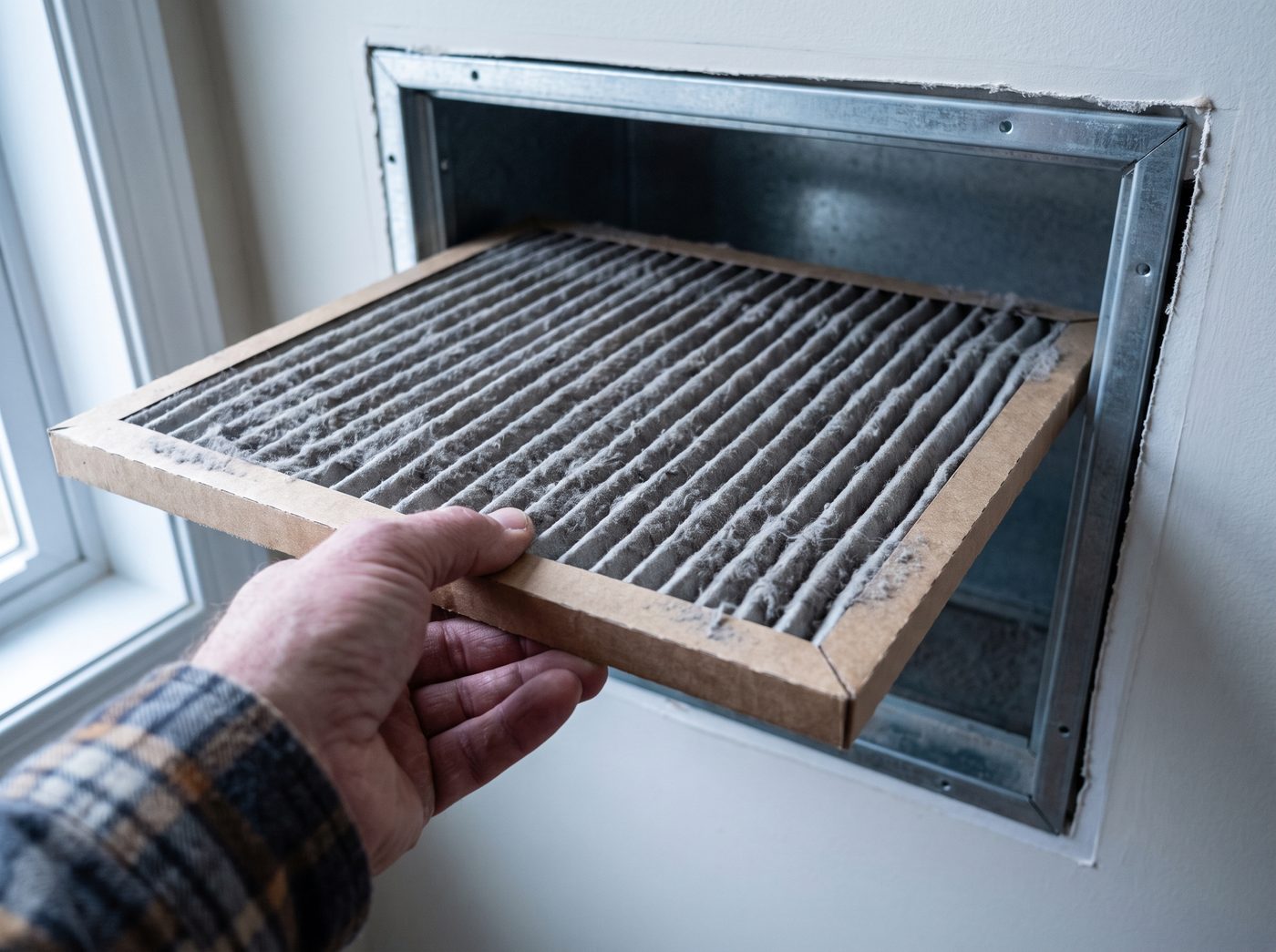
An AC that runs but blows warm is usually one of four things, and the first two are free to check. A thermostat that is not actually calling for cooling, a filter blocked enough to freeze the coil, an outdoor unit that is not running, or refrigerant that has leaked out. Work them in that order, because the cheap causes are also the common ones.
- 01
Check what the thermostat is actually asking for
Set to COOL, not FAN or AUTO alone, and the target at least five degrees below what the room reads. A thermostat set to fan-on with cooling off blows air all day and none of it is cold.
- 02
Pull the filter out and look through it
If you cannot see light through it, it is starving the coil of airflow, and a starved coil freezes. This is the single most common cause on this page and the cheapest to fix.
- 03
Look for ice
Check the copper line at the indoor unit and the coil itself. Ice means the system has already frozen. Shut it off and run the fan alone for two to four hours to thaw it before doing anything else. You cannot diagnose past a block of ice.
Do not chip or melt ice off a coil. The fins bend and the tubing punctures, which turns an airflow problem into a refrigerant leak.
- 04
Go outside and see whether the condenser is running
The large outdoor unit should be humming with the fan spinning. If it is dead silent, check the breaker and the outdoor disconnect. If it hums but the fan does not turn, that is usually a failed capacitor, and that is where you stop.
- 05
Clear the outdoor unit
Cut back anything growing within two feet of it and rinse the fins from the inside out with a garden hose, not a pressure washer. A condenser packed with cottonwood and grass clippings cannot dump heat, and a system that cannot dump heat cannot make cold.
- 06
Measure the split
With the system running and the coil clear, hold a thermometer at a supply vent and at the return. A healthy system reads roughly 15 to 20 degrees colder coming out than going in. Much less than that, with a clean filter and a running condenser, points at refrigerant, which is a call.
What it costs
| Cost | Source | |
|---|---|---|
| Change the filter yourself | about $6 to $20 | |
| Service call to diagnose | $75 to $200 | |
| Capacitor replacement | $100 to $250 | |
| Refrigerant recharge | $100 to $320 for R410A systems $180 to $600 for older R22 systems | |
| Refrigerant leak repair | $200 to $1,500 | |
| AC repair overall | $150 to $650, averaging $360 |
Every figure here is published by the source named beside it. We do not average them into a number of our own.
Would a home warranty have covered this?
It is the question everyone asks standing in front of a bill this size, and the honest answer is that it depends entirely on the contract rather than on the failure. We do not sell these, take anything for recommending them, or run a page telling you to buy one. What we can do is point at what the consumer regulators say to check, with the repair cost sitting in the table above for comparison.
- They are service contracts rather than warranties, and they may duplicate cover you already have, cover only part of a product, or make repairs slow to get. FTC consumer alert
- Price the deductible and the per-visit service fee, not just the annual premium, and check the reimbursement limits and the cancellation terms. FTC consumer alert
- Find out exactly what you must do before the company will pay for a repair. Read that part before something breaks rather than after. NC Department of Justice
- Many contracts replace equipment only with a particular brand, or only if their own contractor does the work, and many require private arbitration instead of court. NC Department of Justice
Where to stop
The first five steps are homeowner work. These are not, and two of them can hurt you rather than just cost you.
- Anything to do with refrigerant
- Federal law requires EPA Section 608 certification to buy or handle it. A system low on refrigerant also has a leak somewhere, so topping it up without finding the leak is paying to fill a bucket with a hole in it.
- The capacitor
- It stores a charge after the power is off and can discharge through you. It is a cheap part and a genuinely dangerous one to poke at.
- The compressor
- If the compressor has failed you are into repair-versus-replace territory on the whole system, not a repair decision.
- Anything past resetting a breaker
- Resetting a tripped breaker is fine. Opening the panel, or a breaker that trips again immediately, is not: a breaker doing its job twice is telling you something is wrong downstream of it.
Why it happened
Most warm-air calls are airflow, not refrigerant. A filter blocks gradually over a season, airflow across the coil drops, the coil gets cold enough to freeze the moisture condensing on it, and once it is a block of ice no air moves at all. The system is working exactly as designed. It is just breathing through a blocked straw.
What stops it happening again
Airflow is the whole game. A filter you actually change and a condenser that is not buried in shrubbery prevent most of what is on this page, and neither costs anything but the reminder.
- The part
- A pleated filter in the right size. Around $6 to $20 depending on size and MERV rating, and the size is printed on the edge of the one you just pulled out.
- How often
- Filter every 90 days, monthly if you have pets or are running the system hard. Clear two feet around the condenser at the start of every cooling season.
Want the rest of the house covered?
One email a month, timed to the systems you actually have. The same kind of thing as the tablet: small, cheap, and it stops the call.
Also asked
- Could a dirty filter cause warm air from my AC?
- Yes, and it is the most common cause. A blocked filter starves the coil of airflow, the coil freezes, and a frozen coil moves no air at all. The giveaway is ice on the copper line or very weak airflow at the vents.
- How do I know if the thermostat is the issue?
- Set it to COOL and at least five degrees below the room temperature, and listen. The outdoor unit should start within a minute or two. If nothing happens outside, the problem is either the thermostat, its batteries, or the power to the outdoor unit.
- What AC problems can I safely fix myself?
- Filters, thermostat settings, thawing a frozen coil, clearing the outdoor unit, and resetting a tripped breaker once. Refrigerant, capacitors, and the compressor are not homeowner jobs, and two of those three are dangerous rather than merely difficult.
- What signs mean I need an HVAC technician?
- A condenser that hums without the fan turning, a breaker that trips again straight after you reset it, a temperature split well under 15 degrees with a clean filter, or ice that comes straight back after thawing.
- How much does AC repair usually cost?
- HomeGuide puts AC repair at $150 to $650, averaging $360, with a diagnostic call at $75 to $200 that most companies credit against the repair if you go ahead on the same visit.