Find out first
Find out what year the house was built, and whether anyone has replaced the sewer line since. Those two answers are free, and together they decide whether the rest of this page is about you.
Your sewer lateral: what the pipe under the garden is made of
The useful life of Orangeburg pipe was previously thought and advertised to be 50 years. The company that made it closed for good in 1974. APWA Minnesota, The Rise and Fall of Orangeburg Pipe
Updated
Does this apply to you?
The sewer lateral is the pipe that carries everything from the house out to the main under the street. On most properties it is the homeowner's, it is buried under the garden or the drive, and it is the one part of the plumbing nobody has ever looked at. What it is made of was decided by whoever built the house, in the year they built it.
There is no lookup for this and we are not going to build one. Nobody records what your lateral is made of by address: it is private property, it went in before most permit records were digitised, and it is underground. Ann Arbor keeps a register of replacement addresses back to the mid-1980s, which is one city being unusually organised rather than a national dataset.
What that does mean is worth acting on: your own city or sewer utility may hold a record of work on your line, and asking costs nothing. Start there before you pay anyone.
What actually decides the answer
- The house went up between about 1945 and 1972
- This is the Orangeburg window. APWA Minnesota puts its common use from the 1940s to the 1970s. Ann Arbor calls the early 1950s to the early 1970s a reasonable assumption, notes contractors reporting it in homes as early as 1949, and removed it from the approved materials list in an ordinance effective May 1970.
- Nobody has replaced the line since
- A replacement at any point resets this entirely, and modern PVC is not a thing to worry about. If the house has changed hands recently the seller disclosure or an old inspection report may say. If it has been in the family, ask.
- Everything drains slowly, not one fixture
- This is the single most useful distinction on the page. One slow basin is a basin problem. The whole house running slowly, or the lowest drains backing up when you run the washing machine, points past the fixtures and out at the lateral. A single slow drain is a different job
- You are on a public sewer at all
- Worth settling first, because a lateral is only a lateral if it runs to a main. Roughly one US home in five treats its own waste in the garden instead, and the checks take a minute. How to tell if you are on septic
- You have needed a rooter more than once
- A line that is cleared and then clogs again is telling you the clog is not the problem. Ann Arbor lists mechanical cleaning as one of the ways Orangeburg gets discovered, usually because the machine finds something that should not be there.
- Mature trees between the house and the street
- Orangeburg was thought to be impermeable to tree roots. APWA explains why it was not: as the tar pitch dries, moisture from the flow penetrates the pipe wall, and roots follow it in. Clay lines have the same problem at every joint.
- A smell you cannot place, indoors or in the garden
- A cracked or separated lateral can vent where it should not. It is not proof of anything on its own, and there are much more ordinary causes worth ruling out first. Work through the ordinary causes first
Dates and materials from APWA Minnesota and the City of Ann Arbor. Neither can tell you what is under your own garden, which is what section three is for.
How to find out
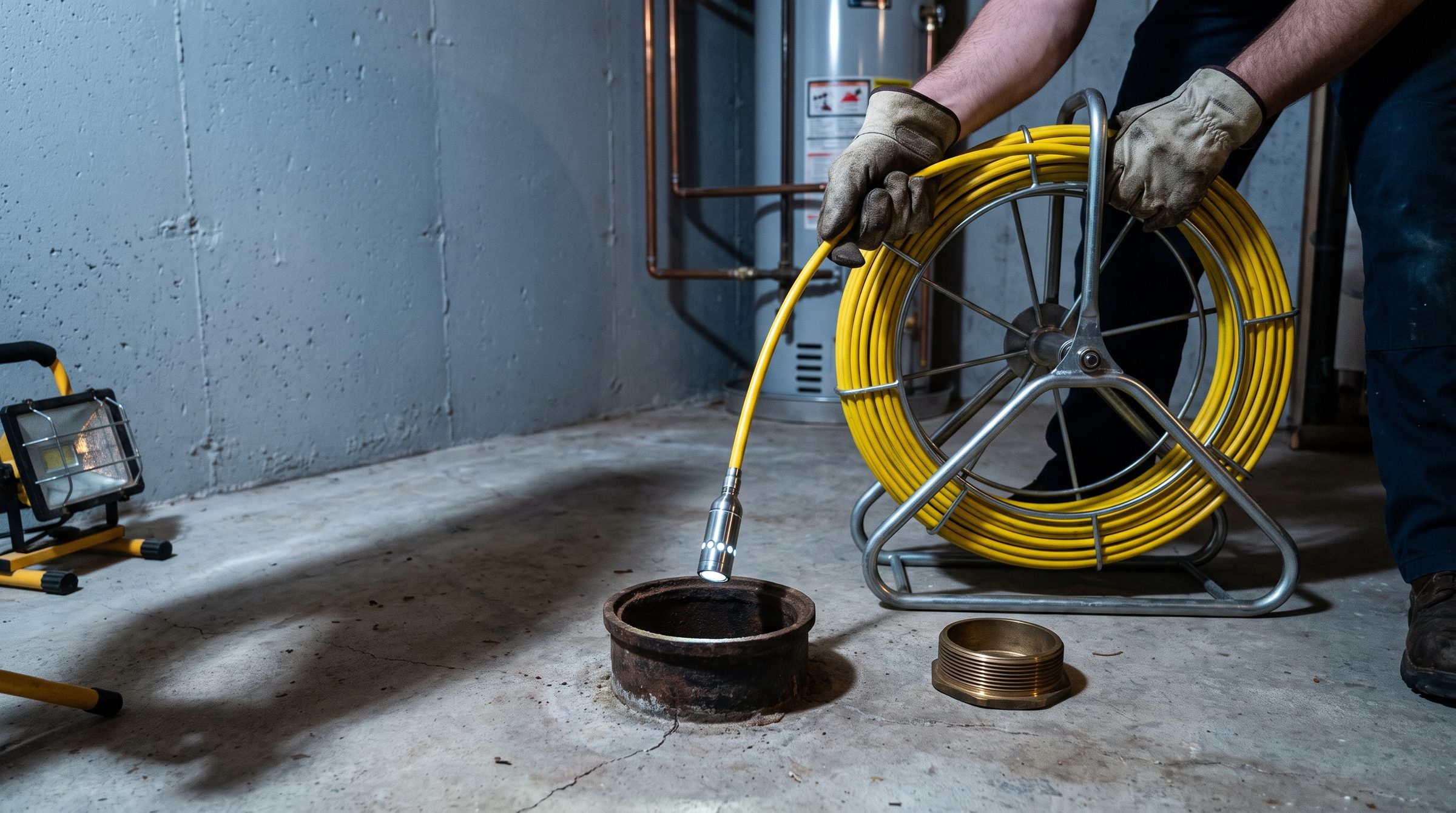
A camera goes down the line and you watch the screen. That is the whole method, and it is the only one that answers the question without digging. Ann Arbor lists the three ways Orangeburg actually turns up: a television or video scan, mechanical cleaning, or excavating to the pipe. Only the first is something you would choose to do on a normal Tuesday.
What it costs to find out
- Ask your city or sewer utility for records on your address
- Free City of Ann Arbor
- A video inspection of the line
- $100 to $500 Angi
- Find the cleanout first
- It is a capped pipe, usually four inches across, either just outside the foundation on the sewer side of the house or in the basement floor near where the main drain leaves. A camera goes in there. If you cannot find one, say so when you book, because it changes the job.
What to ask for, and what to watch
- 01
Ask for the footage counter to be on screen
The camera reel counts distance. A finding at 40 feet is actionable; a finding "out by the tree" is not. It also tells you whether the problem is on your side of the property line.
- 02
Ask for a copy of the recording before they leave
It is the only evidence you will have, and you will want it if you get a second quote or if it becomes part of a sale. Plenty of firms hand it over as a matter of course. Ask anyway.
- 03
Watch for the pipe going oval rather than for a hole
Ann Arbor describes the characteristic failure: the pipe flattens under the earth pressure around it and loses its circular cross section. That is the thing to look for on the screen, and it is not what most people expect a failing pipe to look like.
- 04
Get the scope done before you buy, not after
It is rarely part of a standard home inspection and it is normally booked separately. It is also the cheapest moment it will ever be worth, because the result is still a negotiating position rather than a bill.
Placement rules from City of Ann Arbor, Orangeburg sewer piping.
Reading your result: what the camera is showing you
You are looking at the inside of a pipe, and the material is usually obvious once somebody says what to look for. This is what the common ones look like and what each one means for the next ten years.
| Result | What it is | What to do |
|---|---|---|
| Deformed, oval, blistered or delaminating | Consistent with Orangeburg. Ann Arbor describes it flattening under earth pressure and losing its circular cross section. | Plan a replacement rather than a repair. Ann Arbor also notes the interior can be out of round while the outer shape still looks sound, so a spot fix is treating one symptom of a whole-length problem. |
| Roots at regular intervals along the line | Clay tile, most likely. The roots come in at the joints, which is why they are evenly spaced. | Often manageable for years with periodic clearing, but it is a standing commitment rather than a fix. Angi puts root removal at $100 to $600. |
| Heavy scale narrowing the bore, rough rusty surface | Cast iron. Durable, and it does not fail the way Orangeburg does. | Usually a monitoring job rather than an urgent one. Angi lists cast iron as the most durable material with the longest lifespan. |
| Smooth, pale, clean-walled pipe | PVC or ABS. Modern, and not what this page is about. | Nothing to do. Note the year it went in, and move on. |
| A separation, a belly holding standing water, or a collapse | A structural finding regardless of what the pipe is made of. | This is the one that does not wait for a convenient month. Get a second opinion on the scope of it before you agree to a dig. |
Bands and thresholds from City of Ann Arbor, Orangeburg sewer piping.
A scope tells you the material and the condition. It does not tell you how many years are left, and anyone who gives you that number from a camera is guessing. What it does give you is the difference between planning a job and being surprised by one.
Where this stops being yours
Finding out is yours, and it is cheap. Everything past the camera is licensed work on a buried pressure-free drain that has to keep falling at the right angle for its whole length, and getting that wrong produces a line that works for a year.
- Do not cut into or break up old fibre pipe yourself
- The City of Ann Arbor describes Orangeburg as made from plant-based fibers and asbestos soaked in a tar-like substance. APWA Minnesota describes compressed wood fibers and coal tar pitch and does not mention asbestos. The sources do not agree, which is itself the reason to let someone equipped handle it rather than to find out with an angle grinder.
- Excavation near the foundation, a drive or the street
- Angi puts excavation alone at $50 to $200 per linear foot, and $300 to $350 where a concrete slab has to come up and go back. Depth, soil and access are what set that, and none of them are visible from the surface.
- Anything that crosses the property line
- Where your responsibility ends and the utility's begins is set locally and it is not always where you would assume. Establish it before agreeing to a job, because it can move a five-figure bill off you entirely.
- The firm that scoped it wanting to replace it the same day
- Sometimes that is genuinely the right call and the urgency is real. It is still the moment to get the recording, get a second quote against it, and make the decision on the footage rather than in the driveway.
If it needs replacing
The spread here is wider than anywhere else on this site, and it is not vagueness. A short run under a lawn and a long run under a mature drive are different jobs that happen to have the same name. Length, depth and what is on top of it are what decide the number.
Angi's own page carries more than one headline figure, so both are below rather than averaged into a third. The per-foot rows are the more useful ones anyway, because a lateral is a length you can pace out.
- Sewer line replacement, stated average
- $3,319, though it often ranges $225 to $10,000 Angi
- Sewer line replacement, stated typical band
- $1,388 to $5,323 Angi
- Complete replacement, per linear foot
- $60 to $250 Angi
- Cured-in-place lining, per linear foot, no full trench
- $90 to $250 Angi
- Excavation alone, per linear foot
- $50 to $200, or $300 to $350 through a concrete slab Angi
- Clearing roots, where the line is otherwise sound
- $100 to $600 Angi
Every figure here is published by the source named beside it. We do not average them into a number of our own.
The checks that have no symptom are the ones people forget
One email a month, seasonal, and this is exactly the kind of thing it carries: the quiet checks that never announce themselves until they are expensive.
When to check again
A scope is not an annual job. It is worth doing at a small number of specific moments, and worthless in between.
- Before you buy, every time, if the house predates about 1975
- It is not usually included in a standard home inspection. It is the cheapest this information ever gets, because it is still a negotiation rather than a bill.
- After a second clog in the same line
- One clog is a clog. Two says the line has a reason, and the camera is how you find out what it is.
- Before landscaping, paving or building over the run
- Whatever you put on top has to come off again if the pipe fails underneath. This is the one genuinely avoidable version of this bill.
- When a large tree goes in, or an existing one gets big
- Roots follow moisture toward the joints. Planting position relative to the run is a decision you only get to make once.
- If the street main is being worked on
- Utilities sometimes offer or require lateral inspection alongside main work, and occasionally contribute. Ask while the machines are already there.
Also asked
- What is a sewer lateral?
- The pipe that carries wastewater from the house out to the sewer main under the street. On most properties the homeowner owns it, it is buried, and it is the part of the plumbing people are least likely to have ever seen.
- What is Orangeburg pipe?
- A bituminized fibre pipe. APWA Minnesota describes layers of compressed ground-up wood fibers impregnated with liquefied coal tar pitch. The City of Ann Arbor describes plant-based fibers and asbestos soaked in a tar-like substance. It was commonly used from the 1940s to the 1970s.
- How do I know if I have Orangeburg pipe?
- The year the house was built is the first filter: roughly 1945 to 1972. After that only a camera scope, mechanical cleaning or digging will tell you, and the scope is the only one you would choose. Your city or sewer utility may also hold a record of past work on the line.
- How long does Orangeburg pipe last?
- Its useful life was advertised as 50 years, according to APWA Minnesota. The company that made it closed in 1974, which puts every foot still in the ground past that advertised life.
- How much does a sewer camera inspection cost?
- Angi puts a video inspection at $100 to $500. It is normally booked separately from a standard home inspection rather than included in one.
- How much does it cost to replace a sewer line?
- Angi states an average of $3,319 with a range of $225 to $10,000, and separately a typical band of $1,388 to $5,323. Per linear foot, complete replacement is $60 to $250 and cured-in-place lining is $90 to $250.
- Can a sewer line be relined instead of dug up?
- Often, yes. Cured-in-place lining runs $90 to $250 per linear foot according to Angi and avoids trenching the whole run. Whether it suits your line depends on what the camera shows, which is another reason to keep the recording.
- Who is responsible for the sewer lateral, me or the city?
- Usually the homeowner for the section on their property, but where exactly the responsibility changes hands is set locally and is not always at the property line. Establish it with your utility before agreeing to any work, because it can move a large bill.