Find out first
Look at your water bill. A $0.00 charge for sewer, or no bill at all, means your waste is being treated in your own garden and the whole system is yours.
Septic: how to tell if you have one, where it is, and when to pump it
One in five U.S. homes have septic systems. EPA, SepticSmart for Homeowners
Updated
Does this apply to you?
A septic system treats your household wastewater on your own land, in a tank and then in a drain field, instead of sending it to a municipal plant. EPA describes the process as starting with solids settling in the tank and ending with the wastewater being treated in the soil of the drainfield.
The reason this is a condition page and not a maintenance chore is that a surprising number of owners are not certain which they have, especially after buying. There is no national register to look it up in, and we are not going to build one. EPA gives half a dozen checks you can do from your own paperwork and your own garden, which is better than a lookup anyway, because each one is true of your house rather than likely for your county.
EPA's own checks, in the order they are quickest
- Your utility bill shows $0.00 for sewer, or there is no bill
- This is the definitive one and it takes a minute. EPA: if you have a septic system you will see a $0.00 charge for wastewater or sewer services on your utility bill, or you will not receive a utility bill at all.
- No meter on the water line coming into the house
- EPA notes that an unmetered incoming water line usually means a private well rather than public utility water. Well and septic very often arrive together, and the well is its own unassigned job. What to test private well water for
- You are in a rural area
- EPA puts it plainly: if you live in a rural area there is a high likelihood your home is served by a septic system. Not proof, but it shifts the odds enough to go and check the other three.
- A mound or small hill somewhere in the garden
- EPA notes that some systems build up a mound for the drainfield. If part of your lawn is raised for no landscaping reason, that is a candidate.
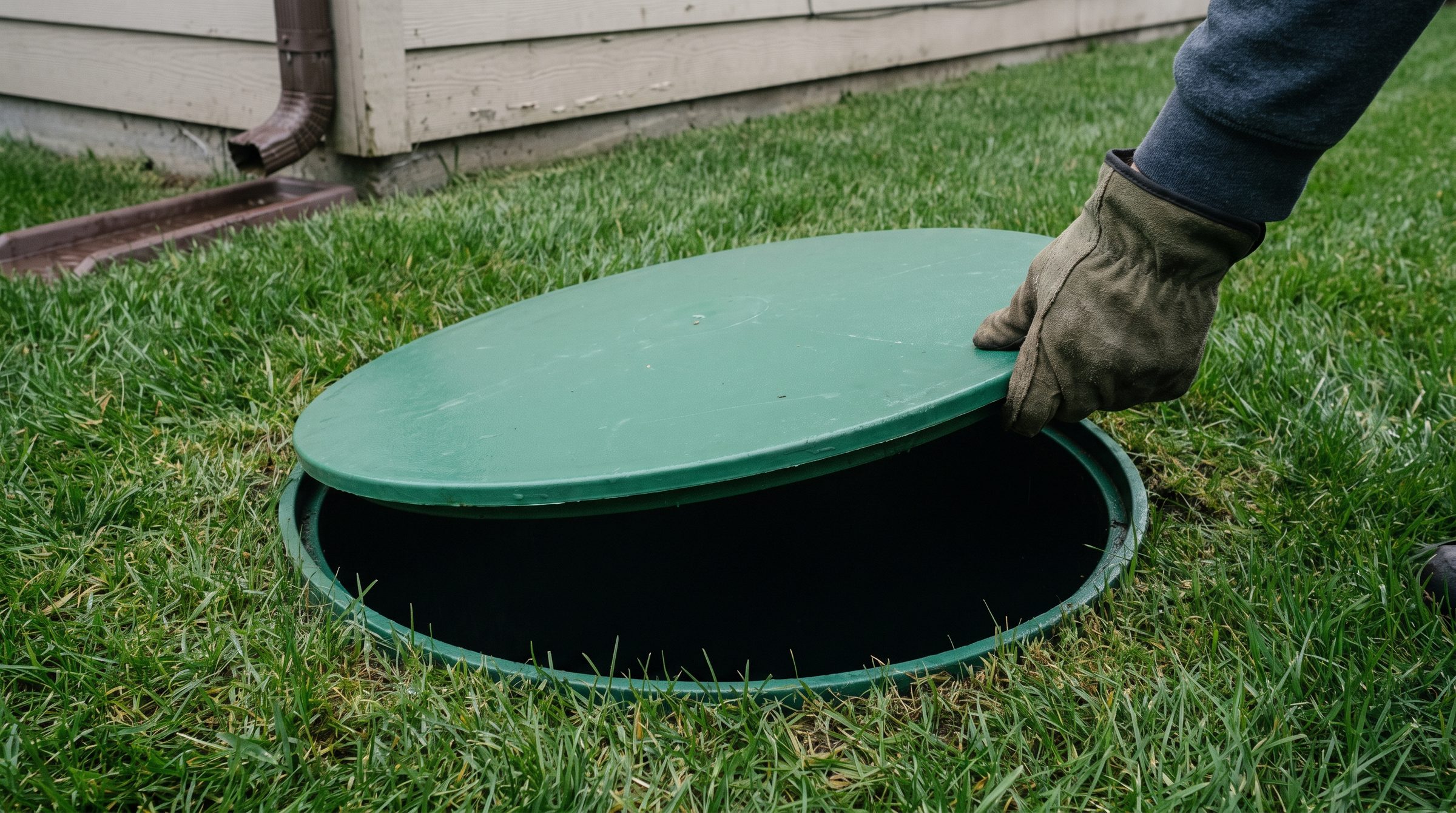
- A black or green disc set into the lawn
- That is an access riser over the tank. EPA suggests following the plumbing outlet leaving the house, then looking for a riser or probing for the top of the tank along that line.
- The deed, the building permit and the design plans
- EPA: the property deed, building permit and design plans will likely say whether a septic system is present. If you bought recently these are in the pile of paperwork you have not opened since closing.
All six checks are EPA's, from their Frequent Questions on septic systems. If none of them settles it, section three is how to get the answer on paper.
How to find out, and how to find the tank
There are two different questions here and the second one matters even when the first is already answered. Knowing you are on septic is not the same as knowing where the tank and the field are, and you need the second before anyone digs, paves, plants or parks. EPA points at the same place for both: whoever permitted the system still holds the drawing.
What it costs to find out
- Read your water bill, or look for a riser in the lawn
- Free EPA checks
- Request the as-built drawing and permits from the permitting authority
- Usually free or a copying fee EPA
- A professional septic inspection
- $250 to $1,175 Angi
- Your local health or environmental department
- EPA says to contact your local permitting authority to obtain a copy of the property's septic record drawing, the as-built design, and copies of the permits. The same office will give you a list of local professionals who can find the tank and drainfield if the paperwork has gone.
What to do once you have found it
- 01
Follow the plumbing outlet out of the house
EPA's method. The tank is on that line, usually within ten to twenty feet of the wall, and the riser or lid is directly above it. Probing gently along the line with a thin rod is how people find a lid that has been turfed over.
- 02
Mark it, and put the drawing somewhere you will find it
EPA advises keeping the maintenance records on work performed on the system. The as-built is worth the same treatment. The person who needs it most is whoever is standing in the garden with a contractor in five years.
- 03
Write down the sludge and scum levels each time it is pumped
EPA specifically recommends recording the levels the professional finds. Two or three readings turn "every three to five years" into an interval that is actually about your household rather than about the average one.
- 04
Keep the drainfield clear before you need to
EPA: do not park or drive on the drainfield, do not build structures on it without checking with a local designer or permitting authority, and do not plant trees, shrubs or vegetable gardens on it, because roots can ensnarl and damage the pipes.
Placement rules from EPA, How to care for your septic system.
Reading the signs: what a failing system looks like
There is no dial to read on a septic system, so the result comes as symptoms in the house and in the garden. These are EPA's, and the one most people miss is the last one, because it looks like good news.
| Result | What it is | What to do |
|---|---|---|
| Bright green, spongy lush grass over the tank or field, even in dry weather | EPA lists this as a sign of failure. The grass is being fertilised and watered by effluent that should be soaking away below it. | The classic missed tell, because a green patch in August reads as luck. Call it in before it becomes standing water. |
| Standing water or damp spots near or over the tank or drainfield | EPA sign of failure. The field is no longer accepting what it is given. | Stop adding load. Keep people and animals off it and get it inspected. |
| Sewage odours around the tank or drainfield | EPA sign of failure. | Outdoors this points at the system. Indoors it is more often a dried-out trap, which is a much smaller job worth ruling out first. |
| Every bath, shower and sink draining very slowly, plus gurgling | EPA lists slow drains and gurgling in the plumbing together. Across the whole house it points past the fixtures. | One slow fixture is a fixture problem. All of them at once is the system. |
| Sewage backing up into the plumbing | EPA sign of failure, and the one that has stopped being a warning. | Stop using water in the house and call a septic professional. This is not the evening to run a load of laundry. |
Bands and thresholds from EPA, Resolving septic system malfunctions.
EPA on the cause: most septic systems malfunction because of inappropriate design or poor maintenance, and failure to perform routine maintenance can cause solids in the tank to migrate into the drain field and clog the system. That sentence is the entire argument for pumping on schedule. The field is the expensive part, and what protects it is emptying the tank before the solids get to it.
Do not open the tank, and do not treat the field as garden
Almost everything on this page is yours: the checks, the paperwork, the records, keeping load off the field. Pumping and inspection are not, and the tank itself is not somewhere to put your head.
- Pumping is not a DIY job and Angi says so directly
- They put a local septic cleaner at $200 to $1,275 including labour and note it is not a cost you can avoid, with a risk of environmental contamination and legal problems if the tank is improperly pumped. The waste has to go to a licensed disposal point.
- Never enter a septic tank, and take care even leaning over an open one
- It is a confined space holding gases produced by decomposition. This is the one item on this page where the failure mode is not expensive, it is fatal, and it is why the lid is the professional's to lift.
- Do not build on the drainfield without checking first
- EPA: do not build any structures in or on your drainfield area without checking with a local designer or permitting authority. A patio over the field is a decision you get to make once.
- Do not plant trees, shrubs or a vegetable garden on it
- EPA is explicit that roots can ensnarl and damage drainfield pipes. The tidy green rectangle is exactly where people put the raised beds.
- Do not park or drive on it
- EPA again, and it includes the caravan, the trailer and the skip nobody thought of as parking. Compaction ruins the soil structure the field depends on.
What it costs, on schedule and off it
This is the clearest arithmetic of any page on this site, and it is worth reading in one go. The recurring job is a few hundred pounds every few years. The thing it protects is five figures.
Angi's page carries more than one headline figure for pumping, so both are below rather than averaged into a third.
- Pumping the tank, stated average
- $428, with most paying $292 to $564 Angi
- Pumping a common 1,000 gallon tank
- $325 to $700 Angi
- Inspection
- $250 to $1,175 Angi
- Repairs, average and range
- $1,830 average, $165 to $6,500 Angi
- Replacing the tank and drain field
- $5,000 to $12,000, averaging $6,000 Angi
- A mound system, the most expensive field type
- $12,000 Angi
- An effluent filter at the tank outlet
- Inexpensive, per NSF, and see the note below NSF
Every figure here is published by the source named beside it. We do not average them into a number of our own.
The checks that have no symptom are the ones people forget
One email a month, seasonal, and this is exactly the kind of thing it carries: the quiet checks that never announce themselves until they are expensive.
When to pump, and when to inspect
EPA gives intervals here rather than triggers, which is unusual on this site and makes the calendar entry easy. What changes the interval is your household, not the calendar.
- Inspected at least every three years
- EPA: the average household septic system should be inspected at least every three years by a septic service professional.
- Pumped every three to five years
- EPA: household septic tanks are typically pumped every three to five years. What moves it is household size, total wastewater generated, volume of solids, and the size of the tank.
- Once a year, if the system has pumps or float switches
- EPA: alternative systems with electrical float switches, pumps or mechanical components should be inspected more often, generally once a year.
- Spread the laundry across the week, every week
- EPA is direct about this one: doing all the household laundry in one day might seem like a time-saver but it can harm your septic system. It is the cheapest thing on this page and it costs nothing at all.
- Fix a running toilet the day you notice it
- EPA: a single leaky or running toilet can add as much as 200 gallons of water per day. On a septic system that is not a water bill, it is load on the field.
- Before you buy
- Ask for the as-built, the permits and the pumping records, and get it inspected separately. A field at the end of its life is a five-figure negotiation while you still have one.
Retest guidance from EPA, How to care for your septic system. EPA gives these as typical intervals for an average household. Yours moves with household size and water use, which is why recording the sludge and scum levels at each pump is worth more than the published interval.
Also asked
- How do I know if I have a septic system?
- EPA gives the quickest check as your utility bill: with a septic system you will see a $0.00 charge for wastewater or sewer services, or receive no bill at all. Also check the deed, building permit and design plans, and look for a mound or a black or green access disc in the garden.
- How do I find my septic tank?
- EPA's method is to follow the plumbing outlet leaving the house and look for an access riser or probe for the top of the tank. For the exact position, ask your local health or environmental department for the property's as-built record drawing and permits.
- How often should a septic tank be pumped?
- EPA says household septic tanks are typically pumped every three to five years, and the system should be inspected at least every three years. Systems with pumps or float switches generally need inspecting once a year.
- How much does it cost to pump a septic tank?
- Angi puts the average at $428, with most people paying between $292 and $564. A common 1,000 gallon tank runs $325 to $700, and price varies a lot by region.
- Do I need an effluent filter?
- NSF describe effluent filters as an inexpensive way of preventing solids being discharged into the septic field, fitted at the tank outlet. They also say a filter may not be necessary if the tank is maintained correctly. Check with your local public health authority first, since some require certification to NSF/ANSI 46.
- What are the signs of a failing septic system?
- EPA lists sewage backing up into the plumbing, baths and sinks draining very slowly, gurgling in the pipes, standing water or damp spots over the tank or drainfield, sewage odours, and bright green spongy grass over the system even in dry weather.
- How much does it cost to replace a drain field?
- Angi puts replacing the tank and drain field together at $5,000 to $12,000, averaging $6,000, with a mound system the most expensive at around $12,000. Replacing a drain field on its own runs around $7,000.
- What should I never flush on a septic system?
- EPA's list includes cooking grease or oil, non-flushable wipes including baby wipes, feminine hygiene products, condoms, dental floss, nappies, cigarette butts, coffee grounds, cat litter, paper towels, pharmaceuticals, and household chemicals such as petrol, oil, pesticides, antifreeze, paint and paint thinners.
- Can I plant a garden over my drain field?
- EPA advises against planting trees, shrubs or vegetable gardens on the drainfield, because roots can ensnarl and damage the pipes. Grass is the usual answer, and you should not park, drive or build on it either.