Find out first
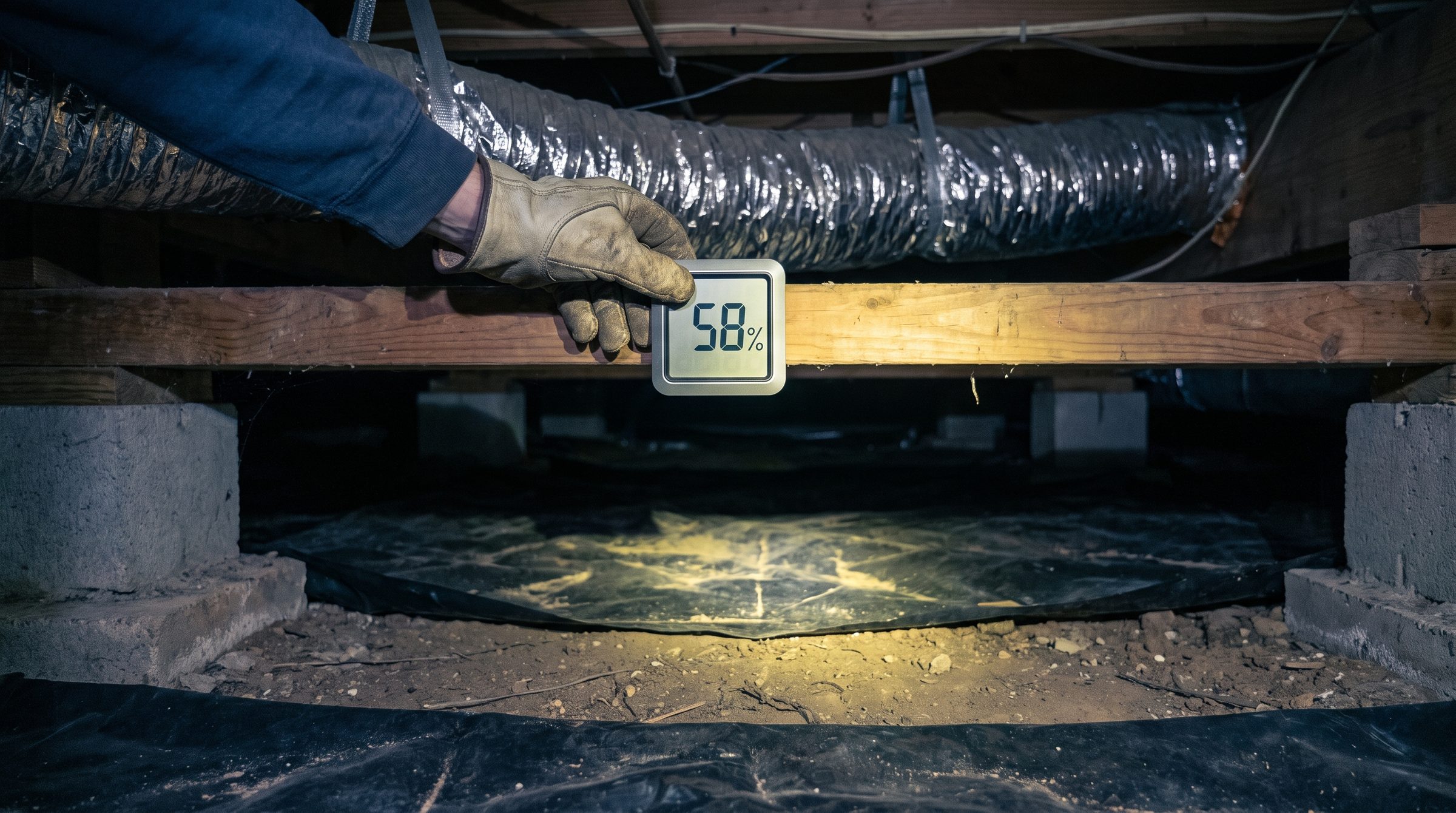
Put a $10 to $50 humidity meter under the house for a day, and take a torch down with you to look at the ground sheet while you are there.
Crawl space damp: how to check yours, and what the humidity should be
EPA puts the line at 60 percent relative humidity, ideally 30 to 50, and says the meter is a $10 to $50 instrument sold in most hardware shops. EPA, Mold, Moisture and Your Home
Updated
Does this apply to you?
If the house sits over a crawl space rather than a slab or a basement, then yes, and the reason it is worth a look is that a crawl space is the part of the house nobody visits. Things go wrong down there for years without anyone noticing, and what you eventually notice is not water. It is a smell in a room above it.
There is no lookup for this one and there could not be. Nothing about damp under a specific house is collected by any agency, and the honest test is cheap enough that a lookup would be the slow way round: a meter, a torch, and twenty minutes.
Before you go down, the house will already have told you some of it.
What the house is already telling you
- A musty smell in rooms on the floor above
- The classic one, and it usually arrives before anything visible. Air moves upward through a house, so what is under the floor does not stay under the floor.
- Floors that feel bouncy, uneven or soft underfoot
- That is the expensive symptom, because it means moisture has been working on the joists or the subfloor rather than just sitting in the air.
- Condensation on pipes, ducts or windows
- EPA names condensation on windows, walls or pipes as a sign of high humidity and says to act quickly on the moisture source rather than the surface.
- Visible mould or mildew, or peeling paint that looks like water damage
- Mould does not grow without moisture. Find the water rather than treating the growth, because the growth comes back. The same rule on bathroom ceilings
- Standing water, or a ground sheet that is torn, missing or laid loose
- Bare soil under a house is a permanent source of water vapour. Whether the sheet is intact is the single most useful thing you can see down there.
- Pests that like damp wood
- Damp wood and blocked vents are on EPA's own list of conditions that make a structure attractive to termites, so the two questions are worth asking on the same trip. Check for termites too
None of these is a measurement, and the argument you will have with a contractor is about a number. That is the next section, and it costs ten dollars.
How to find out
This is the cheapest test on the site, because EPA names both the instrument and its price. A relative humidity meter, left under the house for a day or two and read against a plain threshold, turns a sales conversation into an argument about a number you took yourself.
What it costs to find out
- Humidity meter, sometimes sold as a hygrometer
- $10 to $50 EPA
- A torch and an hour, to look at the ground sheet
- Free EPA prevention guidance
- Any hardware shop
- EPA describes the meter as small, inexpensive and available at many hardware stores. Buy the one that shows relative humidity as a number rather than a coloured dial, because the threshold you care about is a number.
What to do while you are down there
- 01
Leave the meter down there for a full day, not a minute
A crawl space swings with the weather and with the dew point. One reading as you crouch in the hatch is a reading of the hatch.
- 02
Look at the ground sheet before anything else
Is there one, does it cover the whole floor, is it torn, and is it lapped up the walls or just laid flat and curling. Bare soil anywhere is the answer to where the moisture is coming from.
- 03
Look up at the joists and the subfloor, not just down
Dark staining, white bloom, or insulation hanging down out of the bays. Insulation that has fallen is often the first sign it has been wet.
- 04
Find where the water gets in
EPA is direct about this: the key to mould control is moisture control. Ground sloping toward the house, a downspout discharging at the foundation, a leaking supply line or a sweating duct. One of them is usually the whole story.
- 05
Photograph everything, before anyone quotes
You will be shown photographs by whoever inspects it. Having your own, dated, is the difference between a conversation and a presentation.
Placement rules from EPA moisture control guidance.
Reading your result
One number, and EPA publishes the threshold. Relative humidity is what the meter shows, and the same guidance applies under the house as inside it.
| Result | What it is | What to do |
|---|---|---|
| 30 to 50 percent | EPA's ideal range. | Nothing to do. Check again after a wet spell and at the change of season. |
| 50 to 60 percent | Still inside EPA's limit, but with no margin left. | Deal with the cheap causes now: the ground sheet, the grading, the downspouts. This is the band where a few hundred dollars of plastic beats ten thousand of work. |
| Above 60 percent | Above the level EPA says to keep a home below. | Find the water source. Wet materials need drying within 24 to 48 hours to stop mould starting, which is why standing water is urgent rather than annoying. |
Bands and thresholds from EPA, Mold, Moisture and Your Home.
What the number does not tell you is whether the wood has already been damaged, and that is the thing worth paying an inspector for rather than a salesperson. A high reading with intact joists is a drainage job. A normal reading under bouncy floors means the damage happened before you measured.
Where this stops being a job you do yourself
Laying a ground sheet is within reach of most people. The three below are not, and the fourth is about who is telling you the number.
- Anything holding the house up
- Sagging floors mean joists, girders or piers, and that is structural work. Damp is the cause; the repair is carpentry under load.
- Mould beyond a small patch
- EPA gives homeowners guidance for small areas and treats larger contamination as a different job with different protective equipment. Under a house, in a confined space, is the wrong place to find your limits.
- Encapsulation is not a ground sheet
- A sealed system takes in the walls, the vents, the sump if there is one and usually a dehumidifier, and getting it wrong traps moisture rather than excluding it. This is the point at which the money starts.
- Treat payback claims as sales copy, wherever they come from
- Figures circulate about the energy saving and the years to break even, including on the page this site takes its cost data from. We do not repeat them. A price is a price; a payback is a prediction made by someone selling the work.
If it comes back damp
There is a real ladder here rather than one answer, and it is worth climbing from the bottom. Drainage and a ground sheet first, a dehumidifier if the number will not come down, and full encapsulation last, because it is between three and fifteen thousand dollars and it does not fix a downspout.
- Vapour barrier sheeting, materials, 6 mil to 20 mil
- $0.30 to $0.70 per square foot HomeGuide
- Crawl space dehumidifier, unit only
- $300 to $2,000 HomeGuide
- Dehumidifier with professional installation
- $1,000 to $3,000 HomeGuide
- Crawl space insulation
- $1.00 to $4.50 per square foot HomeGuide
- Full encapsulation
- $3 to $10 per square foot, or $3,000 to $15,000 HomeGuide
Every figure here is published by the source named beside it. We do not average them into a number of our own.
The checks that have no symptom are the ones people forget
One email a month, seasonal, and this is exactly the kind of thing it carries: the quiet checks that never announce themselves until they are expensive.
When to look again
A crawl space is a place you have no reason to visit, which is exactly why it needs to be on a schedule rather than on your conscience.
- Twice a year, spring and autumn
- The two moments the dew point moves. Ten minutes with a torch, and read the meter if you have left one down there.
- After heavy or prolonged rain
- Water that gets in during a storm and does not leave is the case you want to catch, because drying within 24 to 48 hours is what stops mould starting.
- When the smell upstairs changes
- A musty note that was not there last month is information. It is usually the first report you get from a place you never go.
- After any plumbing work or a leak anywhere above it
- Supply lines and waste pipes run through the crawl space in most houses, and a slow drip has nowhere to announce itself.
Also asked
- What humidity should a crawl space be?
- EPA advises keeping indoor humidity below 60 percent relative humidity and ideally between 30 and 50 percent. A meter to check it costs $10 to $50, which EPA notes is available at many hardware stores.
- Why does my house smell musty when nothing looks wet?
- Look under it. A crawl space is the part of the house nobody visits, and a musty smell in rooms above is often the first thing a damp one produces. Mould does not grow without moisture, so the smell is a moisture report.
- Is crawl space encapsulation worth it?
- Sometimes, and it is the last rung rather than the first. Drainage, downspouts and an intact ground sheet are cheap and fix many cases. Encapsulation runs $3 to $10 per square foot, or $3,000 to $15,000, according to HomeGuide. Treat any payback promise as sales copy.
- Do I need a crawl space dehumidifier?
- Only if the number will not come down after the cheap fixes. HomeGuide puts a unit at $300 to $2,000, or $1,000 to $3,000 installed. Buying one before dealing with standing water or a torn ground sheet is paying to dry the outdoors.
- How do I know if crawl space damp has damaged the floor?
- Floors that feel bouncy, soft or uneven are the sign that moisture has reached the joists or the subfloor rather than sitting in the air. That is structural work and a humidity reading will not tell you about it.
- How often should I check my crawl space?
- Twice a year, spring and autumn, plus after heavy rain, after any plumbing work, and whenever the smell upstairs changes. Wet materials want drying within 24 to 48 hours to stop mould starting.