Find out first
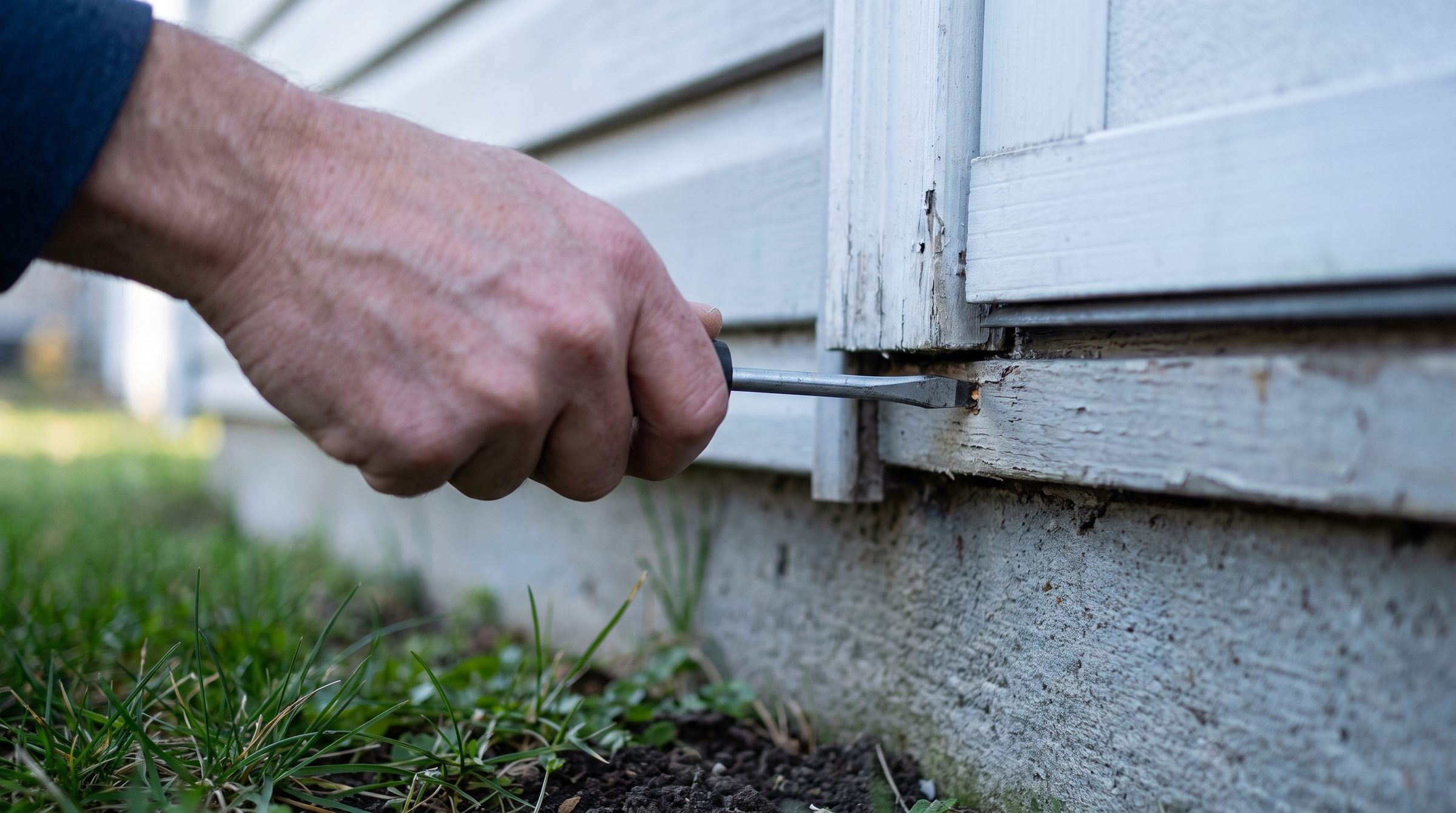
Take a flathead screwdriver to the exposed wood around the base of the house and probe for hollow spots. That is EPA's method and you already own the tool.
Termites: how to check for them yourself, and what the signs mean
EPA: most people are not aware they have termites until they see a swarm, or come across the damage during construction. EPA, Termites: How to Identify and Control Them
Updated
Does this apply to you?
Subterranean termites are the common kind across most of the United States, and they do not announce themselves. EPA puts it plainly: they rarely emerge from the soil, the mud tubes or the wood they are tunnelling through, so most people find out from a swarm or from opening up a wall for another reason.
We do not publish a termite risk map. The national ones are coarse climate bands rather than an answer about a house, and a band cannot tell you what a look at your own foundation can. What decides your risk is the conditions immediately around the structure, and EPA lists those exactly.
Every row below is something you can change this weekend, which is the useful part.
Conditions around the house that make it attractive
- Wood in contact with soil, anywhere
- Steps, posts, fence rails against siding, a deck ledger buried in a flower bed. EPA's construction advice is a ventilation space between soil and wood, and anything that closes that gap is a bridge.
- Firewood or timber stored against the house
- EPA is explicit: do not pile or store firewood or wood debris next to the house. It is the single easiest thing on this list to fix.
- Wet soil against the foundation
- Keep the soil around the foundation dry through grading and drainage, which EPA specifically includes maintaining gutters and downspouts. What gutter guards actually do
- Blocked vents, or a damp crawl space
- EPA says to keep vents free from blockage, including by plants. Damp and termites are the same visit, because the conditions overlap almost exactly. Check the crawl space
- Cracks in the foundation, or gaps where pipes pass through
- EPA advises filling cracks in cement foundations and around utility penetrations with cement, grout or caulk. These are the access points.
- Leaks you have been meaning to get to
- Fix leaks immediately is on EPA's prevention list for a reason. A slow leak produces the one thing a colony needs and cannot make for itself.
- Shrubs and trees grown against the wall
- Planted too close, or allowed to grow against exposed wood, they hold moisture against the structure and hide the very surfaces you would inspect.
Conditions and prevention measures from EPA's termite fact sheet. None of it needs a contractor, and doing it is worth more than knowing which band your county is in.
How to find out
There is no kit to buy for this one. EPA's consumer method is a flathead screwdriver and your eyes, and the reason it works is that termites eat wood from the inside and leave the surface intact. Sound wood resists the tip. Wood that has been eaten gives, or goes through.
What it costs to find out
- A flathead screwdriver you already own
- Free EPA method
- An annual professional inspection and treatment plan
- $200 to $900 per year HomeGuide
- Start with your own foundation line
- The sill plate, the rim joist, posts, steps, the back of the garage, and anything wooden within a foot of the ground. You are looking for mud tubes on masonry and hollow spots in the wood.
What you are actually looking for
- 01
Mud tubes on foundation walls, piers or crawl space masonry
Pencil-width tunnels of soil running vertically. They are how subterranean termites travel between the ground and the wood, and they are the clearest sign available to a homeowner.
- 02
Probe the wood rather than tapping it
Press the screwdriver into exposed wood at the base of the house. A hollow spot under an intact surface is the finding. Damage is usually along the grain.
- 03
Piles of small equal-length wings, usually on sills and windowsills
Swarmers shed their wings after flying. The wings often outlast the swarm, so a pile of them means a swarm happened here even if you missed it.
- 04
Do not disturb what you find
Breaking open tubes or spraying an aerosol at a colony scatters it and makes the inspection that follows harder. Photograph it and leave it.
Placement rules from EPA termite fact sheet.
Reading your result: is it a termite or an ant?
This is the question that actually decides the next hour, and EPA publishes the distinguishing features. Flying ants swarm in the same season and are mistaken for termites constantly, in both directions.
| Result | What it is | What to do |
|---|---|---|
| Wings | Termite: roughly equal in length, front and back. | Ant: front wings noticeably longer than the hind wings. |
| Antennae | Termite: straight, and may droop. | Ant: bent at about ninety degrees. |
| Mud tubes on masonry | Termite. Ants do not build them. | A confirmed sign. Get it inspected rather than treated by you. |
| Hollow wood with an intact surface | Consistent with termites, which eat from the inside out. | Also consistent with rot, which is a moisture problem. Either way something is wrong inside a member you cannot see. |
Bands and thresholds from EPA identification guidance.
The types differ and it changes the treatment: subterranean is the common one and lives in soil, drywood does not need soil contact at all, and Formosan is the invasive one that costs the most to deal with. Identification is the inspector's job. Yours is knowing whether to call one.
Treatment is not a DIY job, and EPA says so directly
Finding them is yours. Everything after that is licensed work, and this is one of the clearest lines on the site because the failure mode is invisible: a colony that survives a bad treatment keeps eating while everyone believes it is handled.
- EPA: termiticide application can normally only be properly performed by a trained professional
- The registered products are applied to soil under and around a structure, at volumes and depths set by the label. A hardware-shop spray is not a smaller version of that job.
- A hardware-shop aerosol makes the real treatment harder
- It kills what you can see and scatters the rest. The colony is not where you are spraying.
- Homeowners insurance does not cover this
- Termite damage is treated as gradual and preventable, so treatment and repair are normally your bill. Policies may respond where the infestation followed a flood or water damage.
- Structural repair is a separate trade from pest control
- The company that kills the colony is not necessarily the one that replaces a sill plate. Get the damage assessed by someone who is not selling the treatment.
If you find them
Treatment is priced by method and by the type of termite, and the spread is wide because a perimeter treatment and tenting an entire house are different undertakings. The figures below are published; what you need is an inspection that tells you which row you are in.
- Chemical or bait treatment, per treatment
- $225 to $2,500 HomeGuide
- Subterranean termites, the common case
- $250 to $2,000 HomeGuide
- Bait stations, plus annual monitoring
- $1,000 to $2,500, then $200 to $400 a year HomeGuide
- Formosan termites, the invasive one
- $800 to $5,000 and up HomeGuide
- Whole-home tenting and fumigation
- $2,000 to $8,000 HomeGuide
Every figure here is published by the source named beside it. We do not average them into a number of our own.
The checks that have no symptom are the ones people forget
One email a month, seasonal, and this is exactly the kind of thing it carries: the quiet checks that never announce themselves until they are expensive.
When to check again
EPA says to inspect periodically so colonies do not become established, and does not name an interval. These are the moments that actually matter.
- Once a year, walking the foundation line
- Screwdriver, torch, twenty minutes. The same walk each time is what makes a change visible.
- In spring, when swarms happen
- A swarm is the one time a colony is visible, and the wings it leaves behind outlast it. Check sills and windowsills.
- After any leak, flood or drainage problem
- Moisture is the precondition. A wet season under the house changes the answer from last year.
- Before you buy, and before you sell
- Damage has to be disclosed in a sale, and it is the classic thing found late in a transaction when it costs the most to negotiate.
- Annually, if you have bait stations
- They are monitored and replaced on a schedule. A station nobody has checked is decoration.
Retest guidance from EPA termite fact sheet. EPA says "inspect periodically" without naming an interval. The yearly walk is a practical reading of that, not an agency recommendation.
Also asked
- How do I check for termites myself?
- EPA's consumer method is to probe exposed wood with a flathead screwdriver, looking for hollow spots under an intact surface, and to look for mud tubes on foundation masonry. It costs nothing and takes about twenty minutes.
- How can I tell termites from flying ants?
- EPA gives two tells. Termite wings are roughly equal in length and their antennae are straight and may droop. Ants have front wings longer than the hind wings and antennae bent at about ninety degrees.
- What are mud tubes?
- Pencil-width soil tunnels running up foundation walls, piers or crawl space masonry. Subterranean termites build them to travel between the soil and the wood, and they are the clearest sign available without opening anything up.
- Can I treat termites myself?
- No. EPA states that termiticide application can in most cases only be properly performed by a trained pest management professional. A shop-bought spray kills what you can see and scatters the rest.
- How much does termite treatment cost?
- HomeGuide puts chemical or bait treatment at $225 to $2,500, subterranean termites at $250 to $2,000, and whole-home tenting at $2,000 to $8,000. Bait systems add $200 to $400 a year for monitoring.
- Does homeowners insurance cover termite damage?
- Not usually. It is treated as gradual and preventable damage, so treatment and repairs are normally the homeowner's cost. Policies may respond where the infestation followed a flood or water damage.
- How do I prevent termites?
- EPA's list: keep soil around the foundation dry with grading, gutters and downspouts, fix leaks immediately, fill cracks and gaps around utility penetrations, keep vents unblocked, keep shrubs off the walls, and never store firewood against the house.