Worth it?
Is a water softener worth it?
Only above a number
This one turns on a single figure, and almost nobody being quoted has read theirs. Above about 10 grains per gallon the case is strong and both the industry and USGS call that water very hard. Below about 7 it is weak, and HomeGuide's own table says no treatment is needed at all under 3.5. Get your number before anyone gets a quote in front of you, because everything else on this page depends on it.
Start by being clear about what is not in dispute. Ion exchange works. It swaps the calcium and magnesium for sodium, a hardness test after a properly sized unit reads lower than it did before, and none of that is in doubt. The question is not whether softeners do anything. It is whether your water is hard enough for what they do to be worth a national average of $2,500 and a bill every year after that.
The useful thing about this decision is that the threshold does not have to come from us. HomeGuide publishes a hardness table saying no treatment is needed below 3.5 grains per gallon, that 3.5 to 7 may benefit, that 7 to 10 is where softening is recommended, and that 10 to 20 is where it is essential. That table sits on a page whose own button offers free estimates from installers, so it is not a sceptic talking. USGS, which sells nothing to anyone, classifies water above 180 mg/L as very hard, and 180 mg/L is about 10.5 grains. The seller and the government put the line within half a grain of each other, which is more agreement than most household spending decisions ever get.
Then there is the number that never appears on a quote. HomeGuide puts salt or potassium at $50 to $150 a year and maintenance at $100 to $300 or more, on a unit that lasts 15 to 20 years. Multiplied out that is $2,250 at the bottom and $9,000 at the top, on a purchase whose national average is $2,500. A softener is not something you buy, it is something you buy and then keep paying for, and that is exactly why the hardness number decides it. Above the threshold you are paying to stop damage you can see. Below it you are paying an annual bill to remove something that was not costing you anything.
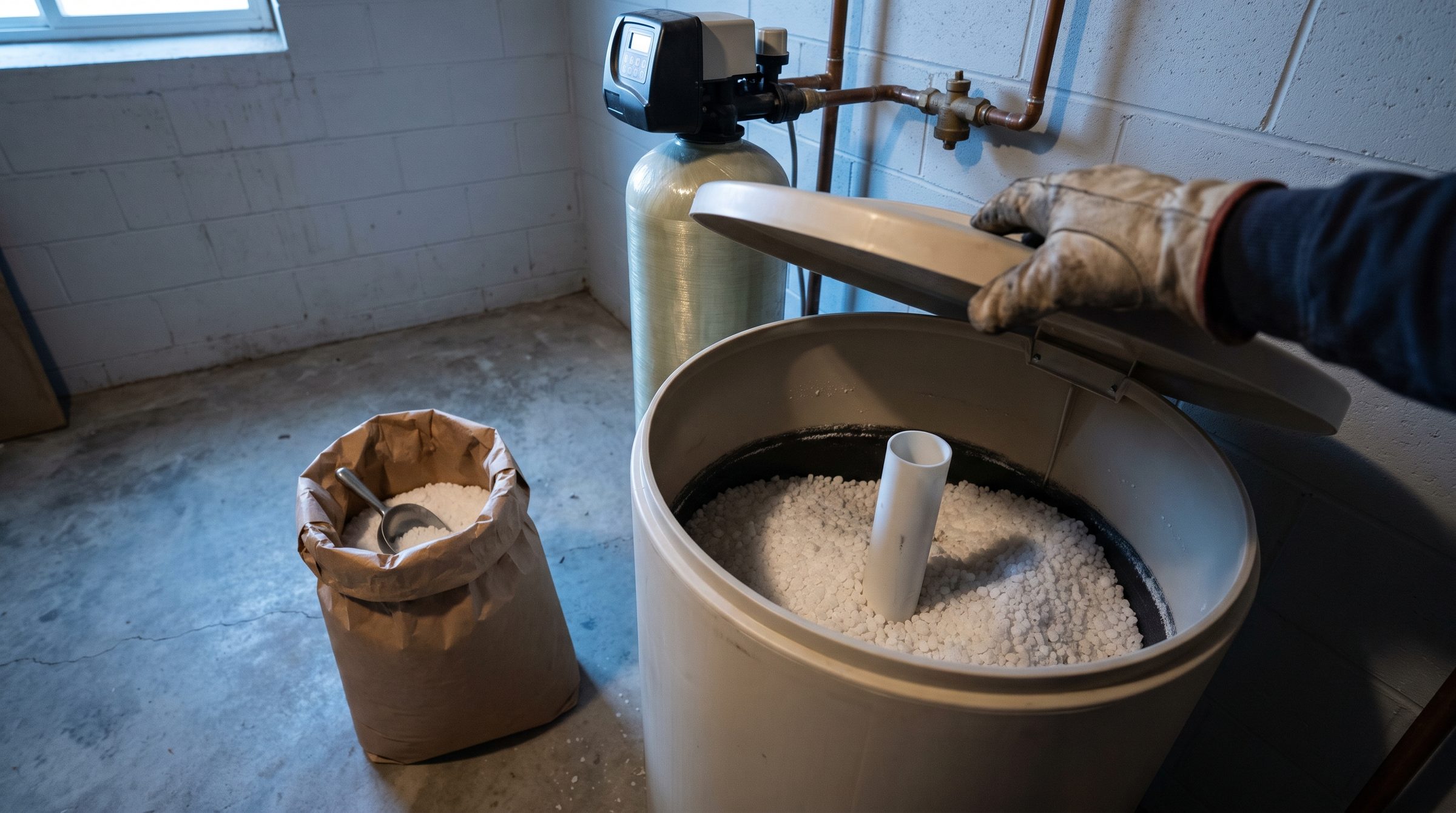
When it is genuinely worth paying for
- Your measured hardness is above about 10 grains per gallon
- This is the case the whole page is built around, and both tables agree on it. HomeGuide's own classification calls softening essential from 10 grains up, and USGS calls anything above 180 mg/L very hard, which is about the same line. At that level scale forms faster than descaling what you can reach keeps up with, and it forms hardest on whatever heats the water.
- You are on a well, and the number came back high
- Nobody is blending your water and nobody is going to change the source on your behalf. A utility can soften your problem by accident when it switches supply; a well will not, and its chemistry moves with rainfall and the season instead. That makes a permanent fix a better fit than a descaling routine.
- Scale has already cost you a water heater, and the replacement is going in anyway
- HomeGuide puts replacing a standard tank water heater at $600 to $3,100 and lists frequent repairs to water-using appliances among the signs a house would benefit from softening. If that has already happened once, the softener is being compared against a second replacement rather than against nothing, and it is going in at the moment the plumbing is already open.
- The house already has a soft water loop
- HomeGuide notes that homes with an existing loop need less modification, which puts the job near the bottom of the $1,200 to $3,800 range rather than the top. A replacement unit on plumbing that is already there, at a genuinely hard number, is the easiest yes on this page.
When it is not
- Nobody has actually measured your hardness
- And a free in-home test from the company quoting for the unit is the oldest arrangement in this trade: the person measuring the problem is the person selling the fix. A strip you bought yourself is $9 to $35 and answers to nobody.
- Your number is under about 7 grains per gallon
- HomeGuide's table says no treatment is needed below 3.5 and that 3.5 to 7 only may benefit. That is the seller's table, not ours. At that level descaling the kettle and the shower head, and flushing the water heater on schedule, is the whole job.
- You were sold a salt-free system to deal with hard water
- HomeGuide is explicit that salt-free systems do not technically soften water: they change how the minerals crystallise so less scale forms, and are not as effective at reducing hardness. They also cost more, at $1,500 to $4,500 against $1,200 to $3,800. Paying a premium for the version that does less is the clearest bad buy in this category.
- It is a magnetic unit
- HomeGuide puts these at $2,000 to $6,000 and says in the same breath that their effectiveness varies with water chemistry and flow rate, and that they work best as a supplementary treatment rather than a primary softening solution. That is a supplement priced like a whole system.
- Whole-house reverse osmosis has been proposed to fix hardness
- It is $4,800 to $10,000, roughly four times the price of the thing that does this specific job, plus filters at $30 to $150 every 6 to 12 months and a membrane at $40 to $250 every 2 to 3 years. Reverse osmosis is the right answer to a contamination problem and an expensive answer to a hardness one.
- The pitch is about your skin and your laundry
- Those are real and some people notice the difference immediately, so this is not a reason to dismiss anyone. It is a reason to know which purchase you are making. $2,500 up front and $150 to $450 a year for a nicer shower is a legitimate thing to buy and a completely different argument from protecting the plumbing. Ask which one you are being sold.
Ten dollars, before anyone gets a quote in front of you
Every branch of this decision runs through your grains per gallon, and there are three ways to get it that cost between nothing and $200. Your water supplier's annual quality report is free, though hardness is not a regulated contaminant so not every utility publishes it. A test strip is $9 to $35. A professional hard water test is $130 to $200, still a fraction of the cheapest installation. What to refuse is the free in-home test from the company quoting for the unit. And if there is already a softener in the house, test both sides of it, because two similar readings mean the thing is not doing anything and you have a service call rather than a purchase.
What it costs
Every figure below is published by the source named beside it and links to it.
| Job | Published range |
|---|---|
| Salt-based, also called ion exchange, installed | $1,200 to $3,800 HomeGuide |
| National average, all softener types | $2,500 HomeGuide |
| Full published spread for a softener with installation, low to high | $800 to $8,000 HomeGuide |
| Dual-tank ion exchange, installed | $1,700 to $5,000 HomeGuide |
| Salt-free, which prevents scale rather than softening | $1,500 to $4,500 HomeGuide |
| Magnetic | $2,000 to $6,000 HomeGuide |
| Whole-house reverse osmosis | $4,800 to $10,000 HomeGuide |
| Salt or potassium, every year, for as long as you own it | $50 to $150 HomeGuide |
| Maintenance, every year | $100 to $300 or more HomeGuide |
| A dedicated electrical circuit, where the unit needs one | $250 to $900 HomeGuide |
| A professional hard water test | $130 to $200 HomeGuide |
| A hardness test strip you buy yourself | $9 to $35 Home Depot listings |
| What it is protecting: replacing a standard tank water heater | $600 to $3,100 HomeGuide |
If you do go ahead, insist on these
01Size it from your number, not from your house
HomeGuide's formula is daily water use multiplied by your grains per gallon, then multiplied again by 3 to 7 depending on how many days you want between regenerations. Their worked example is 400 gallons a day at 20 grains, which is 8,000 grains a day, which is a 32,000 grain unit on a four-day cycle. They also say undersized systems regenerate more often, use more salt and last less time, so a guess costs money twice.
02Get the running cost in writing, not just the installed price
$50 to $150 a year for salt and $100 to $300 or more for maintenance is the half of this purchase that never stops. Over a 15 to 20 year life it is $2,250 to $9,000, and it is the number least likely to appear on the quote you are handed.
03Ask about the soft water loop and the electrical circuit before anyone prices it
An existing loop puts the job at the bottom of the range because there is less plumbing to modify. A unit needing its own dedicated circuit adds $250 to $900. Both are knowable before a van arrives, and both move the price more than haggling will.
04Decide about the kitchen cold tap before it is plumbed, not after
Ion exchange trades calcium and magnesium for sodium. HomeGuide names three ways around it: bypass the drinking taps, fit an under-sink reverse osmosis unit, or regenerate with potassium chloride instead of sodium chloride. All three are cheap to specify at installation and awkward to retrofit, and anyone in the house on a restricted-sodium diet should be part of that conversation.
05Test both sides of it once it is running, at handover
A strip either side of the unit is the only proof it does what was sold. Two similar readings mean it is not working. It is a ten dollar check on a several thousand dollar purchase, and it is far easier to raise while the installer is still standing in your basement.
We will tell you when something is not worth buying
One email a month, and the same standard as this page: what is worth doing, what is not, and what it costs either way.
Common questions
- Is a water softener worth it?
- It depends on one number. Above about 10 grains per gallon the case is strong: HomeGuide's own table calls softening essential from 10 up and USGS classifies anything above 180 mg/L, which is about 10.5 grains, as very hard. Below about 7 grains it is weak, and HomeGuide says no treatment is needed at all under 3.5. Measure before you decide.
- At what water hardness do you actually need a softener?
- HomeGuide publishes the thresholds in grains per gallon: 0 to 3.5 no treatment needed, 3.5 to 7 may benefit, 7 to 10 softening recommended, 10 to 20 softening essential. USGS puts very hard water above 180 mg/L, which works out at about 10.5 grains, so the two agree closely.
- How much does a water softener cost to run each year?
- HomeGuide puts salt or potassium at $50 to $150 a year and maintenance at $100 to $300 or more. That is $150 to $450 annually, and on a unit lasting 15 to 20 years it adds up to $2,250 to $9,000 over its life, against a national average purchase price of $2,500.
- Is a salt-free water softener worth the extra money?
- It is hard to argue so. HomeGuide puts salt-free at $1,500 to $4,500 against $1,200 to $3,800 for salt-based, and states that salt-free systems do not technically soften water and are not as effective at reducing hardness. The premium buys the version that does less. It suits people who specifically want no sodium added and have only moderate hardness to deal with.
- Will a water softener pay for itself?
- We do not publish a payback figure, for the same reason we do not publish one for crawl space encapsulation: it is a forecast, and every version of it in circulation is made by someone selling the work. What is publishable is $1,200 to $3,800 installed, $150 to $450 a year to run, 15 to 20 years of life, and a hardness threshold that the industry and USGS agree on. Above 10 grains the case stands on scale damage you can see. Below 7, no payback figure rescues it.
- How long does a water softener last?
- HomeGuide puts a quality system at 15 to 20 years with proper maintenance, depending on water quality, usage and how well the brine tank is looked after. That lifespan is what the running cost gets multiplied by, so it is the single most important number after your hardness.
Last updated 2026-08-23. Tell us if something here is wrong.