Worth it?
Is crawl space encapsulation worth it?
Sometimes, and last
Sometimes, and almost never first. Encapsulation is the top of a ladder, and the bottom rungs fix a lot of crawl spaces for a fraction of the money. Where the cheap steps have genuinely been done and the humidity still will not come down, it is a real fix and worth the $3 to $10 per square foot. Where they have not, it is an expensive way to seal a problem in.
The useful thing about this job is that you can buy it in pieces, and HomeGuide publishes the pieces separately. Sealing vents and holes is $150 to $450. A vapor barrier installed is $1,200 to $4,000. A dehumidifier is $1,000 to $3,500. Full encapsulation is $3,000 to $15,000. Those are rungs, and most people are sold straight to the top one without being shown the ladder.
What encapsulation genuinely does is control moisture. That is a real mechanism and it is why the job exists. What it is usually SOLD on is an energy saving and a years-to-break-even figure, and those two claims are not equally well supported. The energy case depends almost entirely on whether your heating and cooling ducts run through the crawl space, and on your climate, and on what insulation is already there. Nobody quoting you knows those in advance.
So this page does what the crawl space guide does: it publishes the prices, which are facts, and refuses to publish the payback, which is a forecast made by the industry that sells the work. A price is a price. A payback is a prediction.
When it is genuinely worth paying for
- Your heating and cooling ducts run through the crawl space
- This is the strongest case and it is a mechanism rather than a hope. If the ducts are down there, the space is already half inside the building envelope, and sealing it means the air around them is no longer damp outdoor air. Everything the salesperson claims is most likely to be true here.
- The cheap rungs are done and the humidity still will not come down
- Downspouts moved, grading corrected, ground sheet intact and taped, vents dealt with, and a meter still reading high through a season. At that point you have ruled out the cheap causes by experiment rather than by assumption, which is the only honest basis for spending five figures.
- There is documented mould or rot, not just a smell
- Once joists or subfloor are affected you are no longer buying comfort, you are stopping structural damage. HomeGuide put crawl space mould remediation at $1,500 to $4,000 on its own, and doing that twice is worse value than fixing the cause.
- High water table, and drainage alone has not held it
- Some sites simply cannot be dried by managing surface water. HomeGuide put an interior drain at $800 to $3,000, and if that has been tried and the space is still wet, the argument for sealing and dehumidifying is a good deal stronger.
When it is not
- The ground sheet is torn, thin or missing
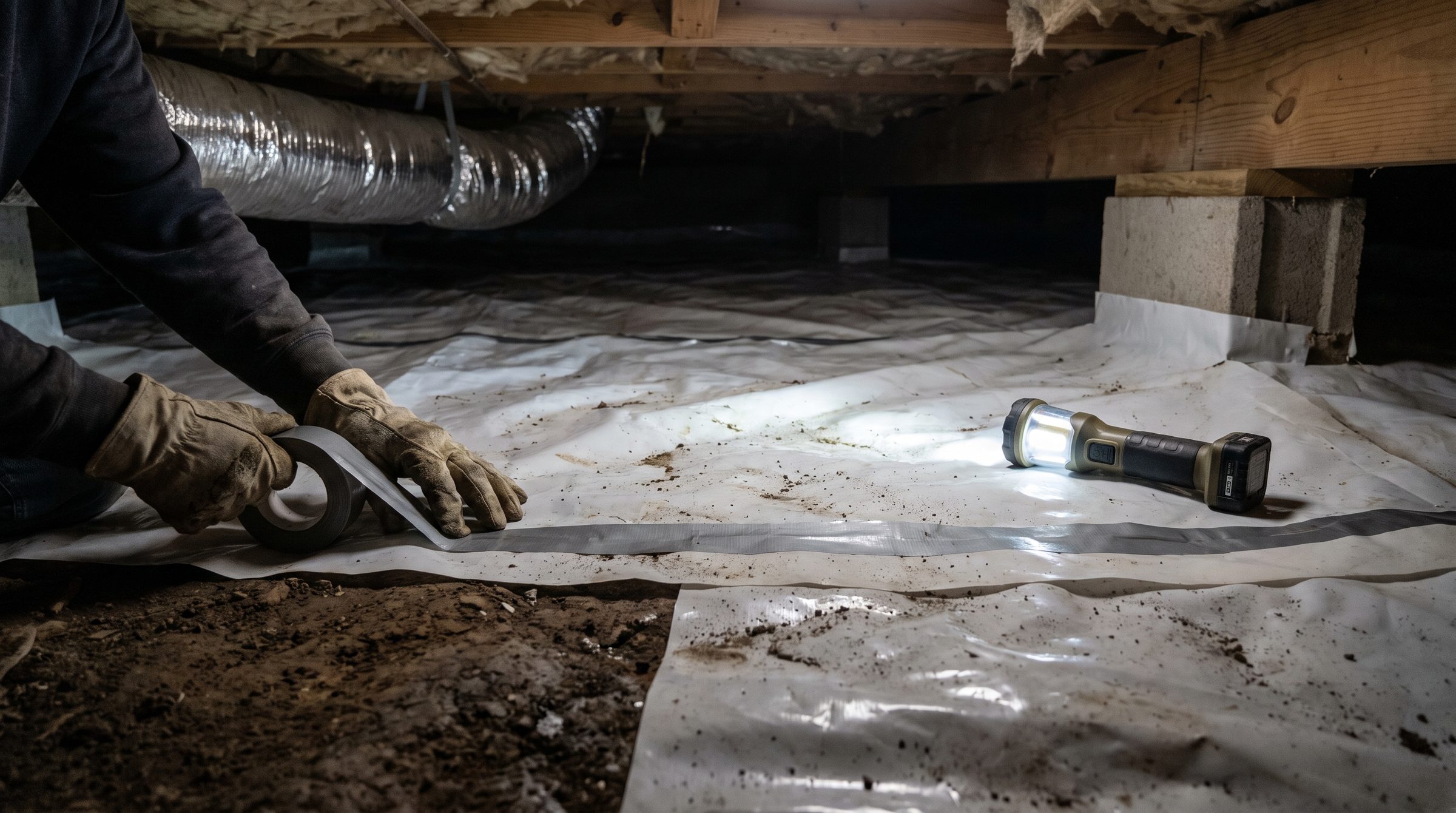
- A moisture barrier is $2 to $4 per square foot installed against $3 to $10 for encapsulation. Doing the cheap version properly first is not a delay tactic, it is how you find out whether you needed the expensive one.
- Your downspouts discharge next to the foundation
- You are paying to seal a crawl space that is being watered from above. Extensions cost very little and this is the single most common version of the problem.
- Nobody has actually measured the humidity
- A meter costs a few pounds and settles the argument. Buying a five-figure fix for a number nobody has read is the definition of being sold to.
- The pitch is energy savings and a payback figure
- If the case rests on the forecast rather than on moisture, be suspicious. Ask what happens to the argument if the saving is half what they say, because for most houses without ducts down there, it is.
- You are about to sell
- It rarely returns its cost at sale and a buyer will not pay for it line by line. A documented moisture fix and an inspection report do more for the same money.
The ladder, from the bottom
Move the downspouts away from the foundation and check the grading falls away from the house. Put a meter down there and read it across a season rather than on one dry afternoon. Lay or repair the ground sheet and tape the seams, at $2 to $4 per square foot installed. Seal obvious holes and deal with the vents, at $150 to $450. If the number still will not come down after all of that, a dehumidifier at $1,000 to $3,500 is the next rung, and full encapsulation is the one after it. Most crawl spaces never need the top of the ladder, and the ones that genuinely do are much easier to identify once the bottom rungs have been tried.
What it costs
Every figure below is published by the source named beside it and links to it.
| Job | Published range |
|---|---|
| Full encapsulation, per square foot | $3 to $10 HomeGuide |
| Full encapsulation, total | $3,000 to $15,000 HomeGuide |
| Sealing vents and holes on its own | $150 to $450 HomeGuide |
| A moisture barrier, installed | $2 to $4 per square foot HomeGuide |
| Vapor barrier installation as a line item | $1,200 to $4,000 HomeGuide |
| A crawl space dehumidifier, installed | $1,000 to $3,500 HomeGuide |
| An interior drain, where the water table needs it | $800 to $3,000 HomeGuide |
| Crawl space inspection | $100 to $250 HomeGuide |
| Mould remediation in a crawl space, if it has got that far | $1,500 to $4,000 HomeGuide |
If you do go ahead, insist on these
01Fix the water source before anything gets sealed
Encapsulating over standing water or an active leak traps it against the structure. Any contractor worth using will say this first; if yours does not, that is the information you needed.
02Ask exactly what the quote includes
HomeGuide note that most pros include a light cleaning but charge extra for removing mould, pests or standing water, and that old insulation removal adds $1 to $2 per square foot. Cleaning and repairs alone run $500 to $8,000.
03Get the humidity measured before and after, in writing
It is the only outcome anyone can verify. A job sold on moisture control that never produces a before-and-after number was sold on something else.
04Do not accept a payback figure as a reason
Take it as marketing, not as a term of the deal. If the moisture case does not stand on its own, the energy forecast should not be what tips it.
05Ask whether drainage is needed as well
HomeGuide put an interior drain at $800 to $3,000 and note pros recommend it with a high water table or seepage. Finding that out afterwards is how a fixed price becomes a range.
We will tell you when something is not worth buying
One email a month, and the same standard as this page: what is worth doing, what is not, and what it costs either way.
Common questions
- How much does crawl space encapsulation cost?
- HomeGuide put it at $3 to $10 per square foot, or $3,000 to $15,000 total, depending on size and condition. A 1,000 square foot crawl space runs $3,000 to $10,000 and a 2,000 square foot one $6,000 to $20,000.
- Is encapsulation the same as a vapor barrier?
- No, and the difference is most of the price. A vapor barrier is a sheet over the ground, about $2 to $4 per square foot installed. Encapsulation seals the whole space including walls and vents, usually with a dehumidifier, and is $3 to $10 per square foot.
- Will encapsulation lower my energy bills?
- It depends mostly on whether your heating and cooling ducts run through the crawl space, and on your climate and existing insulation. We do not publish a saving figure or a payback period, because those are forecasts made by the industry that sells the work. The moisture control is the part with a clear mechanism.
- What should I do before paying for encapsulation?
- Move the downspouts, check the grading, put a humidity meter down there and read it across a season, repair or lay the ground sheet, and seal obvious holes. Those cost a fraction and they tell you whether you needed the expensive fix at all.
- Does encapsulation add value when I sell?
- Rarely line for line. A documented moisture fix and a clean inspection report do more for the same money, and a buyer is not usually paying a premium for the sealed space itself.
- Do I still need a dehumidifier after encapsulation?
- Usually yes, and most complete jobs include one. HomeGuide put installation at $1,000 to $3,500. A sealed space with no way to remove moisture can hold whatever gets in.
Last updated 2026-08-23. Tell us if something here is wrong.