Find out first
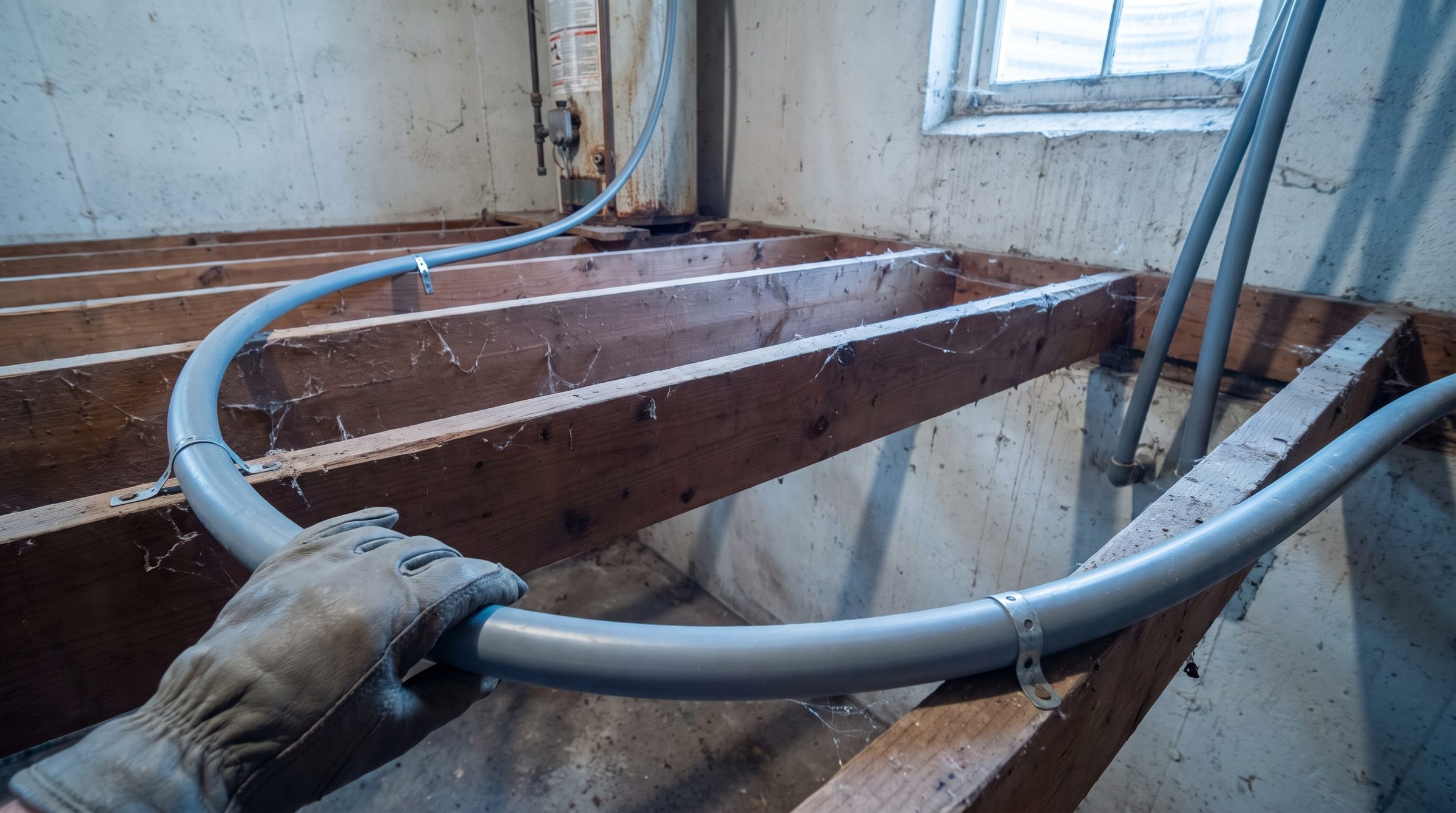
Look at the supply pipe where it enters the house, at the water heater, and under the sinks: flexible grey, sometimes blue or black, half an inch to an inch across, stamped PB2110.
Polybutylene pipe: how to recognise it, and why it cannot be tested
Any deterioration of polybutylene pipes happens from within and cannot be detected without turning off the water and dismantling the pipe. InterNACHI
Updated
Does this apply to you?
Polybutylene is a supply pipe, which means it carries water to the taps rather than away from them. InterNACHI describes it as a plastic manufactured between 1978 and mid-1995 for use as piping in home plumbing systems, inexpensive, and with real advantages over other materials: flexibility, ease of installation, resistance to freezing. It went into up to 10 million homes in the United States during that period. The same page then says production ceased in mid-1996, which is a different date from the one in its first sentence, so both are here rather than averaged into a third.
InterNACHI's account of what ended it is a sentence in the opening paragraph and a sentence further down the same page, and here they are together. Production ceased after scores of allegations surfaced claiming that polybutylene pipes were rupturing and causing property damage, and class-action lawsuits filed against the manufacturers were successful and resulted in payouts to homeowners. Why it ruptures is still argued, and the argument is set out under the table further down, because it decides whether the fittings or the whole run are the thing to worry about.
Here is the part that makes this a condition page rather than a crisis guide, and it is the only sentence on this page you really need. Deterioration happens from within. It cannot be detected without turning off the water and dismantling the pipe, which InterNACHI puts far beyond the standards of practice of home inspection, and it adds that no tests for weaknesses should be performed. So a run that has never leaked and a run that is about to let go look identical from the outside. Thirty quiet years is not evidence. It is just thirty years.
There is no lookup for this and there is nothing to build one from. Nobody records house by house what the supply pipe is made of, and the date range above is when the material was made rather than when your house was built, so the year on the deed settles nothing either. What you have is a fact about your own basement, and the four things below are what it looks like.
What you are looking for, in the order it is easiest to see
- The code PB2110 stamped along the pipe
- InterNACHI: polybutylene pipes are usually stamped with the code PB2110. That is the whole identification, and it is worth being clear about what it is not. The stamp tells you what the pipe is made of. It says nothing at all about what condition that pipe is in, and there is no marking anywhere on it that does.
- Flexible, sometimes curved, half an inch to an inch across
- InterNACHI describes it as flexible and sometimes curved, unlike rigid piping materials such as copper, and half an inch to an inch in diameter. A run that sweeps round a corner instead of turning through an elbow is the giveaway.
- Supply only, never a waste, drain or vent pipe
- InterNACHI is explicit that it was not used for waste, drain or vent piping. So the big plastic pipes going down and out of the house are somebody else's problem. Look at the small ones going to things.
- Grey most of the time, and the colour is a trap
- InterNACHI: most commonly grey, but they can also be white, silver, black or blue, and blue PB is used primarily outdoors and should only be used to carry cold water. Black or white pipes might not be polybutylene at all, and might be polyethylene or PVC respectively. Colour is also somewhat region-dependent: InterNACHI notes that experienced home inspectors in California might never come across grey PB, while it is quite common elsewhere.
None of the four tells you what condition the pipe is in, and that is not a gap in the list. There is no test that does.
How to find out
Every other page in this section sends you off to measure something. This one cannot, and it is the only honest thing to say up front. There are two questions here and only one of them has an answer: what the pipe is made of, which you can usually settle yourself in ten minutes, and how much life it has left, which nobody can settle at any price. The paid step below buys the first answer and does not exist for the second.
What it costs to find out
- A plumber's service call to confirm what the pipe is, first hour of work included
- $50 to $200 HomeGuide
- Inside: at the sinks, the toilets, the basement ceiling and the water heater
- InterNACHI's own interior list, and it is short enough to work through in one go: protruding from walls to feed sinks and toilets, running across the ceiling in unfinished basements, and near the water heater. Anywhere the pipe is already exposed is where this costs you nothing.
- Outside: the basement wall, the meter and the main shut-off
- InterNACHI's exterior list: entering the home through the basement wall, at the water meter, and at the main water shut-off valve. Worth doing even if the inside looked like copper, because the service entry is often the last piece anybody replaced.
- A licensed plumber, if what you are looking at is ambiguous
- InterNACHI: if in doubt, a licensed plumber can be contacted to determine whether or not a pipe is made from PB. That is the whole job, and it is what the service call above buys. Do not accept an inspection that claims to have graded the condition of the pipe, because the same page says no tests for weaknesses should be performed.
Four rules for looking at it
- 01
Check the whole system, not one run
InterNACHI: inspectors should check an entire pipe for PB, not just a portion of it. Some copper piping systems have been found to use PB at junctures, and a common example of that union is where PB pipe links with copper stub outs that feed bathroom fixtures. Copper at the water heater does not mean copper at the far bathroom.
- 02
Treat grey as common rather than conclusive
Colour is somewhat region-dependent, in InterNACHI's words, and its own example is that experienced home inspectors in California might never come across grey PB while it is quite common elsewhere. Grey narrows it down. It does not close the question, and in some places its absence closes nothing either.
- 03
Do not assume black or white flexible pipe is PB
InterNACHI warns that black or white pipes might not be polybutylene, and might be polyethylene or PVC respectively. Its own descriptions of the lookalikes: polyethylene is flexible and black, PVC and CPVC appear white or off-white and can be flexible or rigid, and PEX can be black, blue or red and is more easily coiled and more flexible than PB.
- 04
Look at the fittings as hard as you look at the pipe
The joints are half of the argument about how this material fails, and they are also where a partial repipe shows itself: a copper elbow married to a grey run is somebody's later work. Read the note under the table below before you decide the fittings settle anything.
Placement rules from InterNACHI, Polybutylene for Inspectors.
Reading what you found
There is no number on this one, and unlike the rest of this section there is not even a test to produce one. What you have is a material, and the four rows below are four different situations rather than four degrees of the same one. Which row you are in decides who you need to talk to, not how bad it is, because how bad it is cannot be established from outside the pipe.
| Result | What it is | What to do |
|---|---|---|
| Grey or blue flexible pipe stamped PB2110 | Polybutylene, identified by its own marking. InterNACHI: usually stamped with the code PB2110, flexible and sometimes curved unlike rigid materials such as copper, half an inch to an inch in diameter. Blue PB is used primarily outdoors and should only be used to carry cold water. | The stamp has settled the material and nothing else. There is no regulation requiring replacement, InterNACHI says so plainly, and many plumbers recommend it anyway. That is a decision about risk you cannot measure, so make it on your own terms rather than on a quote that implies somebody has measured it. |
| Partly replaced, with abandoned PB left in the walls | Somebody has done part of the house. The runs that were easy to reach came out and the ones behind sheetrock stayed, and the two are hard to tell apart from a basement. | Establish what is still carrying water, not what is still visible. InterNACHI warns that PB installed behind sheetrock can leak unnoticed for long periods of time and cause mould and water damage, which is the whole hazard of this row. Genuinely disconnected pipe left where it lay asks nothing of you. |
| PB stub-outs on an otherwise copper system | InterNACHI: some copper piping systems have been found to use PB at junctures, and a common example of this union is where PB pipe links with copper stub outs that feed bathroom fixtures. | A copper house is not automatically a PB-free house. Look at the short lengths coming out of the wall at the fixtures, which is the one place this hides in plain sight, and treat the rest of the system as unchecked until you have followed it. |
| Black or white flexible pipe | May be polyethylene or PVC rather than PB. | Confirm before acting. InterNACHI: black or white pipes might not be polybutylene, and might be polyethylene or PVC respectively. This is the row where the service call is worth paying for, because acting on a misidentification here costs thousands and answering it costs a phone call and an hour. |
Bands and thresholds from InterNACHI, Polybutylene for Inspectors.
This is the row where we show our working, because our own source publishes two accounts of how this material fails and does not choose between them. InterNACHI cites two papers published by the University of Illinois at Chicago showing that certain disinfectants can react with the polybutylene and cause it to flake apart at any location within the PB piping system, with small fractures deepening over time and eventually working their way to the pipe's exterior, allowing water to escape. The same page then reports that some manufacturers claim the majority of leaks occur at joints and unions, which is where a leak would likely appear if a pipe were improperly installed. Those are not compatible. One makes it a material that degrades everywhere at once, the other makes it a plumbing job that was done badly. We are not in a position to settle which is right, so both are printed. What neither account changes is the note this whole page rests on: the deterioration is inside the pipe, so whichever mechanism you believe, you cannot see it, and neither can anybody you pay.
Four things that are not yours to sort out
Identifying the material is a torch and ten minutes. Everything in this list is the part that identification cannot reach, and the first row is why the other three exist.
- The failure is inside the pipe or inside the joint, and neither is visible
- The two accounts InterNACHI publishes disagree about which, and agree that it is not on the outside. Leaking, it says, can happen without warning. When one does let go the only thing that matters in the first minute is stopping the water, and that is worth knowing where to do before you need to. What to do when one lets go
- Nobody can tell you how long yours has left
- InterNACHI, in the same note that says home inspectors are not required to record the presence of polybutylene: no tests for weaknesses should be performed, and any deterioration happens from within and cannot be detected without turning off the water and dismantling the pipe. Anyone selling you a condition assessment of a PB system is selling something the standards of practice do not contain.
- A look round the house that finds no leak is not evidence of condition
- It is evidence that nothing is leaking today, which is a different sentence. InterNACHI notes that PB installed behind sheetrock can leak unnoticed for long periods of time and cause mould and water damage, so even an actual leak is not guaranteed to announce itself, let alone the absence of one.
- A partial replacement leaves live PB behind a wall
- This is the instruction to check an entire pipe rather than a portion of it, turned into the thing that goes wrong. A job that replaced the accessible runs and stopped at the sheetrock has left the least visible pipe in the house doing the work, and a paid-invoice-for-a-repipe is not a statement about which runs were in it.
If it is polybutylene and it is coming out
This is the number the reader arrived braced for, and it is down here because identifying the material does not oblige anybody to spend it. InterNACHI is careful about this: no regulations require the replacement of polybutylene piping with other material, many plumbers recommend doing it anyway, and its own phrase for what that costs is several thousand dollars. The rows below are what several thousand dollars turns out to mean.
They all come off one HomeGuide page about plumbing generally, though one row below is priced for this material by name, and they are not alternatives to each other. The size in each label is part of the figure and not decoration: HomeGuide's $3,100 to $5,500 is a 2,000 square foot house and its $2,280 to $4,080 is a 1,500 square foot one. A quote for one bathroom is not a quote for any row here.
- Replacing lead and polybutylene pipe in a 2,000 square foot home
- $2,000 to $15,000 HomeGuide
- Repiping an existing 2,000 square foot house
- $3,100 to $5,500 HomeGuide
- National average for a plumbing installation
- $4,080 HomeGuide
- Full published spread for a plumbing installation, low to high
- $1,500 to $15,000 HomeGuide
- Repiping an existing house, per linear foot of pipe
- $0.40 to $2.00 HomeGuide
- Replumbing a 1,500 square foot house
- $2,280 to $4,080 HomeGuide
- Replacing a single fixture rather than the house
- $450 to $1,800 HomeGuide
- Making good the drywall cut to reach the pipe
- $300 to $1,500 or more HomeGuide
Every figure here is published by the source named beside it. We do not average them into a number of our own.
The checks that have no symptom are the ones people forget
One email a month, seasonal, and this is exactly the kind of thing it carries: the quiet checks that never announce themselves until they are expensive.
When to look again
Polybutylene does not change on a schedule you can watch, which is the whole trouble with it. So these are three moments rather than three intervals, and each one is a point where looking is cheap.
- When you buy
- Before the money moves. InterNACHI notes that home inspectors are not required to record the presence of polybutylene, so an inspection report that does not mention it is not a report that ruled it out. Ask the question specifically, and ask what was actually looked at.
- Whenever a wall is open for another reason
- A bathroom being gutted, a kitchen coming out, a ceiling down after a different leak. It is the one moment a run of PB can be replaced without anything having to be cut to reach it, and it is also the only time anybody gets to see the pipe InterNACHI describes as the one that leaks unnoticed behind sheetrock.
- After any leak anywhere in the system
- Not because one leak predicts the next, which nobody can claim, but because a failure is the one occasion when a plumber has the pipe in their hands and can tell you what the rest of the house is made of. Ask while they are there.
Also asked
- How do I know if I have polybutylene pipe?
- Look at the supply pipes where they are already exposed. InterNACHI: polybutylene is usually stamped with the code PB2110, is flexible and sometimes curved unlike rigid materials such as copper, is half an inch to an inch in diameter, is most commonly grey though it can also be white, silver, black or blue, and was never used for waste, drain or vent piping. Check the whole system rather than one run, because some copper systems use PB at junctures.
- Can polybutylene pipe be tested?
- No, and this is the single most useful thing to know about it. InterNACHI: no tests for weaknesses should be performed, and any deterioration happens from within and cannot be detected without turning off the water and dismantling the pipe, which is far beyond the standards of practice of home inspection. What a plumber can settle is what the pipe is made of, and HomeGuide puts a plumber's service call at $50 to $200, which it says usually covers the first hour of work.
- Is polybutylene pipe a dealbreaker when you are buying a house?
- It is a negotiation rather than a verdict. InterNACHI says no regulations require the replacement of polybutylene piping, while also noting that it can reduce a home's value or prolong its time on the market, and that homeowners might face higher insurance premiums or be denied coverage entirely. The useful move is to price the repipe and ask your insurer, in that order, before the money moves.
- How much does it cost to replace polybutylene pipe?
- InterNACHI's own phrase is several thousand dollars. The one HomeGuide figure priced for this material by name is $2,000 to $15,000 to replace lead and polybutylene pipe in a 2,000 square foot home, which is how HomeGuide bundles the two. Its generic plumbing figures put repiping an existing 2,000 square foot house at $3,100 to $5,500, replumbing a 1,500 square foot one at $2,280 to $4,080, and a national average for a plumbing installation at $4,080, across a full published spread of $1,500 to $15,000. Doing one fixture rather than the house is $450 to $1,800.
- Is PEX the same thing as polybutylene?
- No. InterNACHI lists PEX among the materials not to be confused with PB: it is cross-linked polyethylene, common in radiant-heating systems, can be black, blue or red, and is more easily coiled and more flexible than PB. The confusion runs the other way too, because InterNACHI warns that black or white flexible pipe might be polyethylene or PVC rather than polybutylene.
- Does polybutylene pipe affect home insurance?
- It can. InterNACHI: homeowners might face higher insurance premiums or be denied coverage entirely. That is worth a phone call to your own insurer before you accept anybody's account of what you have to do, because their underwriting standard is a fact you can get in one conversation and the condition of the pipe is not a fact anybody can get at all.