Do this now
Shut the main water valve off now. Not when you have found the leak, not when you have looked at it. Now. Every minute it runs is more of your house that has to be dried, cut out or replaced.
Burst pipe: shut the main off first, and where that valve actually is
Updated
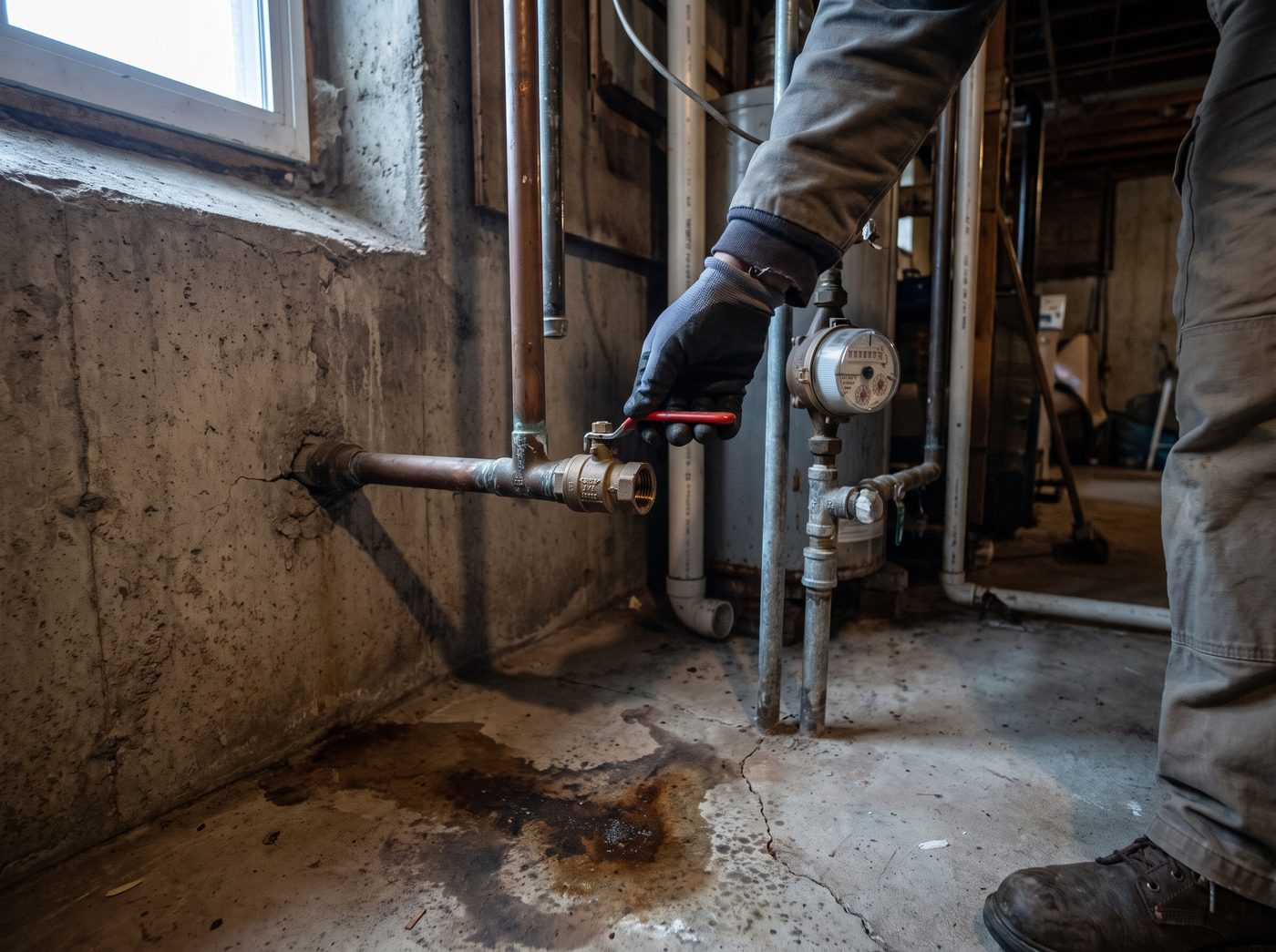
With a burst pipe the sequence matters more than the diagnosis, because the damage is accumulating while you think. Water off at the main, power off if it is anywhere near electrics, taps opened to drain the system, then contain and photograph. The repair itself is a plumber. Your job is the first five minutes.
- 01
Shut the main off
Usually where the supply enters the house: a basement wall, a crawl space, a utility cupboard, or beside the water heater. Outside there is often a second valve at the meter or in a small covered box near the property line. Turn clockwise until it stops.
- 02
Kill the power if water is anywhere near it
Ceiling light fittings, sockets, a panel in the same space. Do it at the panel if you can reach it without standing in water, and call the utility if you cannot.
- 03
Open the taps
Lowest taps in the house first, and flush a toilet. This drains the pipes and takes the pressure off, so the burst stops pushing water even before the last of it runs out. People skip this and wonder why it is still leaking.
- 04
Contain and get the air moving
Buckets, towels, anything porous lifted off the floor. Then fans and a dehumidifier running continuously. Material dried within about two days is often salvageable and material that stays wet past that generally is not.
- 05
Photograph before you clear up
The burst itself, the water at its worst, damaged items, and wide shots showing the extent. Do it before you start moving things. This is the evidence any claim rests on and it cannot be recreated afterwards.
- 06
Call a plumber, and say the water is already off
It changes the urgency and often the price. A live burst is an emergency call out. A contained one with the main shut is a normal job, and you did that in the first two minutes.
What it costs
| Cost | Source | |
|---|---|---|
| Burst pipe repair, per linear foot | $150 to $250 | |
| Pipe repair overall | $400 to $2,000 | |
| Class 1 water damage, minimal | $150 to $500 | |
| Class 2, up to 12 inches standing water | $1,500 to $5,000 | |
| Class 3, through walls and subfloor | $5,000 to $15,000 | |
| Plumber minimum call-out, travel only | $50 to $150 |
Every figure here is published by the source named beside it. We do not average them into a number of our own.
Where to stop
Shutting off, draining and drying are yours. The pipe is not.
- The repair itself
- Soldered joints, push-fit, PEX or old galvanised all behave differently, and a bodged repair under pressure fails behind a wall where you cannot see it.
- Anything near electrics that are still live
- Water tracks along cable runs and into fittings well away from the burst.
- Turning the water back on to check
- Leave it off until it is repaired. Repressurising a damaged system finds the next weak joint, and now you have two.
- Water that has been standing for days, or that reached sewage
- That is remediation rather than drying, and a health matter.
Why it happened
Pipes burst where they are coldest and least used: an outside wall, an unheated crawl space, a garage, a vacation home with the heat turned down. Water expands as it freezes and the ice plug pushes pressure along the pipe until something gives, which is usually not at the ice itself but at a fitting further along. That is why the burst is often nowhere near the cold spot that caused it.
What stops it happening again
Know where the main shutoff is before you need it, and make sure everyone else in the house does. Then insulate the pipes that run through unheated space, and keep the heat on at a minimum when the house is empty in winter. Turning the heating off to save money while away is the single most expensive economy in this guide.
- The part
- Foam pipe insulation, a few dollars a length. A tag on the shutoff valve so nobody has to hunt for it in the dark.
- How often
- Find and label the main shutoff today. Insulate exposed pipes before the first freeze. Never drop the thermostat below about 55 degrees in an empty house in winter.
Want the rest of the house covered?
One email a month, timed to the systems you actually have. The same kind of thing as the tablet: small, cheap, and it stops the call.
Also asked
- Where is my main water shutoff valve?
- Usually where the supply enters: a basement wall, crawl space, utility cupboard or beside the water heater. There is often a second valve outside at the meter. Find it now rather than during a burst.
- Why should I open the taps after shutting the water off?
- It drains the pipes and releases the pressure, so the burst stops pushing water sooner. Start with the lowest taps in the house. Skipping this is why people think the valve did not work.
- How much damage does a burst pipe do?
- It depends almost entirely on how long it ran. HomeGuide puts minimal damage at $150 to $500 and water through walls and subfloor at $5,000 to $15,000. The difference is mostly minutes.
- Should I turn the water back on to see if it is still leaking?
- No. Leave it off until it is repaired. Repressurising a damaged system tends to find the next weak joint, and then you have two failures instead of one.
- Why did the pipe burst away from the frozen bit?
- The ice plug does not split the pipe where it forms. It pushes pressure along until something gives, usually at a fitting, which is often somewhere warmer and well away from the cold spot.