Find out first
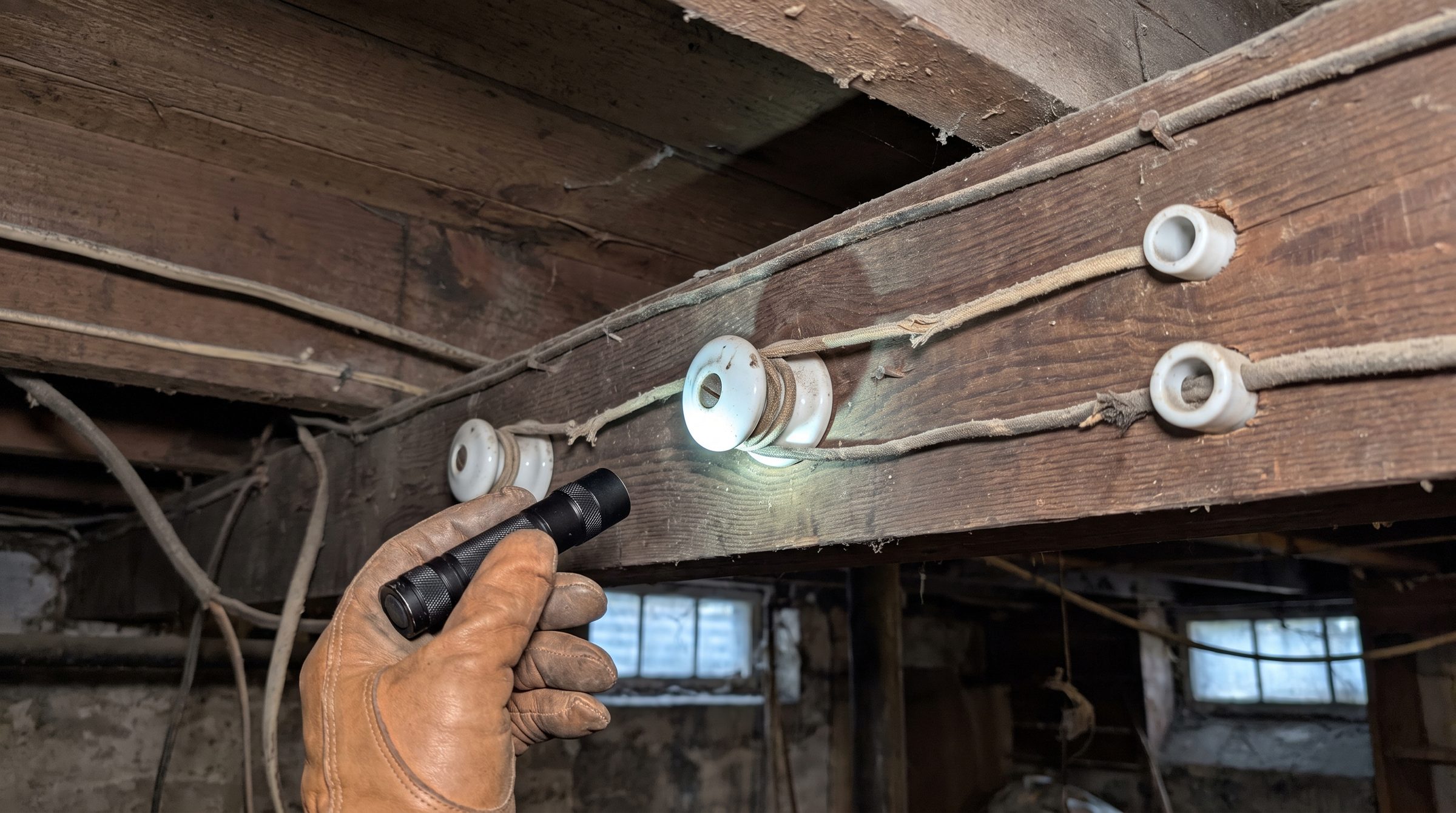
Look at exposed runs in the basement or attic: two separate cloth-covered conductors running apart from each other, through white ceramic tubes where they cross framing, held on ceramic knobs.
Knob and tube wiring: how to recognise it, and whether it has to come out
It is not inherently dangerous. The dangers from this system arise from its age, improper modifications, and situations where building insulation envelops the wires. InterNACHI
Updated
Does this apply to you?
Knob and tube is the wiring method that came before the sheathed cable in your walls now. Two separate conductors, held clear of the timber on ceramic knobs and threaded through ceramic tubes wherever they cross a joist or a stud, run apart from each other rather than together in one jacket. The age of the house is the first filter, and our two sources give different ranges, so both are here with their names on rather than averaged into a third. InterNACHI: most houses constructed prior to World War II were wired using the knob and tube method. HomeGuide: it was used in most homes until the 1950s.
The reason this is a condition page rather than a crisis guide is that nothing is usually happening. InterNACHI is direct about it: knob and tube is not inherently dangerous, and the dangers arise from its age, from improper modifications, and from building insulation enveloping the wires. It is considered obsolete and it is not permitted in any new construction, but there is no code that requires its complete removal, and jurisdictions treat it differently from one another.
There is no lookup for this and there is nothing to build one from. What your house has is a fact about your own basement rather than about your ZIP code, and the four things below are what the house tells you if you go and look.
What you are looking for, in the order it is easiest to see
- White ceramic knobs and ceramic tubes on the framing
- The knobs are small porcelain spools nailed to the side of a joist or stud with the wire seated in the groove. The tubes are the sleeves the wire passes through where it crosses framing. Nothing else in a house looks like them, which is what makes this the quickest check on the page.
- Two conductors running apart from each other, not one cable
- Modern wiring is a single sheathed cable with everything inside it. Knob and tube is two separate wires with a visible gap between them, following the same route but never touching. If you can see daylight between the two, that is the system.
- No third wire, and two-prong outlets throughout
- InterNACHI puts it plainly: it has no ground wire and thus cannot service any three-pronged appliances. A house full of two-slot outlets is not proof on its own, because other old wiring methods are ungrounded too, but it fits.
- Cloth-looking insulation that has gone brittle
- InterNACHI describes knob and tube as more vulnerable to damage than modern wiring because it is insulated with fibre materials and varnish, which can become brittle. Look at it. Do not test it by bending it.
None of the four tells you whether any of it is still live, and that is the question everything below turns on.
How to find out
There are two questions here and they are not equally easy. Whether the house has knob and tube in it is something you can settle yourself in ten minutes with a torch. Whether any of it is still energised is not, and it is the one that decides everything else on this page. The paid step below exists for the second question, and it is the only paid step this page asks for.
What it costs to find out
- An electrical inspection
- $100 to $200 HomeGuide
- Your own basement and attic, first
- This costs nothing and it is where the exposed runs are. InterNACHI describes the system as insulated copper conductors passing through lumber framing drill-holes via protective porcelain insulating tubes, supported along their length by nailed-down porcelain knobs. That is the description to match what you are looking at against.
- Your insurer, before anyone quotes you for a rewire
- InterNACHI: some insurance companies refuse to write fire insurance for houses with this type of wiring, although this may be remedied if an electrician can verify that the system is safe. Asking what your own insurer requires is a phone call, and it is the thing most likely to decide what you actually have to do.
- ASHI, if you want to read the disagreement yourself
- The two trade bodies do not tell the same story about why building insulation over knob and tube is a bad idea, and the note under the table below sets both out. This is the ASHI article that half of it comes from, and it is also where the 15-amp point and the asbestos point come from.
Four rules for looking at it
- 01
Do not touch the conductors, and do not probe them
You are identifying a wiring method, not testing a circuit. The insulation on these wires is the part InterNACHI describes as able to become brittle, so handling it is how an intact run stops being one. Look with a torch and keep your hands off it.
- 02
Establish whether it is energised before anything else
Live or dead is the question that sorts every other question on this page, and it is the one worth paying an electrician to answer. Plenty of houses have knob and tube still sitting on its knobs with nothing connected to it.
- 03
Look specifically at the splices and at anything covering the wires
Two places do most of the arguing. Anywhere knob and tube meets modern cable, and anywhere building insulation has been laid over it. Both are later work rather than original work, and both are in the stop line below.
- 04
Photograph what you find
Wide enough to show the run, close enough to show the knob, the tube and any splice. It is what you show an electrician, an insurer or a surveyor, and it saves everybody the argument about whether it is really knob and tube.
Reading what you found
There is no number on this one. What you have is a state, and the four below are genuinely different situations rather than degrees of the same one. Which row you are in decides whether this page costs you nothing or a great deal.
| Result | What it is | What to do |
|---|---|---|
| De-energised, abandoned in place | Knobs and tubes still on the joists, nothing connected to them. Wiring that was left where it lay when the house was rewired. | Nothing to do. Establishing this is why the live-or-dead question comes first: it turns every row below into somebody else's problem. Being sure it is dead is the hard part, and it is not something to settle by touching it. |
| Energised, original, undisturbed | Live, and as it was installed. This is the state InterNACHI is describing when it says the system is not inherently dangerous and that the dangers come from age, improper modifications and building insulation. | An insurance question rather than a fire question. No code requires its complete removal and no code permits it in new work either, so what happens next is usually decided by your insurer. Ask them for their underwriting standard for a house with live knob and tube. That advice is ASHI's. |
| Spliced into modern cable | Somebody has extended a circuit. InterNACHI lists knob and tube being spliced with modern wiring incorrectly by amateurs among the problems with the system, and puts improper modifications alongside age as the source of the danger. | A real defect. Have it evaluated. This is the row where the age of the system stops being the point and somebody's later work becomes it. |
| Buried in blown-in or rolled insulation | Building insulation lying over the conductors. The NEC rule InterNACHI quotes says this wiring is not permitted in hollow spaces of walls, ceilings and attics where such spaces are insulated by loose, rolled or foamed-in-place insulating material that envelops the conductors. | The NEC case, and the one the two trade bodies explain differently. Read the note under this table before you accept anybody's account of why it matters, including a quote built on it. |
Bands and thresholds from InterNACHI, Knob-and-Tube Wiring.
This is the row where we show our working, because the two bodies we are citing do not agree. InterNACHI says knob and tube is designed to dissipate heat into free air, that insulation around it causes heat to build up, and that this creates a fire hazard. ASHI says covering knob and tube with thermal insulation is a bad idea but not necessarily for the reason many of us believe, and that under normal operating conditions knob and tube covered by thermal insulation should not overheat more than any other wiring method. ASHI gives different reasons for the same advice: insulation-covered knob and tube may be damaged by attic traffic, and carelessly installed insulation may push the wires too close to framing and other surfaces. Same conclusion, incompatible mechanisms, and we are not in a position to settle it, so both are printed here. What is not in dispute is the advice: do not bury it. One jurisdiction allows it on conditions, and the conditions are the point. InterNACHI notes the California Electrical Code allows insulation to be in contact with knob and tube provided certain conditions are met, among them that a licensed electrical contractor must certify that the system is safe, that the certification is filed with the local building department, that accessible areas where insulation covers the wiring carry a warning sign, and that the insulation is non-combustible and non-conductive. That is a narrow carve-out with paperwork attached, not general permission.
Five things that are not yours to sort out
Almost everything above is a look with a torch. These are not. The first two are the difference between a system InterNACHI calls not inherently dangerous and one that has been made dangerous by later work.
- Building insulation lying over the conductors
- InterNACHI quotes the NEC rule that this wiring is not permitted in hollow spaces of walls, ceilings and attics where such spaces are insulated by loose, rolled or foamed-in-place insulating material that envelops the conductors. Removing insulation from around live wiring is not a job to do on a Saturday to make the problem go away.
- Anywhere it has been spliced into modern cable
- InterNACHI: knob and tube is often spliced with modern wiring incorrectly by amateurs, partly because it is so easy to get at. Improper modification sits in the same sentence as age in the thesis at the top of this page, and this is what it looks like in a basement.
- There is no ground wire, so nothing three-pronged is properly served
- InterNACHI: it has no ground wire and thus cannot service any three-pronged appliances. That is a fact about the whole system rather than a fault in one outlet, which is why it is here rather than in a list of things to fix.
- It is a 15 amp circuit, and it may have more connected to it than is safe
- ASHI, plainly: it is a 15-amp circuit and may have more lights and receptacles connected to it than is safe. If a breaker or fuse on one of these circuits keeps going, that is the circuit reporting the problem rather than being awkward. When the breaker keeps going
- The conductor insulation is a potential asbestos containing material
- ASHI lists it among the reasons knob and tube is at the end of its service life, and the material in question is the insulation on the wires themselves. It is the plainest argument on this page for leaving it alone rather than tidying it up yourself.
If it is live, modified, and going
This is the number the reader arrived frightened of, and it is down here because most people who read this page do not need it. A rewire is what it costs when the answer is that the system is live and has been worked on. Everything above is what decides whether that is your house.
The whole-house figures and the per square foot figures come off the same HomeGuide page and are not alternatives to each other. Which one describes your job depends on how much of the house is being done, and a quote covering one room is not a quote for the third row down.
- Replacing knob and tube wiring
- $12,000 to $35,000 HomeGuide
- Replacing knob and tube, per square foot
- $8 to $17 HomeGuide
- Rewiring generally, per square foot
- $5 to $17 HomeGuide
- Replacing the electrical panel
- $850 to $2,500 HomeGuide
- Upgrading a 100 amp panel to 200 amp
- $1,400 to $2,800 HomeGuide
- Grounding one outlet in a house with no ground wire
- $100 to $300 HomeGuide
- Adding a new circuit and breaker
- $150 to $300 HomeGuide
Every figure here is published by the source named beside it. We do not average them into a number of our own.
The checks that have no symptom are the ones people forget
One email a month, seasonal, and this is exactly the kind of thing it carries: the quiet checks that never announce themselves until they are expensive.
When to look again
Knob and tube does not change on a schedule. What changes is what has been done to it and around it, so these are events rather than intervals.
- When you buy
- Before the money moves, while there is still a negotiation. Ask what the system is, whether it is live, and what your insurer requires, in that order.
- After any attic insulation work
- The single event most likely to create the violation. Insulation goes in over a weekend and it goes in over everything, including the conductors the NEC rule InterNACHI quotes says it must not envelop. Go and look afterwards, whoever did it.
- When an insurer asks
- InterNACHI notes some insurance companies refuse to write fire insurance for houses with this wiring, although this may be remedied if an electrician can verify that the system is safe. That sentence is worth having in front of you before the conversation.
- After any electrical work done by a previous owner
- Improper modification is half of the danger InterNACHI describes, and a previous owner's new circuit is exactly where it lives. Look at where the old work meets the new.
Also asked
- Is knob and tube wiring dangerous?
- InterNACHI says it is not inherently dangerous, and that the dangers from the system arise from its age, improper modifications, and situations where building insulation envelops the wires. So the useful question is not whether you have it, but whether it has been modified or buried.
- Does knob and tube wiring have to be replaced?
- Not as a rule. InterNACHI: while it is considered obsolete, there is no code that requires its complete removal, and it is treated differently in different jurisdictions. It is not permitted in any new construction, which is a different question from whether existing wiring has to come out.
- Will my insurer refuse to cover a house with knob and tube wiring?
- Some will. InterNACHI: some insurance companies refuse to write fire insurance for houses with this type of wiring, although this may be remedied if an electrician can verify that the system is safe. Ask your own insurer what their standard is before you accept that a rewire is unavoidable.
- Can I insulate my attic if I have knob and tube wiring?
- The NEC rule InterNACHI quotes says this wiring is not permitted in hollow spaces of walls, ceilings and attics insulated by loose, rolled or foamed-in-place material that envelops the conductors. InterNACHI and ASHI give different explanations of why that matters and the same advice not to do it. California allows insulation contact on conditions, one of which is that a licensed electrical contractor must certify that the system is safe.
- How much does it cost to replace knob and tube wiring?
- HomeGuide puts replacing knob and tube at $12,000 to $35,000, or $8 to $17 per square foot. Replacing the electrical panel is a separate $850 to $2,500, and upgrading a 100 amp panel to 200 amp is $1,400 to $2,800.
- How do I know if my knob and tube wiring is still live?
- Not by touching it. Plenty of houses have knob and tube left in place with nothing connected to it, and telling the two apart is what an electrical inspection is for, at $100 to $200 per HomeGuide. Dead wiring left where it lay is the one state on this page that asks nothing of you.