Do this now
If the breaker trips again immediately after a reset, leave it off. Do not keep resetting it. It is the only thing standing between a fault and a fire, and each reset asks it to hold that fault a little longer.
Breaker keeps tripping: it is reporting a fault, not being fussy
Updated
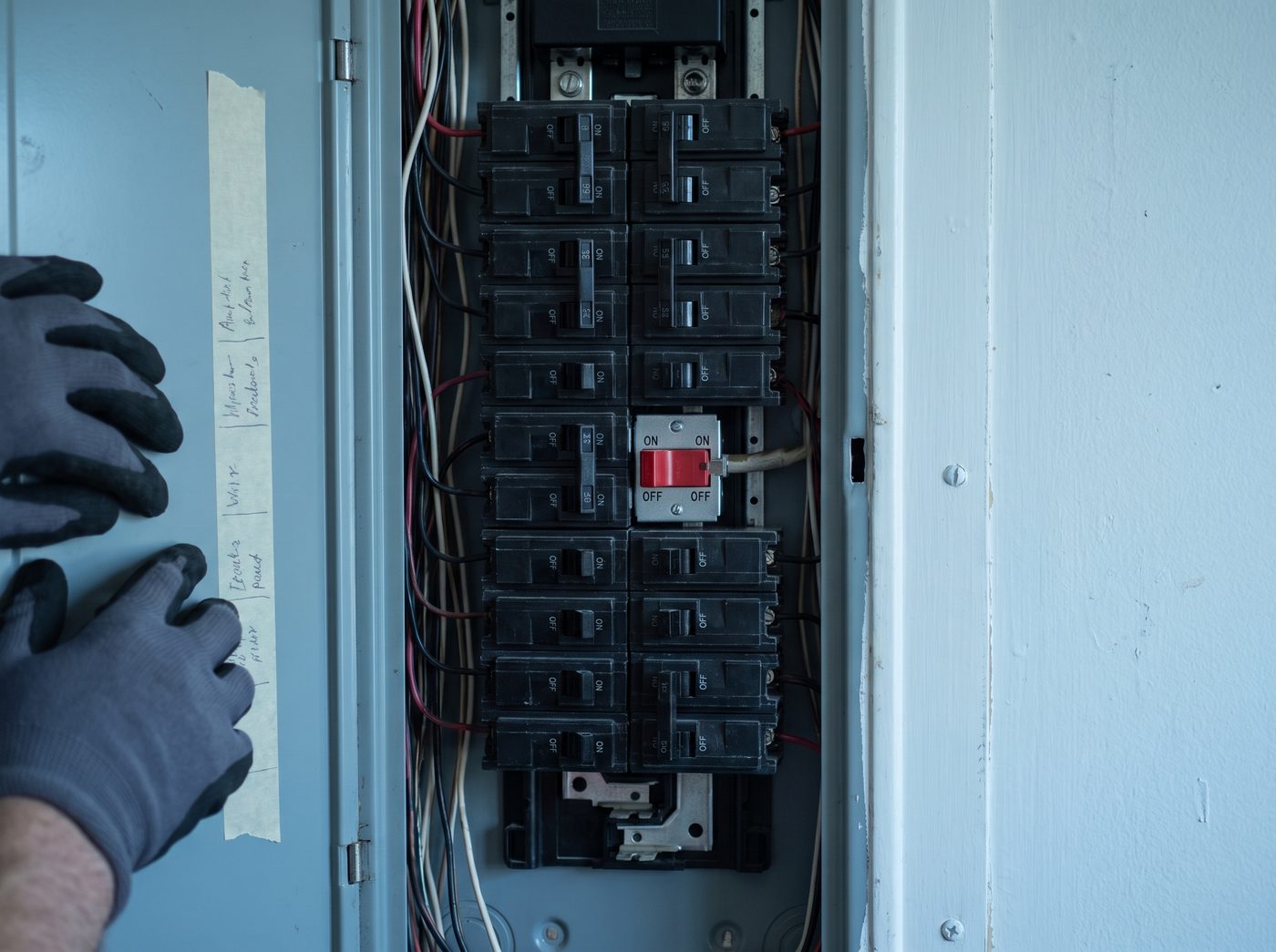
A breaker trips for one of three reasons and they need different responses. An overload, which is too much drawing on one circuit and is often fixable by moving an appliance. A short circuit, where live touches neutral and the trip is instant and violent. Or a ground fault, which is what GFCI outlets and breakers detect. You can narrow it down safely. Fixing the last two is not homeowner work.
- 01
Find out which circuit it is
Read the label strip if there is one, then walk the house and note what is dead. The pattern of dead outlets tells you more about the circuit than the label usually does, and labels are frequently wrong.
- 02
Unplug everything on that circuit
Everything, including things that are switched off but still plugged in. Then reset the breaker. If it holds with nothing plugged in, you have an overload or a faulty appliance rather than a fault in the wiring.
- 03
Add things back one at a time
Plug in one item, wait, then the next. The one that trips it is the culprit. This is slow and it is the single most useful thing you can do, because it separates "a faulty toaster" from "a fault in the wall" for nothing.
- 04
Count the load if it holds until several things run
A space heater, a kettle and a microwave on one 15 amp circuit is an overload, not a fault. Moving one of them to a different circuit solves it. Heaters and anything with a motor are the usual offenders.
- 05
Check for GFCI outlets before assuming the breaker
Bathrooms, kitchens, garages and outdoors. One GFCI outlet often protects several downstream, so a dead bathroom can be a tripped GFCI in the garage. Press reset on every one you can find.
- 06
Stop if it trips with nothing connected
A breaker that will not hold with the whole circuit unplugged means the fault is in the wiring, a device box, or the breaker itself. That is where this guide ends and an electrician starts.
Burning smell, scorch marks, a warm faceplate, or a breaker that is hot to touch: leave it off and call someone today, not at the weekend.
Where to stop
Unplugging things and resetting once is homeowner work. Opening anything is not.
- Removing the panel cover
- The main lugs stay live even with the main breaker off. This is the part of a house that kills electricians who know what they are doing.
- A breaker that trips with the circuit unplugged
- The fault is in fixed wiring or a device box. Nothing you can reach from the front of an outlet will resolve it.
- Anything warm, scorched or smelling of burning
- Heat means resistance where there should be none, and that is how fires start. Leave the breaker off.
- Replacing a breaker with a larger one
- The breaker is sized to protect the wire, not the appliance. A bigger one lets the wire overheat instead of tripping, which is the actual danger and it is invisible.
Why it happened
A breaker is a deliberately weak link. It is sized to give way before the wire behind the wall gets hot enough to be dangerous, which means a tripping breaker is a component performing exactly as designed. The instinct to reset it repeatedly is understandable and it is precisely backwards: the nuisance is the safety feature.
What stops it happening again
Spread high-draw appliances across circuits rather than clustering them on the one convenient wall. Space heaters are the usual cause of winter trips and they want a circuit to themselves. And label the panel properly once, which costs an afternoon and saves every future occupant an hour.
- The part
- Nothing. If you find yourself wanting more outlets on a circuit rather than fewer things on it, that is the conversation to have with an electrician.
- How often
- Label the panel once, properly. Test GFCI outlets monthly with their own test button. Rethink the load whenever you add a heater or an appliance.
Want the rest of the house covered?
One email a month, timed to the systems you actually have. The same kind of thing as the tablet: small, cheap, and it stops the call.
Also asked
- Is it safe to keep resetting a breaker?
- Once is fine. Repeatedly is not. A breaker that trips again immediately is reporting a fault, and resetting it asks it to hold that fault for longer each time.
- How do I tell an overload from a real fault?
- Unplug everything on the circuit and reset. If it holds, it is an overload or a faulty appliance, and adding things back one at a time will find it. If it trips with nothing plugged in, the fault is in the wiring.
- Why is my bathroom dead but no breaker is tripped?
- Look for a tripped GFCI outlet, possibly in another room. One GFCI often protects several outlets downstream, so the dead room and the tripped device can be well apart.
- Can I fit a bigger breaker to stop it tripping?
- No, and this is the dangerous version of the mistake. The breaker protects the wire, not the appliance. A larger one lets the wire overheat inside the wall instead of tripping.
- The breaker feels warm. Does that matter?
- Yes. Warmth means resistance where there should be none. Leave it off and get an electrician out promptly rather than at the weekend.