Do this now
Open the door and pull the rubber seal back towards you, all the way round. What is in that fold is the smell. You do not need a product to find out, and most people have never looked there.
Washing machine smells: the fold in the door seal is where it lives
Updated
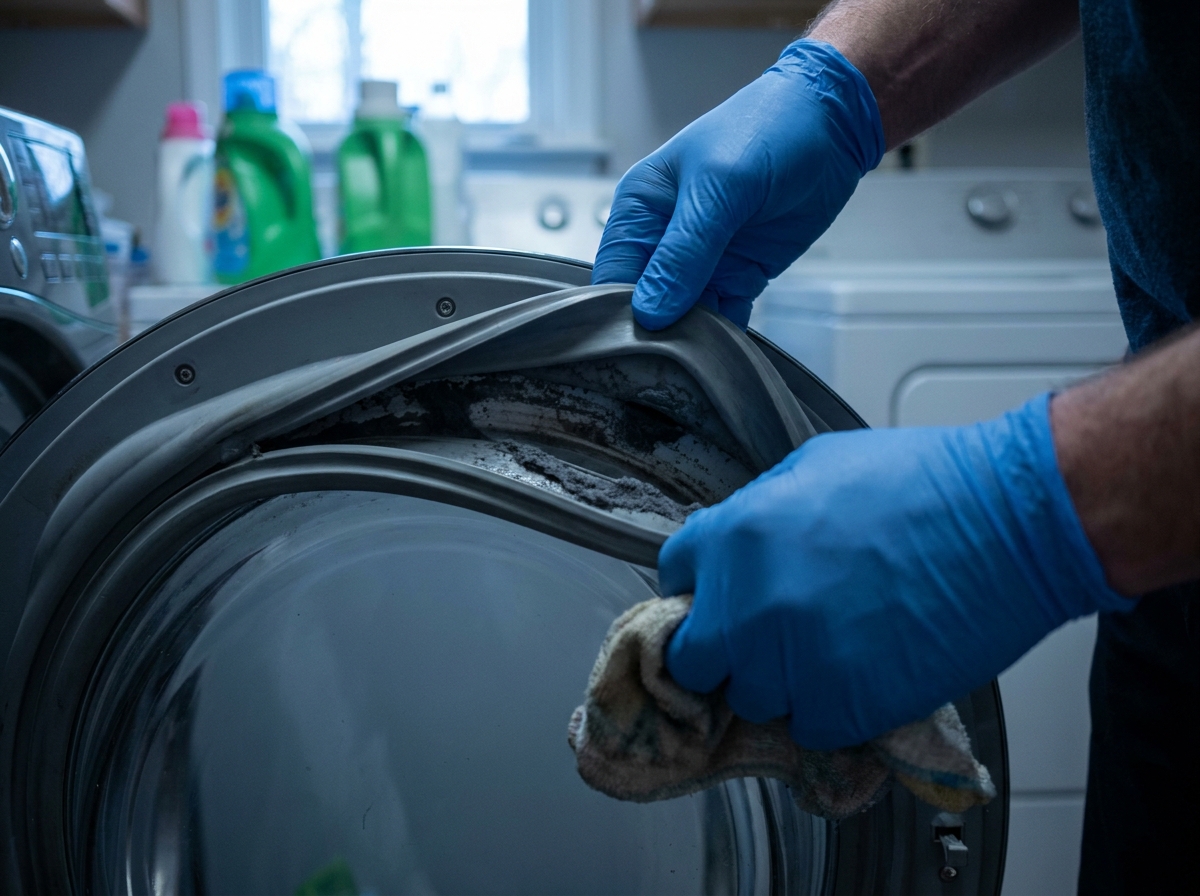
A front-loading washing machine smells because it is a warm, damp, sealed box that never fully dries, and because modern detergents work at low temperatures that do not kill what grows. The smell has three homes: the fold in the rubber door gasket, the detergent drawer, and the drain pump filter behind the panel at the bottom. Cleaning all three and then leaving the door open between washes fixes almost every case. Replacing the machine fixes it too, at several hundred times the cost.
- 01
Clean the door seal fold
Peel the rubber lip back and work all the way round. Expect grey slime, hair, and small items. Wipe it out with hot soapy water or a diluted bleach solution, then dry it. This is the single biggest source and it is the one people never reach.
Do not mix bleach with any other cleaning product. Chlorine and ammonia together produce a gas that will put you in hospital.
- 02
Pull out the detergent drawer completely
It comes out fully, usually with a catch in the middle of the tray. The underside and the recess it sits in hold a soft build-up of undissolved detergent and fabric softener. Both feed the smell. Scrub the drawer, and reach into the housing with a brush.
- 03
Empty the drain pump filter
Behind the small hatch at the bottom front. Put a shallow tray and a towel down first, because there is standing water behind it. Unscrew the cap, let it drain, and clear whatever is in the trap. Coins, buttons and hair are normal, and so is the smell that comes out with it.
- 04
Run a maintenance wash, hot and empty
The hottest cycle the machine has, with nothing in it. Use a proper machine cleaner, or plain white vinegar in the drum with baking soda in the drawer. What matters is the temperature: the low-temperature washes that are kind to clothes are also kind to what is growing.
- 05
Check the drain hose height if it still smells of drains
A sewer smell rather than a mildew smell is a different fault. The drain hose needs a high loop so waste water cannot siphon back, and a standpipe needs a trap. If the smell is sewage rather than damp, look there.
- 06
Leave the door and the drawer open from now on
This is the whole prevention and it costs nothing. A machine that dries between washes does not grow anything. Every other step on this page is undoing the consequence of a closed door.
What it costs
| Cost | Source | |
|---|---|---|
| Machine cleaner or white vinegar | a few dollars | |
| Door gasket replacement, fitted | $275 to $600 | |
| Drain hose replacement | $100 to $200 | |
| Drain pump replacement | $150 to $350 | |
| Washing machine repair, typical | $100 to $400 | |
| Appliance repair, per hour | $50 to $125 |
Every figure here is published by the source named beside it. We do not average them into a number of our own.
Where to stop
Cleaning the seal, the drawer and the filter is homeowner work, and it fixes most of these. These are not.
- The rubber seal is split, perished or pulling away
- A damaged gasket leaks onto the floor and behind the machine, and fitting one is a proper repair rather than a clean.
- Black staining that returns within days of a thorough clean
- That usually means growth behind the drum where nothing you can reach will get to it, and it is a judgement call about repair against replacement.
- Water on the floor as well as a smell
- A leak plus a smell is a seal or a hose, not hygiene, and the floor is what gets expensive.
- A sewer smell you cannot trace to the hose
- That is a plumbing fault at the standpipe or the trap rather than anything inside the machine.
Why it happened
Front loaders use a fraction of the water top loaders did, and a rubber boot to seal a door that faces sideways. Less water means less rinsing, the boot means a fold that holds what does not rinse away, and a closed door after a warm wash means it never dries. Add a low-temperature detergent and fabric softener, which is largely a fat, and you have built a small ecosystem. It is a design trade-off rather than a defect, which is why every brand has the same complaint against it.
What stops it happening again
Leave the door ajar and the drawer open between washes, and wipe the seal dry when you take the laundry out. That is it. If you want a second habit, run one hot maintenance wash a month and use slightly less detergent than the label says, because most people use too much and the excess is what feeds it.
- The part
- A packet of machine cleaner, or a bottle of plain white vinegar. Both are a few dollars and either works. The expensive version of skipping this is a $275 to $600 gasket.
- How often
- Wipe the seal after each load. Hot maintenance wash monthly. Clear the drain pump filter every few months, and pull the seal back to inspect behind it each time.
Want the rest of the house covered?
One email a month, timed to the systems you actually have. The same kind of thing as the tablet: small, cheap, and it stops the call.
Also asked
- Why does my washing machine smell like mildew?
- Damp that never dries, feeding on detergent and fabric softener residue. It collects in the fold of the door seal, the detergent drawer and the drain pump filter, in roughly that order.
- Does vinegar actually clean a washing machine?
- For a maintenance wash, yes, and it is a few dollars. What matters more than the product is running it hot and empty, because low-temperature cycles do not kill what is growing.
- Why does my washing machine smell even though I clean it?
- Almost always because the door seal fold and the drain pump filter have not been reached. A cycle with cleaner in it does not touch either. Both need a hand.
- How much does it cost to replace a washing machine door seal?
- HomeGuide puts a front-loader gasket replacement at $275 to $600 fitted, depending on brand. It is worth trying a proper clean first, because the seal is usually dirty rather than failed.
- Should I leave the washing machine door open?
- Yes, and the detergent drawer too. It is the whole prevention. The only reason not to is a household where a small child or a pet might climb in.