Do this now
Take the tank lid off and put it flat on the floor, not balanced on the seat. They are heavy porcelain and they break, and a cracked lid costs more than everything else on this page put together.
Toilet keeps running: it is the flapper, and the part is under $30
Updated
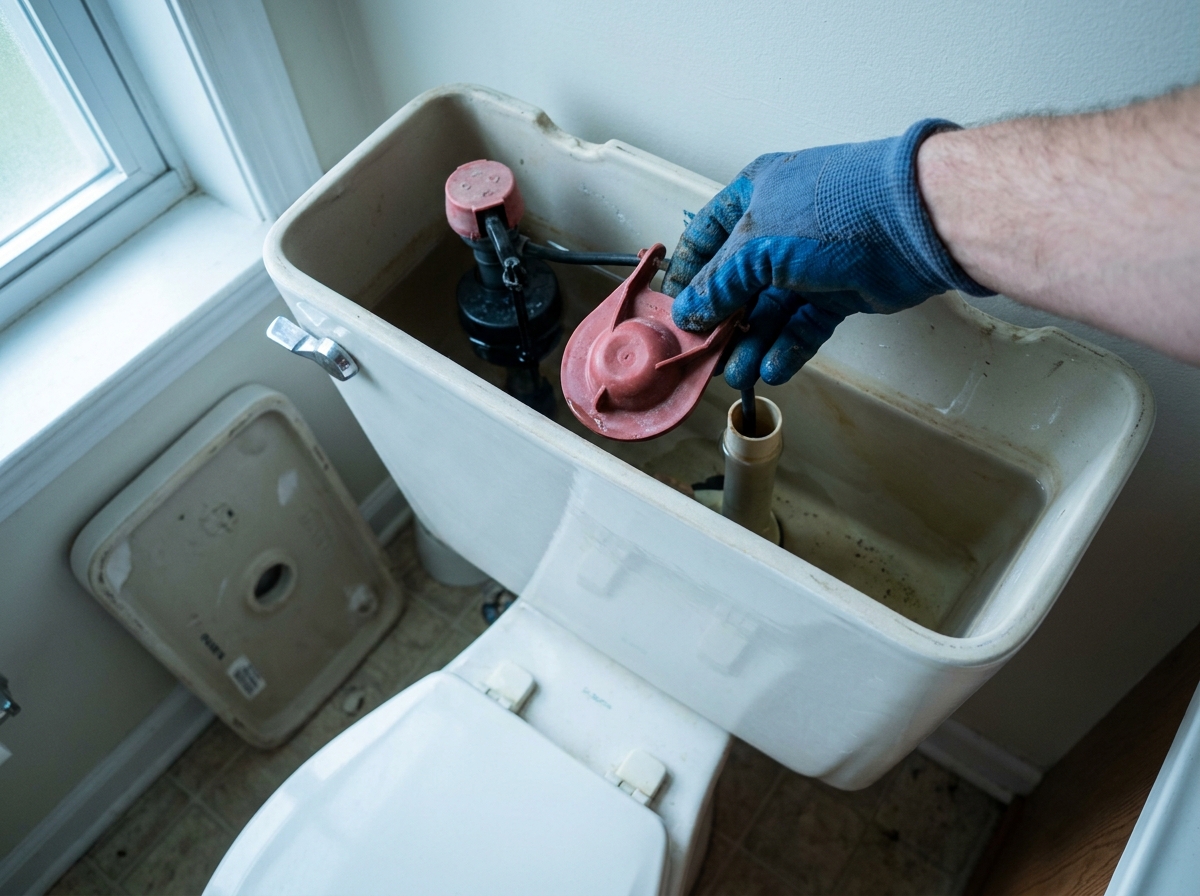
A toilet that never stops running, or that refills itself in bursts when nobody has touched it, is losing water from the tank into the bowl. Nine times out of ten that is the flapper: a rubber seal that hardens and stops sealing. The rest is usually the fill valve set too high, so water runs into the overflow tube continuously. Both are parts under thirty dollars and both are a five minute job.
- 01
Put dye in the tank and wait
A few drops of food colouring in the tank, then leave it twenty minutes without flushing. If colour appears in the bowl, the flapper is leaking. This one test separates the two causes and it costs nothing.
- 02
Look at where the water level sits
It should sit about an inch below the top of the overflow tube. If water is trickling into that tube, the fill valve is set too high and the toilet will run forever trying to reach a level it can never hold. There is an adjustment screw or clip on the valve.
- 03
Feel the flapper
Turn off the supply, flush to empty the tank, and run a finger round the flapper seat. A good flapper is soft and springy. A failed one is hard, slick, or leaves black residue on your finger. The seat it sits on should be smooth: mineral build-up there will defeat a brand new flapper.
- 04
Check the chain
Too tight and it holds the flapper fractionally open, which produces exactly this symptom with a perfectly good flapper. There should be a little slack, about half an inch. Too loose and it tangles under the flapper instead.
- 05
Swap the flapper
Unclip the old one, take it to the shop, match it. They are not universal despite the packaging, and a near-match is what sends people back a second time. Clean the seat with a cloth while the tank is empty.
- 06
If it still runs, replace the fill valve
Whole fill valves are inexpensive and fit most toilets. It is one nut under the tank and the supply line. If you are already in there and the toilet is old, doing both at once is the sensible order rather than two separate afternoons.
What it costs
| Cost | Source | |
|---|---|---|
| Flapper, part only | $12 to $30 | |
| Fill, shut-off and flush valves, part only | $12 to $60 | |
| Doing it yourself | $50 to $200 | |
| Plumber, professional repair | $130 to $300 | |
| Plumber fitting a new flapper and chain | about $130 | |
| Toilet valve replacement, fitted | $70 to $150 | |
| Plumber minimum call-out | $50 to $200 |
Every figure here is published by the source named beside it. We do not average them into a number of our own.
Where to stop
Everything inside the tank is homeowner work and it is genuinely easy. These are not.
- Water on the floor around the base
- That is the wax seal or the tank bolts rather than anything in the tank, and the subfloor is what pays for it being ignored.
- The shut-off valve under the toilet will not turn or weeps once moved
- Old valves seize and then leak after being disturbed. Replacing one means working on the supply line.
- The toilet rocks when you sit on it
- A moving toilet breaks its own seal repeatedly. That is a reseat, not a tank part.
- Cracked porcelain anywhere on the tank or bowl
- A hairline crack becomes a split without warning, and the failure mode is the entire tank of water on the floor at once.
Why it happened
The flapper is a rubber part sitting in standing water, and rubber in water with chlorine in it hardens over a few years until it no longer conforms to its seat. In-tank cleaning tablets accelerate this considerably, which is why the toilet people clean most thoroughly is often the one that runs first. Nothing has broken; a consumable has finished.
What stops it happening again
Stop putting cleaning tablets in the tank. They sit against the flapper and the valve seals for months at a time and they are the single biggest reason those parts fail early. Clean the bowl instead, where the cleaner does the job you actually want.
- The part
- A spare flapper in the cupboard, twelve to thirty dollars. A running toilet wastes a startling amount of water and it is always noticed on a weekend.
- How often
- Dye test once a year, on the same day you do the other annual jobs. Expect a flapper to last a few years, less in hard water.
Want the rest of the house covered?
One email a month, timed to the systems you actually have. The same kind of thing as the tablet: small, cheap, and it stops the call.
Also asked
- Why does my toilet keep running after flushing?
- Water is escaping from the tank into the bowl, almost always past a hardened flapper. Put food colouring in the tank and wait twenty minutes: colour in the bowl confirms it.
- Why does my toilet refill by itself every few minutes?
- Same cause, slower leak. The tank drains gradually past the flapper until the fill valve notices and tops it up. It is called ghost flushing and it is the clearest sign of a failing flapper.
- How much does it cost to fix a running toilet?
- The flapper is $12 to $30 for the part. HomeGuide puts a professional repair at $130 to $300, most of which is the call-out rather than the work.
- Do toilet tablets damage the flapper?
- In-tank tablets sit against the rubber for months and shorten its life noticeably. Clean the bowl instead of the tank.
- I replaced the flapper and it still runs. What now?
- Check the chain has a little slack, and look at whether water is trickling into the overflow tube. If it is, the fill valve is set too high or has failed, and that is the next part.