Do this now
If water is already rising and there is any chance it will reach an outlet, an appliance or the furnace, shut that circuit off at the breaker before you go near the pit. Then read on. A basement with water in it is an electrical problem first and a water problem second.
Sump pump not working: what to check before the water gets to anything
Updated
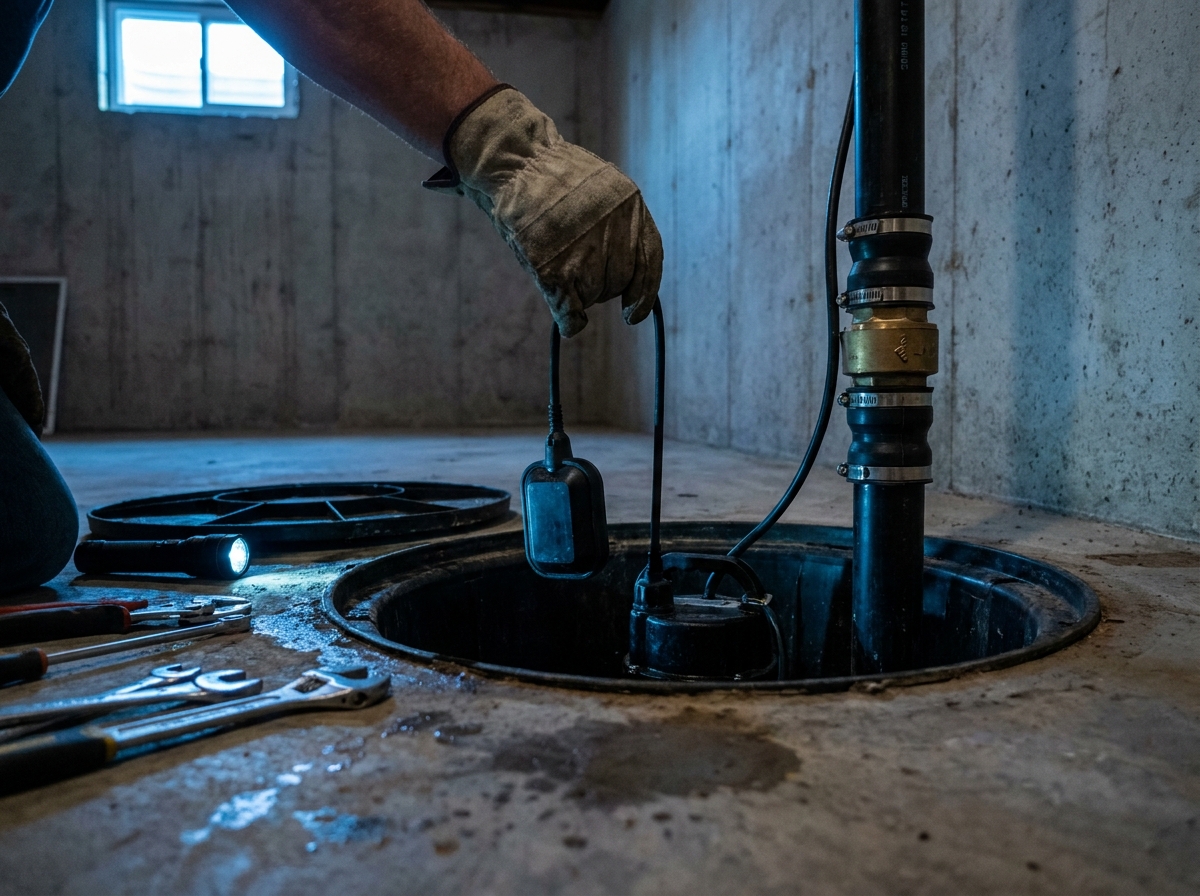
Most sump pump failures on the day are not the pump. They are the float switch stuck against the side of the pit, a check valve that has failed, a tripped breaker or GFCI, or a discharge line frozen or blocked at the outside end. All four are checkable in a few minutes and two of them are parts under forty dollars. A pump that hums but does not move water, or one that cycles every few seconds, is telling you which of these it is.
- 01
Check it has power at all
Follow the cord. Sump pumps are usually on a dedicated circuit and very often plugged into a GFCI, which is exactly the kind of outlet that trips quietly and stays tripped. Press reset on the outlet and check the breaker. If the pump has a piggyback plug, the pump plug sits into the back of the float plug: make sure both are seated.
Do not stand in water while you do this. If the floor is already wet, kill the circuit at the panel first and work from there.
- 02
Lift the float by hand
Reach in and raise the float. If the pump kicks in, the pump is fine and the float is the fault: it is either jammed against the side of the pit, tangled on the cord, or worn out. A pit that is too narrow, or a pump that has walked sideways over the years, is the usual reason.
- 03
Look for the pump humming without moving water
A hum with no flow is usually a jammed impeller or a seized motor. Unplug it, lift it out, and look at the intake screen at the base. Gravel, silt and the occasional piece of the pit lid are what you find. Clearing it takes minutes.
- 04
Check the discharge line at the outside end
Walk outside and find where the pipe exits. In winter it freezes; in any season it fills with leaves, soil or a nest. A blocked discharge makes a working pump look broken, because the water it lifts comes straight back down. Many lines have a small weep hole for this reason. Make sure it is clear.
- 05
Watch the check valve if it cycles every few seconds
Short cycling, where the pump runs, stops, then runs again immediately, usually means the check valve has failed and the water in the pipe is falling back into the pit to be pumped again. You can often hear the clunk. The valve is a part you can replace, and it is the cheapest thing on this page.
- 06
Test it properly once it is running
Pour a bucket of water into the pit and watch a full cycle: it should start, clear the pit, and stop cleanly without cycling again. That is the same test worth doing every spring, before the season that will actually ask something of it.
What it costs
| Cost | Source | |
|---|---|---|
| Check valve, part only | $15 to $30 | |
| Float switch, materials only | $35 to $70 | |
| Replacing the pump itself | $400 to $700 | |
| Sump pump repair and maintenance | $200 to $870 | |
| New pump and install | $600 to $2,500 | |
| Battery backup pump, unit only | $150 to $800 | |
| Plumber, per hour | $45 to $80 |
Every figure here is published by the source named beside it. We do not average them into a number of our own.
Where to stop
Swapping a float switch or a check valve, and clearing the pit or the discharge, is homeowner work. These are not.
- Standing water anywhere near outlets, the furnace or the panel
- Water and electricity in the same room is the one failure on this site that hurts people rather than budgets. Kill the circuit from a dry spot and call someone.
- The pit needs digging, deepening or moving
- That is concrete work and drainage design, not a pump swap, and getting the depth or the basin size wrong is how a new pump fails early.
- The pump has no dedicated circuit, or you are adding one
- New circuit work is an electrician and usually a permit. It is also the right fix, because a sump pump sharing a circuit is a sump pump waiting for something else to trip it.
- Water is coming in faster than any pump clears it
- The pump is not the problem then. That is a drainage or grading issue, and a bigger pump only buys you a slightly slower flood.
Why it happened
A sump pump spends almost all of its life doing nothing, which is why it fails at the exact moment it is asked to work. Floats stick because the pit is tight or the cord has wrapped. Check valves wear because every cycle slams them shut. Discharge lines block because they end outside where leaves and frost are. The motor itself usually outlasts all three, so the day it will not run, the odds are against the expensive part being the problem.
What stops it happening again
Pour a bucket of water into the pit every spring and watch a full cycle. That single habit finds a stuck float, a dead motor and a failed check valve months before the storm does, and it takes two minutes. Clear the outside end of the discharge line at the same time.
- The part
- A spare check valve on the shelf, at $15 to $30, and a battery backup pump if the basement is finished. The backup is the only part on this site that protects against the power cut and the storm arriving together, which is when they arrive.
- How often
- Bucket test every spring, and again in autumn if you get freeze-thaw. Clear the discharge outlet twice a year. Expect a working life of about ten years.
Want the rest of the house covered?
One email a month, timed to the systems you actually have. The same kind of thing as the tablet: small, cheap, and it stops the call.
Also asked
- Why is my sump pump running constantly?
- Either the float is stuck in the up position, or the check valve has failed and the water it lifts is falling straight back into the pit. Listen for a clunk after each cycle: that is the valve.
- My sump pump hums but no water moves. What is wrong?
- Usually a jammed impeller. Unplug it, lift it out and clear the intake screen at the base. If it still hums with a clear intake, the motor has seized.
- How much does it cost to replace a sump pump?
- Replacing an existing pump runs $400 to $700 according to HomeGuide, because there is no digging or electrical work involved. A new installation, including the basin, is $600 to $2,500.
- How long does a sump pump last?
- About ten years is the usual expectation, less if it runs frequently. The float switch and the check valve normally fail well before the motor does.
- Do I need a battery backup sump pump?
- If the basement is finished, or if losing it would flood something expensive, yes. Storms take the power out and fill the pit in the same hour, and a mains pump does nothing without mains.