Do this now
Pull the fridge out and look at the coils at the back or underneath. If they are furred with dust and pet hair, that is very likely your whole problem and it costs nothing.
Fridge not cooling: clean the coils before you call anyone
Updated
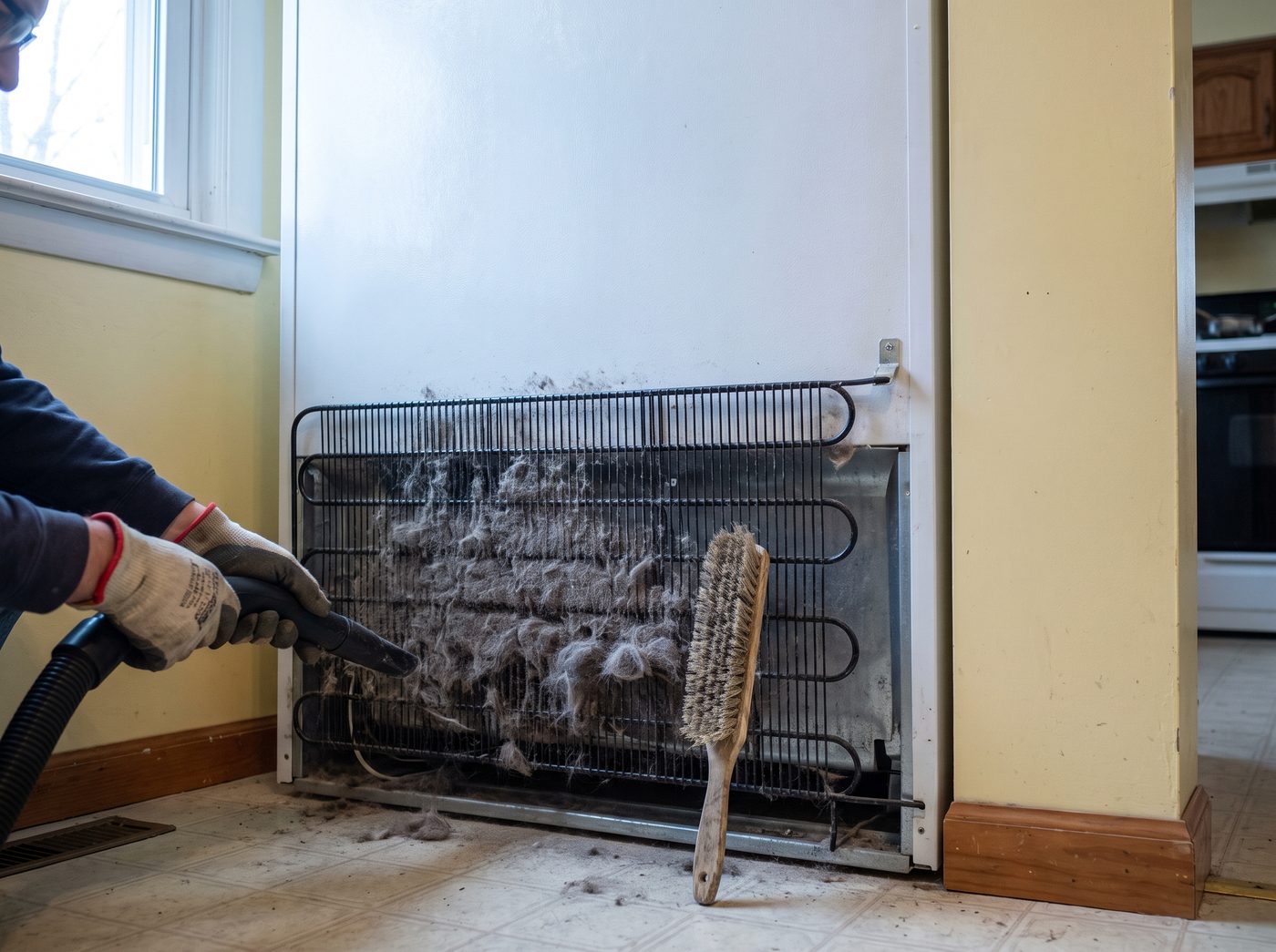
A fridge that hums but does not cool is usually not broken. Condenser coils choked with dust cannot shed heat, so the compressor runs constantly and never gets the box cold. After that it is a blocked vent between freezer and fridge, a failed evaporator fan, or a defrost problem icing the coil. The genuinely expensive failure, the compressor, is the least common of the five.
- 01
Check the obvious before you move furniture
Thermostat dial knocked, door not sealing, a bottle holding a door ajar, or the appliance in a garage that is now colder than its own thermostat. All real, all common, all free.
- 02
Clean the condenser coils
Unplug it. The coils are behind a panel at the back or on a grille underneath. Vacuum and brush the dust and pet hair off them, and the floor underneath while you are there. If it has never been done, this alone fixes a large share of these faults.
- 03
Listen for the fans
One fan by the compressor at the back and one inside the freezer. Open the freezer and press the door switch: you should hear the evaporator fan. Silence there with a running compressor is a strong pointer to that fan.
- 04
Check the vents between freezer and fridge
Cold air is made in the freezer and blown through into the fridge. Packing the freezer solid against the vent, or a bag of peas resting on it, starves the fridge while the freezer stays fine. Fridge warm and freezer cold is the signature.
- 05
Look for ice on the back wall of the freezer
A solid sheet of frost over the evaporator means the defrost cycle has failed. The ice blocks airflow completely. Emptying it and leaving the doors open for twenty four hours will restore cooling temporarily, which confirms the diagnosis but does not fix it.
- 06
Give it a day before judging
After cleaning coils or thawing, a full fridge takes many hours to pull back down to temperature. Put a thermometer in a glass of water on the middle shelf and read it the next morning rather than opening the door every ten minutes.
What it costs
| Cost | Source | |
|---|---|---|
| Clean the coils yourself | nothing | |
| Refrigerator repair overall | $125 to $500 | |
| Evaporator fan motor | $250 to $400 | |
| Defrost heater | $120 to $400 | |
| Thermostat | $100 to $400 | |
| Control board | $400 to $750 | |
| Compressor | $700 to $1,250 |
Every figure here is published by the source named beside it. We do not average them into a number of our own.
Would a home warranty have covered this?
It is the question everyone asks standing in front of a bill this size, and the honest answer is that it depends entirely on the contract rather than on the failure. We do not sell these, take anything for recommending them, or run a page telling you to buy one. What we can do is point at what the consumer regulators say to check, with the repair cost sitting in the table above for comparison.
- They are service contracts rather than warranties, and they may duplicate cover you already have, cover only part of a product, or make repairs slow to get. FTC consumer alert
- Price the deductible and the per-visit service fee, not just the annual premium, and check the reimbursement limits and the cancellation terms. FTC consumer alert
- Find out exactly what you must do before the company will pay for a repair. Read that part before something breaks rather than after. NC Department of Justice
- Many contracts replace equipment only with a particular brand, or only if their own contractor does the work, and many require private arbitration instead of court. NC Department of Justice
Where to stop
Coils, vents and doors are homeowner work. Inside the sealed system is not.
- Anything involving refrigerant
- Sealed system work needs certification and equipment, and on a domestic fridge it is usually more than the appliance is worth.
- The compressor
- HomeGuide puts it at $700 to $1,250, which on most fridges is replacement territory rather than repair.
- The control board
- $400 to $750 and frequently misdiagnosed. Get a second opinion before agreeing to one.
- A fridge that has been warm for more than four hours
- Deal with the food question separately and properly. That is a health decision rather than a repair one.
Why it happened
A refrigerator does not make cold, it moves heat out of the box, and it dumps that heat through the condenser coils. Cover those coils in a felt of dust and hair and the heat has nowhere to go, so the compressor runs and runs and the inside never gets cold. The appliance is working perfectly. It is wearing a coat.
What stops it happening again
Vacuum the coils twice a year, more with pets. It takes ten minutes, it is the only maintenance a fridge asks for, and it is the difference between an appliance that runs constantly and one that cycles. It also shows up on the electricity bill.
- The part
- A coil brush, a few dollars, or the crevice tool you already own.
- How often
- Coils twice a year, quarterly with shedding pets. Check the door seals by closing them on a banknote: if it slides out freely, the seal is not sealing.
Want the rest of the house covered?
One email a month, timed to the systems you actually have. The same kind of thing as the tablet: small, cheap, and it stops the call.
Also asked
- Why is my fridge running constantly but not cold?
- Most often condenser coils choked with dust, so the heat has nowhere to go. Unplug it, vacuum the coils at the back or underneath, and give it a day to pull back down.
- The freezer is cold but the fridge is not. What does that mean?
- Cold air is made in the freezer and blown through to the fridge, so that pattern points at a blocked vent between them or a failed evaporator fan rather than the cooling system.
- There is a sheet of ice on the back wall of my freezer.
- The defrost cycle has failed and the ice is blocking airflow. Emptying it and leaving it open for a day restores cooling, which confirms it but does not fix it. HomeGuide puts a defrost heater at $120 to $400.
- How often should I clean refrigerator coils?
- Twice a year, or quarterly if you have shedding pets. It is the only routine maintenance a fridge needs and it is the most commonly skipped.
- Is it worth repairing or replacing a refrigerator?
- Fans, thermostats and defrost heaters usually are. A compressor at $700 to $1,250 or a control board at $400 to $750 on an older machine is where the sums stop working.