Do this now
Do not paint over it, and do not reach for the bleach. Put your hand flat on the wall first: cold but dry points at condensation, actually damp points at water getting in.
Mould on walls: whether the wall is cold or wet decides everything
Updated
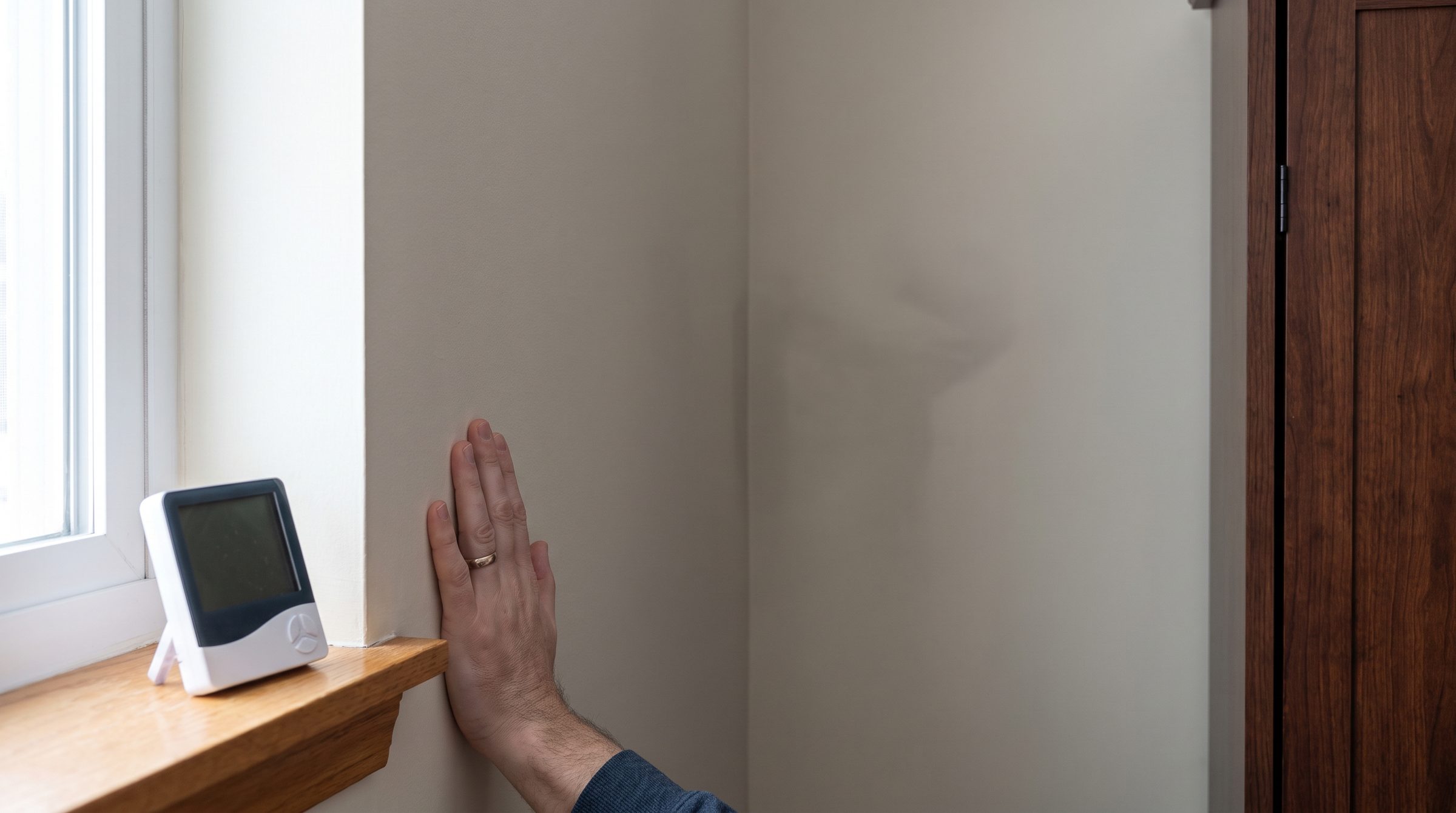
Mould is not the problem, it is the receipt. EPA are blunt about it: control moisture and you control mould. So the only question worth answering first is where the moisture is coming from, and your hand answers it. A wall that is cold and dry to the touch, with black speckling in the corners, behind furniture or along the outside walls, is condensation out of the air in the room. A wall that is actually damp, especially with a tide line or a patch that darkens after rain, has water arriving from somewhere. Clean either one and it comes back. Fix the cause and it does not.
- 01
Put a hand flat on the wall, in and around the mould
You are feeling for two things: temperature and wetness. Cold is expected on an external wall in winter and is not itself a fault. Actual dampness is. Compare it against an internal wall in the same room so you have something to judge against.
- 02
If it is genuinely damp, stop cleaning and find the water
Look directly above for a plumbing run or a bathroom, outside for a blocked gutter or a cracked downpipe discharging against that wall, and at ground level for earth or a path bridging the damp course. EPA put it first for a reason: fix plumbing leaks and other water problems as soon as possible.
- 03
If it is cold and dry, it is condensation, and now measure it
Warm air holds moisture, cold surfaces make it let go, and the coldest parts of a room are external corners, the wall behind a wardrobe and anywhere the insulation stops. That is why it appears in patches rather than evenly.
- 04
Measure the patch against ten square feet before you touch it
EPA say that if the mouldy area is less than about ten square feet, roughly a three foot by three foot patch, in most cases you can handle the job yourself. That is the line, and it is worth measuring rather than eyeballing, because the professional bands start at exactly that size.
- 05
Clean it with detergent and water
EPA's instruction is to scrub mould off hard surfaces with detergent and water and dry completely. They specifically do not recommend chlorine bleach or other biocides as a routine practice during mould cleanup, which is the opposite of what most people reach for. Wipe rather than scrub hard on painted plaster: hard scrubbing drives it into the paint and spreads spores.
Never mix two cleaning products. Chlorine and ammonia together produce a toxic gas, and plenty of household cleaners contain one or the other without saying so plainly.
- 06
Dry the surface completely, then leave it visible for a fortnight
EPA are explicit about drying completely. Resist repainting straight away. A freshly painted wall tells you nothing, and you want to see whether it comes back before you decide the cause is fixed.
- 07
Bring the humidity down and the wall temperature up
EPA recommend keeping indoor humidity below 60 percent, ideally between 30 and 50 percent. Their two levers for condensation are reducing the humidity and increasing the air temperature, plus covering cold surfaces with insulation. In practice: ventilate while cooking and drying clothes, do not heat one room and leave the rest cold, and pull furniture a few inches off external walls so air can move behind it.
What it costs
| Cost | Source | |
|---|---|---|
| Detergent and water, the method EPA actually recommends | Whatever is under the sink | |
| Getting the humidity into the range EPA name | Below 60 percent, ideally 30 to 50 percent. Ventilation and heat, not a purchase | |
| Professional remediation, per square foot | $15 to $30 | |
| A small job, 10 to 100 square feet | $500 to $1,500 | |
| A medium job, 100 to 300 square feet | $1,500 to $6,000 | |
| Remediation labour, per hour | $75 to $120 | |
| Mould inspection, when the source is not obvious | $300 to $650 | |
| A basement dehumidifier, installed | $1,100 to $2,800 |
Every figure here is published by the source named beside it. We do not average them into a number of our own.
Where to stop
A patch on a wall is genuinely yours. These are the versions where it is not, and the first one is a published threshold rather than our opinion.
- The area is bigger than about ten square feet
- That is EPA's own line for handling it yourself. HomeGuide's smallest professional band starts at exactly ten square feet and runs $500 to $1,500, so the threshold is also where the money starts.
- You cannot find where the water is coming from
- Cleaning a damp wall is redecorating, not repair. HomeGuide puts a mould inspection at $300 to $650, which is worth it precisely when the source is not obvious.
- It is in the HVAC system or the ductwork
- It is being distributed rather than sitting in one place, and it is not reachable. HomeGuide puts that at $2,000 to $10,000, which reflects the scope rather than the severity.
- It comes back within weeks of a proper clean and dry
- The moisture source is still running. That is information, not failure, and it means the diagnosis was wrong rather than the cleaning.
- Someone in the house has asthma, a lung condition or a weakened immune system
- Their exposure while you disturb it is the consideration, not the size of the patch. EPA note that biocides may be considered in circumstances involving immunocompromised people, which is a decision to take with a professional rather than from a page.
Why it happened
Air holds moisture in proportion to how warm it is, and every house makes a surprising amount of it: cooking, showering, drying clothes indoors, breathing. When that air reaches a surface cold enough, it has to give the moisture up, and it does so on whatever is coldest. In a heated house the coldest spots are external corners, the wall behind a wardrobe that stops air moving, window reveals, and any place the insulation stops or a beam bridges from outside to inside. That is why mould in a bedroom appears in a corner rather than across the whole wall, and why it arrives in winter and fades in summer without anybody doing anything. Nothing is broken. The wall is simply the coldest thing in the room.
What stops it happening again
Three things, and they are all about the air rather than the wall. Get the humidity into the range EPA name, which for most houses means ventilating while cooking and showering and never drying washing on a radiator in a closed room. Keep the whole house gently warm rather than one room hot and the rest cold, because the cold rooms are where the moisture from the warm ones ends up. And leave a gap behind furniture on external walls so the air can reach the surface at all.
- The part
- A cheap hygrometer, so the humidity figure stops being a guess. EPA name the target range and you cannot aim at it without a number.
- How often
- Check the humidity through the winter rather than the summer, and look behind the furniture on external walls once a season.
Want the rest of the house covered?
One email a month, timed to the systems you actually have. The same kind of thing as the tablet: small, cheap, and it stops the call.
Also asked
- What causes black mould on walls?
- Almost always condensation. Warm moist air from cooking, showering and drying clothes meets a cold surface and gives up its moisture there, which is why it appears in external corners, behind furniture and around windows rather than evenly across a room. The other cause is water getting in from a leak, a blocked gutter or ground level, and that wall feels genuinely damp rather than just cold.
- Should I use bleach to clean mould off walls?
- EPA do not recommend it. Their guidance is that using a chemical or biocide that kills mould, chlorine bleach for example, is not recommended as a routine practice during mould cleanup, and their own method is to scrub it off hard surfaces with detergent and water and dry completely.
- How much mould can I clean myself?
- EPA say that if the mouldy area is less than about ten square feet, roughly a three foot by three foot patch, in most cases you can handle it yourself. Above that they advise getting help, and it is also where professional pricing starts: HomeGuide's smallest band is 10 to 100 square feet at $500 to $1,500.
- What humidity level prevents mould?
- EPA recommend keeping indoor humidity below 60 percent relative humidity, and ideally between 30 and 50 percent. A cheap hygrometer is the only way to know where you actually are.
- Why does mould keep coming back after I clean it?
- Because cleaning removes the mould and not the moisture that grew it. If it returns within weeks of a proper clean and dry, the source is still running, and the useful conclusion is that the diagnosis was wrong rather than the cleaning.
- Is mould on walls dangerous?
- It is an irritant for most people and a genuine problem for anyone with asthma, a lung condition or a weakened immune system. EPA note that biocides may be considered in circumstances involving immunocompromised occupants, which is a conversation to have with a professional rather than a decision to take from a web page.
- Can I just paint over mould?
- It hides it and it comes back through, because the moisture that caused it is still arriving. Clean it, dry it, fix the cause, and leave the wall visible for a couple of weeks before you repaint, so you find out whether the cause is actually fixed.
- How much does professional mould removal cost?
- HomeGuide puts remediation at $15 to $30 per square foot, with a 10 to 100 square foot job at $500 to $1,500 and a 100 to 300 square foot job at $1,500 to $6,000. An inspection on its own is $300 to $650.