Do this now
Before anything else, unplug whatever was in the outlet. If a GFCI tripped because of the appliance rather than the wiring, it will keep tripping until that thing is out, and you will spend an afternoon deciding the house is faulty.
Outlet not working: find the GFCI before you call anyone
Updated
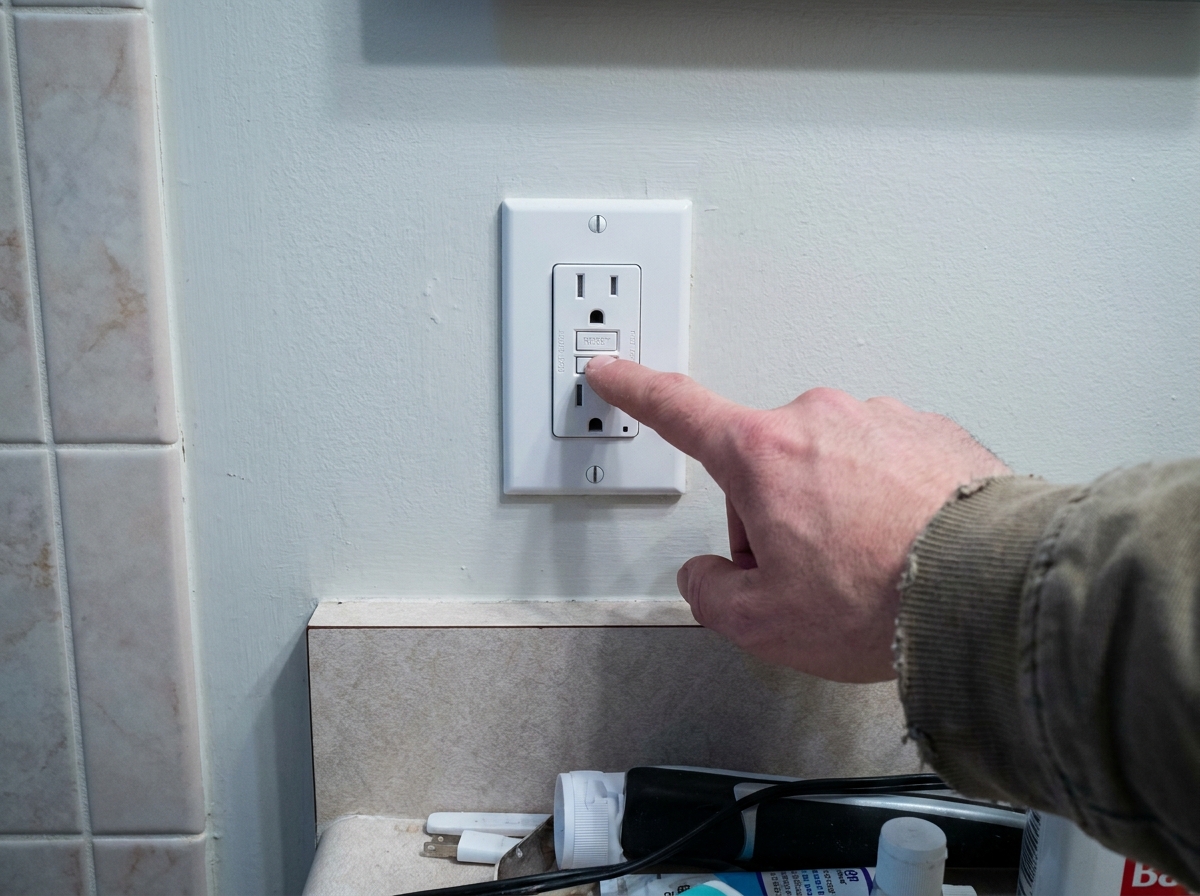
One dead outlet almost never means a broken outlet. GFCI protection is wired in series, so a single GFCI can protect several ordinary outlets downstream of it, and when it trips they all go dead while it sits there looking fine two rooms away. Bathrooms, kitchens, garages, basements and outdoor sockets are the ones to check. If you find the tripped one and reset holds, you are done. If reset will not hold, something downstream is still faulting and that is the useful piece of information to have before you call anyone.
- 01
Unplug what was in it
A failing appliance is the single most common reason a GFCI trips, and it will trip again the moment you reset with it still plugged in. Space heaters, older power tools, anything that has been rained on, and pond or pool equipment are the usual suspects.
- 02
Find every GFCI in the house, not just the nearest one
Look for outlets with test and reset buttons. Check the bathrooms, the kitchen counter, the garage, the basement, the outside walls and the eaves. One of them protects the dead one, and it is very often not in the same room and not on the same floor.
- 03
Press reset firmly and listen for the click
A proper reset gives a solid click. A button that goes in and pops straight back out has not reset, and a button that feels dead may mean the outlet itself has failed. Press test first, then reset: that sequence confirms the device is still doing its job rather than just accepting the button.
- 04
Check the breaker panel as well
A breaker can look closed when it has tripped. Push each one firmly to OFF and then back to ON rather than judging by how it looks in the row. If the breaker is the one that trips, and it trips again immediately, stop there.
Opening the panel door to reach the breaker handles is normal. Removing the cover to look behind it is not, and that is on the stop list below.
- 05
Work out whether it is the load or the wiring
With everything unplugged, reset again. If it holds now, plug things back in one at a time until it trips: the last thing you plugged in is the fault. If it will not hold with nothing plugged in anywhere on that circuit, the fault is in the wiring or in the GFCI itself, and that is an electrician.
- 06
Consider the age of the device
GFCIs wear out. They are protective devices with a service life, commonly quoted at around ten to fifteen years, and an old one can fail to reset or fail to protect while still passing power. If the house is on its original devices, a swap is cheap and worth doing.
What it costs
| Cost | Source | |
|---|---|---|
| GFCI outlet, unit only | $12 to $40 | |
| Replacing an existing outlet with a GFCI | $90 to $200 | |
| Installing a new GFCI outlet | $150 to $350 | |
| Electrician, per hour | $50 to $130 |
Every figure here is published by the source named beside it. We do not average them into a number of our own.
Where to stop
Resetting, unplugging and testing is homeowner work. Anything behind the faceplate is not, and this is one of the shorter lists on the site for a reason.
- Reset will not hold with nothing plugged in
- That is a fault in the wiring or the device, and finding it means working live or pulling the circuit apart.
- Scorch marks, a burning smell, or a warm faceplate
- That is heat where there should be none. Switch the circuit off at the panel and call an electrician the same day.
- The breaker trips again immediately on reset
- Something downstream is drawing current it should not. Repeated resetting is how a fault becomes a fire.
- Anything requiring the panel cover to come off
- The panel itself is on this site’s permanent stop list. The busbars behind that cover stay live with the main breaker off.
- There is no GFCI protection where code now expects it
- Adding it is inexpensive and it is exactly the kind of small job worth having done properly while someone is already in the house.
Why it happened
GFCI devices watch for current leaving the circuit by a route it should not take, which is what happens when electricity finds a person or a puddle. They are deliberately twitchy, because the alternative failure is somebody being hurt. That sensitivity is also why moisture, a long extension run, or an appliance with a tired motor sets them off, and why the trip is often nowhere near the outlet that went dead.
What stops it happening again
Press test and reset on every GFCI in the house once a month. It takes a minute for the whole house and it does two things: it confirms the device still trips, which is the entire point of it, and it teaches you where they all are, which is the thing you actually want to know on the evening an outlet dies.
- The part
- Nothing to buy for the test. A replacement GFCI is $12 to $40 for the unit, and it is worth changing devices that are original to a house older than about fifteen years.
- How often
- Test monthly. Replace on failure, or at roughly fifteen years for original devices.
Want the rest of the house covered?
One email a month, timed to the systems you actually have. The same kind of thing as the tablet: small, cheap, and it stops the call.
Also asked
- Why is one outlet dead when the breaker has not tripped?
- Almost always a tripped GFCI elsewhere on the same circuit. GFCI protection runs downstream, so a device in the garage or a bathroom can kill an ordinary outlet in another room.
- My GFCI will not reset. What does that mean?
- Either something on the circuit is still faulting, or the device itself has failed. Unplug everything on that circuit and try once more. If it holds, add the appliances back one at a time to find the culprit.
- How much does it cost to replace a GFCI outlet?
- HomeGuide puts replacing an existing outlet with a GFCI at $90 to $200 including labor and materials, with the device itself at $12 to $40. Most electricians charge a one hour minimum, so the labor rather than the part sets the price.
- Do GFCI outlets wear out?
- Yes. They are protective devices with a service life, commonly quoted at around ten to fifteen years, and a worn one can fail to reset or pass power without protecting anything. That is why the monthly test matters.
- Why does my GFCI trip when it rains?
- Moisture reaching an outdoor outlet or its wiring is a genuine leakage path, and the device is doing exactly what it is for. Check the weatherproof cover seals and that the outlet is a weather-resistant type.