Do this now
Switch the disposal off at the wall or unplug it under the sink before you put your hands anywhere near it, and put a bowl underneath. Then dry everything completely, because you cannot find a leak in a cupboard that is already wet.
Garbage disposal leaking: where it leaks tells you what it costs
Updated
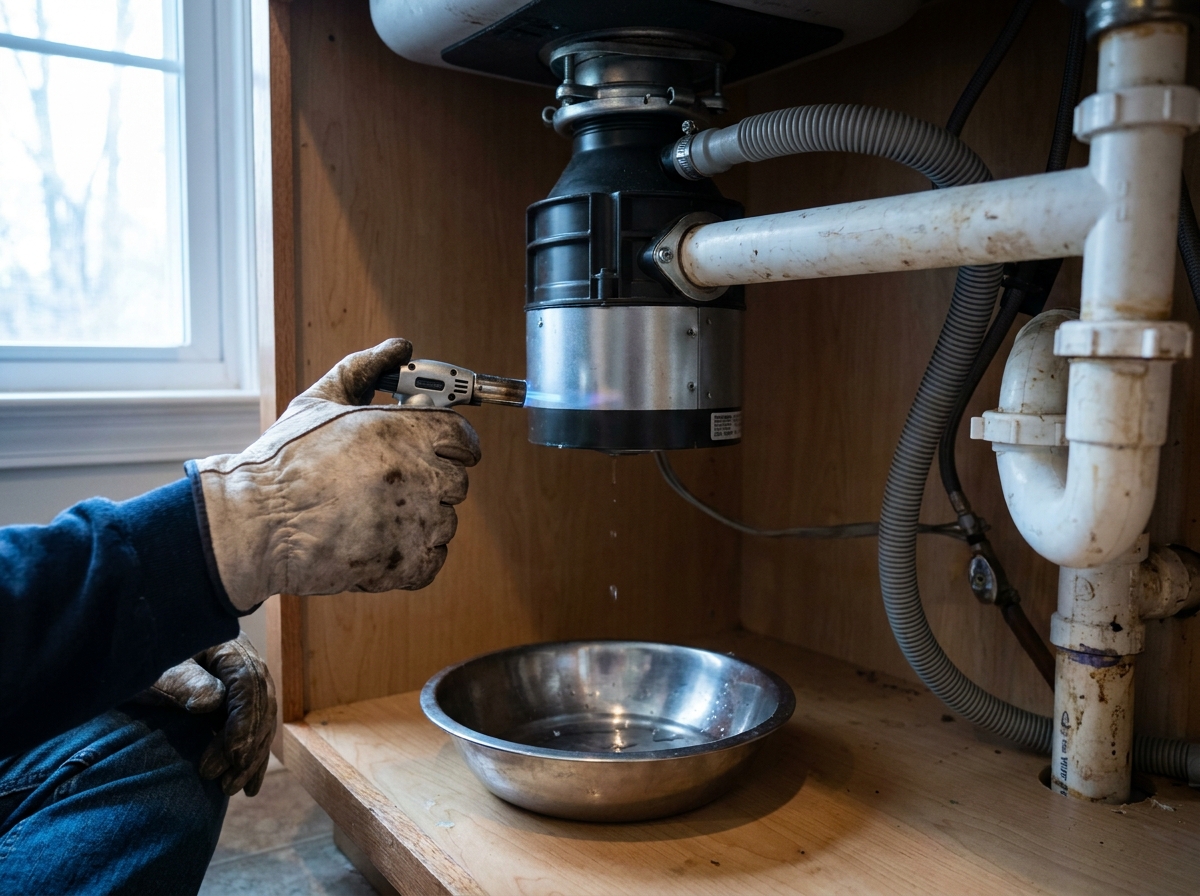
Where it leaks decides everything. Water from the top flange is a mounting gasket and is the cheapest outcome. Water from the side is a drain or dishwasher connection, and is usually a hose clamp or a gasket. Water from the bottom, from the reset button end, means the internal seal has gone and the housing is corroding through, and that is a replacement rather than a repair.
- 01
Isolate it and dry everything
Unplug it, or switch off the breaker if it is hardwired. Towel out the whole cabinet and the top of the unit. A dry cupboard is the only way to find where water is actually appearing.
- 02
Fill the sink, then release it
Plug the sink, fill it with a few inches of coloured water if you have food dye, then pull the plug and watch the unit from below with a torch. Standing water finds a flange leak that a running tap does not.
- 03
Look at the top flange first
Water beading around the sink flange where the unit meets the sink is a failed plumber’s putty seal or a loose mounting ring. Tightening the mounting screws sometimes does it; otherwise the unit comes down and the putty gets redone.
- 04
Then the side connections
The discharge tube has a gasket and bolts, and the dishwasher inlet has a hose and a clamp. Both are common and both are inexpensive. A dishwasher hose that has hardened with age is a very frequent cause and easy to miss.
- 05
Then the bottom, and be honest about it
Water dripping from the base of the motor housing, around the reset button, means the internal seal has failed and the shell is corroding. There is no gasket for this. It is a replacement, and continuing to run it puts water near a motor.
- 06
Check what else got wet
Cabinet bases are chipboard and they swell. If the leak has been going a while, deal with the cupboard floor too, and look for the smell that says it has been damp longer than you thought.
What it costs
| Cost | Source | |
|---|---|---|
| Discharge gasket or hose clamp | a few dollars | |
| New disposal unit, part only | $100 to $300 | |
| Replacing an existing disposal, fitted | $200 to $550 | |
| Labour to replace a disposal | $100 to $250 | |
| Installing a disposal where there was none | $250 to $650 | |
| Repairing sink drain pipes | $100 to $350 |
Every figure here is published by the source named beside it. We do not average them into a number of our own.
Where to stop
Tightening a clamp, replacing a discharge gasket or redoing the flange putty is homeowner work. These are not.
- The leak is from the bottom of the motor housing
- That is the internal seal, and there is no serviceable part. Running an appliance that is leaking onto its own motor is the wrong risk to take.
- The unit is hardwired rather than plugged in
- Disconnecting and reconnecting it is electrical work, and it is exactly the kind of job where a GFCI and standing water are already in the same cupboard.
- Water is reaching an outlet, a power strip or the dishwasher supply
- Kill the circuit and stop. Water plus electricity is the failure on this site that hurts people rather than budgets.
- The cabinet base has swollen or smells of mould
- The leak stopped being the main problem. That is remediation, and it wants looking at properly.
Why it happened
A disposal is a motor bolted underneath a hole in a wet sink, sealed at the top with putty and at the sides with gaskets, and containing a shaft seal that keeps water out of the motor. The putty and the gaskets are consumables and are meant to be renewed. The shaft seal is not serviceable, so when it goes, water sits inside the housing and corrodes it from the inside out. That is why the same symptom is a five dollar fix in one place and a new unit in another.
What stops it happening again
Run cold water before, during and for fifteen seconds after every use, so waste leaves the chamber instead of sitting in it. Standing water inside the unit is what works on the seal. Keep fibrous waste, coffee grounds and fat out of it entirely, since those are what pack the chamber and make it sit wet.
- The part
- Nothing to buy. If you are replacing the unit, the stainless grind chamber models resist exactly the corrosion that kills the cheap ones.
- How often
- Cold water every use. Look in the cupboard with a torch when you check under the sinks each month, which is already on the schedule.
Want the rest of the house covered?
One email a month, timed to the systems you actually have. The same kind of thing as the tablet: small, cheap, and it stops the call.
Also asked
- Why is my garbage disposal leaking from the bottom?
- The internal shaft seal has failed and water is getting into the motor housing, which then corrodes through. There is no repair for it. That is a replacement, at $200 to $550 fitted according to HomeGuide.
- Can I fix a disposal leaking at the top?
- Usually yes, and cheaply. The flange seal is plumber’s putty and the unit is held by a mounting ring. Sometimes tightening the ring is enough; otherwise the putty gets redone.
- Why is water leaking where the dishwasher hose connects?
- The hose hardens with age and the clamp loses its grip. It is one of the most common sources and one of the cheapest, and it is easy to blame on the disposal itself.
- How long does a garbage disposal last?
- Commonly around eight to twelve years. Units that are run without enough cold water, or fed fat and fibrous waste, sit wet inside and reach the seal failure sooner.
- Is it worth repairing a leaking disposal?
- It depends entirely on where. A gasket or clamp is a few dollars and obviously worth it. A housing leak is not repairable, and at $100 to $300 for the unit the sums do not favour trying.