Do this now
With the door FULLY CLOSED, pull the emergency release cord and try to lift the door by hand. Never pull that cord while the door is part-way up.
Garage door will not open: lift it by hand, because that decides who fixes it
Updated
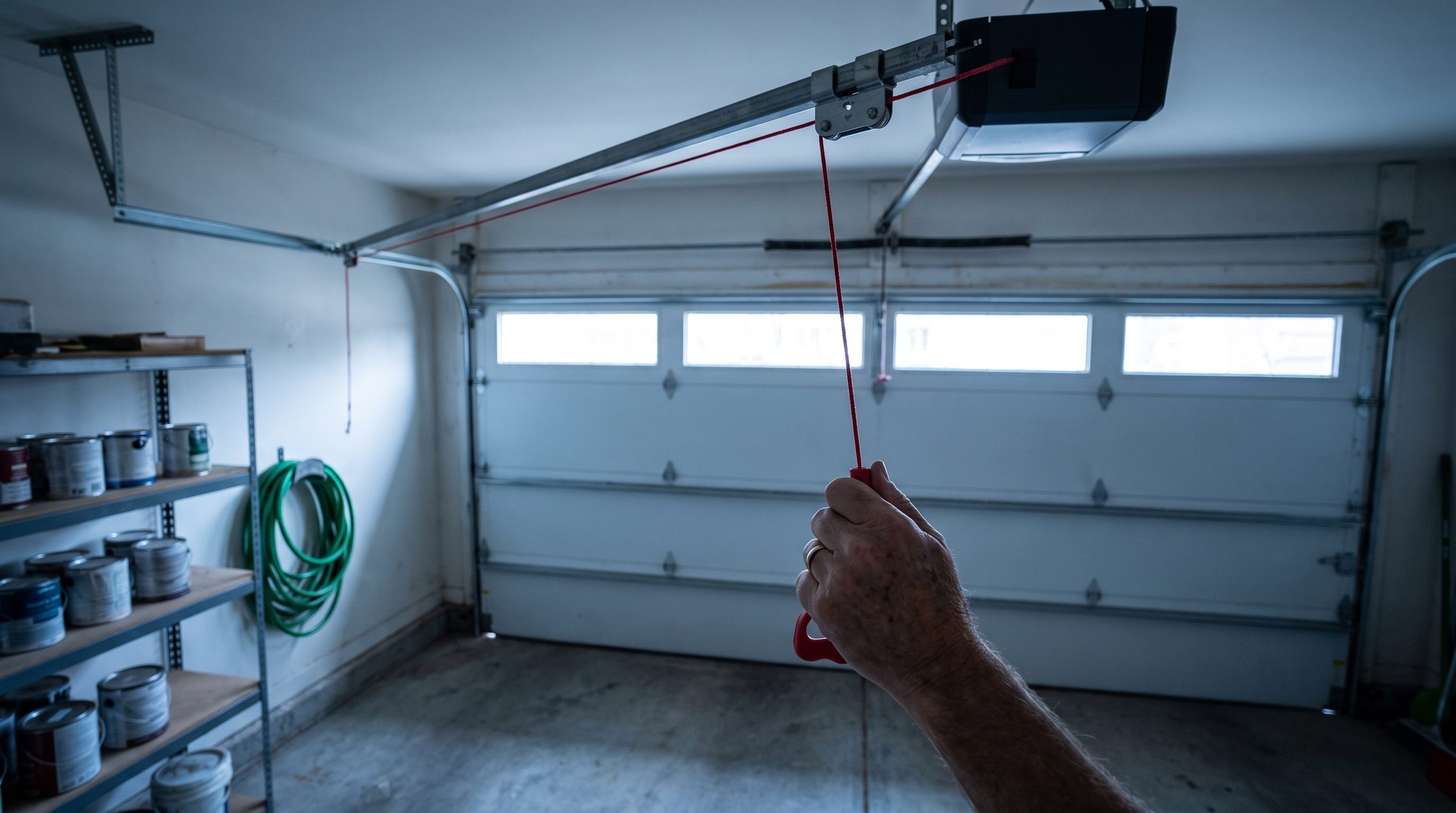
A garage door is not lifted by the opener. It is counterbalanced by springs, and the opener only nudges an already-balanced door along. That is why the hand test settles it: if the door lifts smoothly and stays where you leave it, the door and its springs are fine and you are looking at an opener or a power problem, which is cheap and often free. If it feels like dead weight, or drops the moment you let go, a spring has broken and the job is not yours at any price. Work out which one you have before you touch anything else.
- 01
Make sure the door is all the way down first
This is not a formality. The springs are what hold the door up, so if one has broken and you disconnect the opener while the door is part-way open, there is nothing left holding it.
Never pull the emergency release with the door part-way up. Get it fully closed, or leave it alone and call someone.
- 02
Pull the emergency release cord
The red cord hanging from the rail. Pulling it disconnects the trolley from the opener carriage so the door moves freely by hand. This is also, on its own, the answer a surprising number of times: if someone pulled that cord to get the car out during a power cut, the opener has been running disconnected ever since and the motor whirrs while nothing moves.
- 03
Lift the door by hand. This is the test
It should take moderate effort and no more. Raise it halfway and let go. A correctly balanced door stays roughly where you put it. If it slams down, feels immovable, or takes two people, stop here and read the next step.
- 04
If it was dead weight, stop and look at the spring
Look at the springs above the door or along the tracks either side. A broken torsion spring usually shows a visible gap of an inch or two in what should be a continuous coil. You are looking only. Do not put a tool near it and do not keep pressing the opener button, which will burn out a motor trying to lift a door it was never designed to carry.
Springs are under extreme tension even when broken. This is the item on this page that injures people. Call someone.
- 05
If it lifted fine, the door is fine. Now check the boring causes
Is the opener actually plugged in, and is the outlet live? Garage outlets are frequently GFCI-protected, and a tripped GFCI kills the opener while every light in the house stays on. Check the breaker too.
- 06
Look for the lock button on the wall control
Most wall consoles have a lock or vacation mode that deliberately disables every remote while the wall button still works. It gets pressed by accident, often by a child or an elbow, and it looks exactly like a dead opener. Hold it for a few seconds to clear it.
- 07
Work out whether it is the opener or just the remote
Try the wall button. If the wall button opens the door and the remote does not, nothing is broken in the opener: it is a remote battery, or the remote has lost its programming. If neither works, the opener or its power supply is the problem.
- 08
Re-engage the trolley when you are done
With the door fully closed, pull the release cord back toward the door, or run the opener once and let the carriage pick the trolley back up, depending on the model. Then cycle the door once and watch it the whole way.
What it costs
| Cost | Source | |
|---|---|---|
| Pulling the release cord, or clearing the lock button | Free | |
| Opener repair | $100 to $200 | |
| A new opener, installed | $300 to $900 | |
| Torsion springs, both replaced | $150 to $350 | |
| Extension springs, both replaced | $120 to $200 | |
| Cable repair or replacement | $150 to $350 | |
| Chain repair | $120 to $220 | |
| Track replacement, or realignment after the door came off | $125 to $300, or $200 to $350 to realign | |
| Annual inspection and tune-up | $100 to $250 |
Every figure here is published by the source named beside it. We do not average them into a number of our own.
Where to stop, and this one is not about money
Most of this page is genuinely yours. The items below are the parts of a garage door that store enough energy to hurt somebody, and they are why the trade exists.
- A broken or damaged spring, torsion or extension
- They hold the entire weight of the door as stored tension. Releasing that without the right winding bars, and without knowing the turn count, is how people lose fingers. There is no careful version of this for a homeowner.
- Cables that are frayed, slack or off the drum
- The cables carry the same load as the springs. A cable that has jumped its drum also means the door is no longer level, and rewinding it under load is a two-person job with the right tools.
- The door has come off its tracks
- It is being held by whatever is left, which is not what any of it was designed to do. HomeGuide puts realignment at $200 to $350, which is cheap against what a falling sectional door does.
- The bottom brackets at either side of the door
- They are under the same tension as the springs because the cables terminate there. They look like ordinary brackets and they are not.
- Anything still not working after the checks above
- If the door lifts by hand, the power is live, the lock is off and the wall button still does nothing, the opener has failed internally. At $100 to $200 to repair, it is not worth a day of your weekend.
Why it happened
Two different things wear out on the same door and they fail in opposite ways. The springs do the actual lifting, every single cycle, and they are consumed by use rather than by age, so a busy family door reaches the end of its life years before an identical one on a house where the car lives on the drive. The opener is electronics and a plastic gear, and HomeGuide puts most of them at ten to fifteen years with regular use. The confusing part is that a failing spring presents as a failing opener: the motor strains, the door barely moves, and every instinct says buy a new opener. Fitting one to a door with a broken spring gets you a new opener that also cannot lift it.
What stops it happening again
The balance test above is the whole maintenance programme, and it costs nothing. Do it twice a year with the door disconnected and you will feel a spring going weak months before it snaps, which is the difference between booking a repair and having your car sealed in on a Monday morning. Lubricating the rollers, hinges and springs at the same time is the other half, and it is the single most skipped job on a garage door.
- The part
- A can of garage door lubricant, which is a silicone or lithium spray rather than the general-purpose penetrating oil most people reach for. We are not quoting a price because we have not sourced one for it.
- How often
- Balance test and lubrication twice a year. A professional tune-up runs $100 to $250 if you would rather someone else did it and looked at the springs while they were there.
Want the rest of the house covered?
One email a month, timed to the systems you actually have. The same kind of thing as the tablet: small, cheap, and it stops the call.
Also asked
- Why does my garage door opener run but the door does not move?
- Almost always the emergency release has been pulled, so the trolley is disconnected from the opener carriage and the motor is running with nothing attached. Close the door fully and re-engage the trolley. If it is connected and still does not move, the drive gear inside the opener has probably stripped.
- How do I know if my garage door spring is broken?
- With the door fully closed, pull the emergency release and lift by hand. A door with good springs lifts with moderate effort and stays roughly where you leave it. Dead weight means a spring has gone. You can usually also see a gap of an inch or two in a torsion spring that should be a continuous coil.
- Can I replace a garage door spring myself?
- No. They hold the whole weight of the door as stored tension and releasing that without winding bars and the correct turn count is how people are seriously injured. HomeGuide puts both torsion springs at $150 to $350 fitted, which is not a saving worth chasing.
- My remote does not work but the wall button does. What is wrong?
- Nothing in the opener. Either the remote battery is flat, the remote has lost its programming, or the lock or vacation button on the wall console has been pressed, which disables every remote while leaving the wall button working.
- Why is there no power to my garage door opener?
- Garage outlets are commonly GFCI-protected, and a tripped GFCI takes out the opener while the rest of the house is unaffected. Check the GFCI outlet in the garage, then the breaker, then that the opener is actually plugged in.
- How much does it cost to fix a garage door that will not open?
- It depends entirely on the hand test. If the door lifts by hand, you are looking at $100 to $200 for an opener repair, or nothing at all if it was the release cord or the lock button. If it does not, springs are $150 to $350 and cables are $150 to $350, both fitted.
- Is it safe to pull the emergency release cord?
- Only with the door fully closed. The springs are what hold the door up, so disconnecting the opener on a part-way-open door with a broken spring leaves nothing supporting it. With the door down it is completely safe and it is the first thing to do.