Do this now
Check the fan switch on your thermostat. If it is set to ON rather than AUTO, the blower runs constantly and pushes room-temperature air between burns. That single setting explains a large share of these calls.
Furnace blowing cold air: fan set to ON, or it is lighting and dropping out
Updated
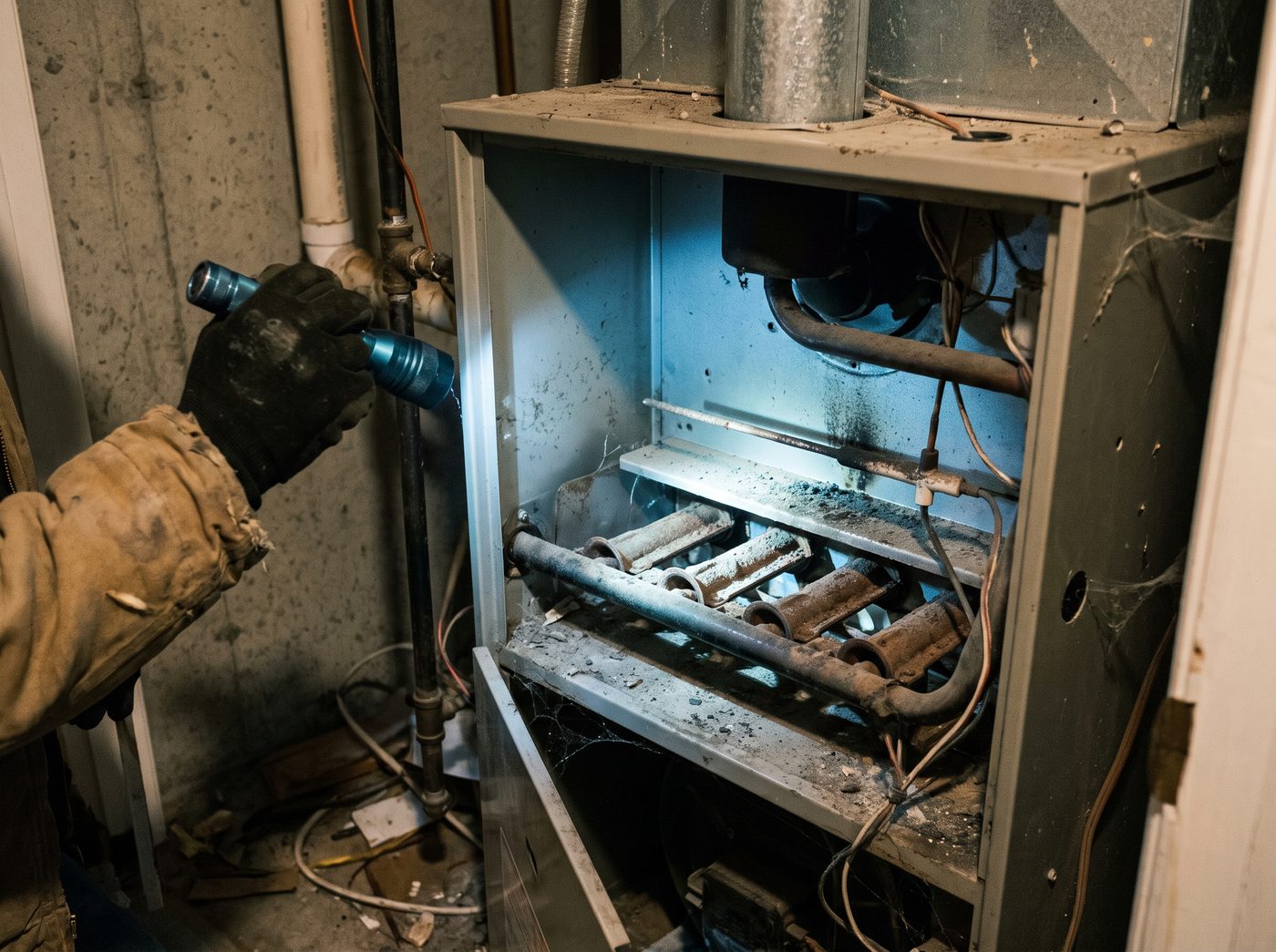
A furnace blowing cold splits three ways. The fan is set to ON so it blows between cycles, which is a thermostat setting rather than a fault. It lights and shuts down after a few seconds repeatedly, which is usually a dirty flame sensor. Or it is not lighting at all, which is the same territory as a furnace that will not start. Watching one full cycle tells you which of the three you have.
- 01
Set the fan to AUTO
On the thermostat, not the furnace. AUTO runs the blower only when there is heat to move. ON runs it continuously, and between burns that means unheated air out of every vent. Change it and wait for a full cycle before concluding anything else.
- 02
Watch one complete cycle
Turn the heat up and stand there. Note whether it ignites, how long it stays lit, and whether the blower starts before or after the burners. Lights then dies after five to ten seconds, repeatedly, is the classic flame sensor pattern.
- 03
Change the filter
A blocked filter overheats the exchanger, the limit switch shuts the burners down and the blower keeps running to cool it, which presents exactly as cold air from the vents. It is free to rule out and it is often the answer.
- 04
Read the blink code
The small window on the cabinet, with the legend printed inside the access panel. It will tell you whether you are looking at ignition failure, a pressure switch or a limit trip, which turns the rest of this from guessing into checking.
- 05
Clean the flame sensor, if you are confident
Power off at the switch and the breaker, gas off at the valve. The sensor is a thin metal rod in the burner path. A light rub with fine abrasive pad or emery cloth removes the oxide film that stops it detecting flame. Reassemble carefully.
If any part of that sentence is unfamiliar, this is the right place to stop. It is a $80 to $250 job done properly and it involves opening a gas appliance.
- 06
Check the vents and returns
Closed registers in several rooms and blocked returns cause the same overheating and shutdown as a dirty filter. Open them and give it a full cycle.
What it costs
| Cost | Source | |
|---|---|---|
| Flame sensor replacement | $80 to $250 | |
| Ignitor replacement | $100 to $250 | |
| Service call, per hour | $75 to $150 | |
| After hours or holiday, per hour | $140 to $210 | |
| Filter | about $6 to $20 |
Every figure here is published by the source named beside it. We do not average them into a number of our own.
Where to stop
Same boundary as any gas appliance, and for the same reasons.
- Any smell of gas
- Leave and call the gas company from outside. They come out for this.
- The gas valve, burners or heat exchanger
- A cracked exchanger vents combustion gas including carbon monoxide into the house, and it is invisible to an untrained eye.
- A furnace that short cycles after the sensor is clean
- Pressure switch, inducer or a blocked flue. All of them are combustion side and all of them matter.
- No carbon monoxide alarm in the house
- Fix that before you troubleshoot anything else. It is the cheapest item in this guide and the only one that matters at 3am.
Why it happened
The flame sensor is a safety device: it confirms there is actually a flame before the gas valve is allowed to stay open. It works by conducting a tiny current through the flame itself, so a film of oxide on the rod is enough to make it report no flame at all. The furnace then shuts the gas off after a few seconds, exactly as it should. A three dollar abrasive pad addresses a fault that behaves like a dying furnace.
What stops it happening again
Filters on schedule, and an annual service before the heating season where the flame sensor gets cleaned as a matter of routine. The sensor films up gradually every year, so it is maintenance rather than a repair, and the difference between the two is whether it happens in October or in January.
- The part
- A filter, and a carbon monoxide alarm on every floor with a gas appliance, replaced on the date printed on the back.
- How often
- Filter every 90 days. Annual service in early autumn. Test the heat in October, before you need it.
Want the rest of the house covered?
One email a month, timed to the systems you actually have. The same kind of thing as the tablet: small, cheap, and it stops the call.
Also asked
- Why is my furnace blowing cold air?
- Most often the thermostat fan is set to ON rather than AUTO, so the blower runs between burns and pushes unheated air. If it is on AUTO, watch a full cycle: lighting then dying after a few seconds points at the flame sensor.
- What is short cycling?
- The furnace ignites, runs for a few seconds and shuts down, repeatedly. The commonest cause is a dirty flame sensor failing to confirm the flame, so the gas valve closes as a safety measure.
- Can I clean the flame sensor myself?
- A confident homeowner can, with the power and gas off, using fine abrasive to remove the oxide film. It is also entirely reasonable to decide that opening a gas appliance is not for you.
- Could a dirty filter make the air cold?
- Yes. It overheats the exchanger, the limit switch shuts the burners down, and the blower keeps running to cool things. From the vents that is indistinguishable from a furnace not lighting.
- What does the blinking light on my furnace mean?
- It is a diagnostic code and the legend is printed inside the access panel. Counting the blinks and reading the legend is free and turns guesswork into a specific fault before anyone arrives.