Do this now
Open the tap that is not running, and leave it open. Thawing a pipe with the tap shut traps meltwater against the ice with nowhere to go, and pressure is what splits pipes.
Frozen pipes: thaw it slowly, and open the tap before you start
Updated
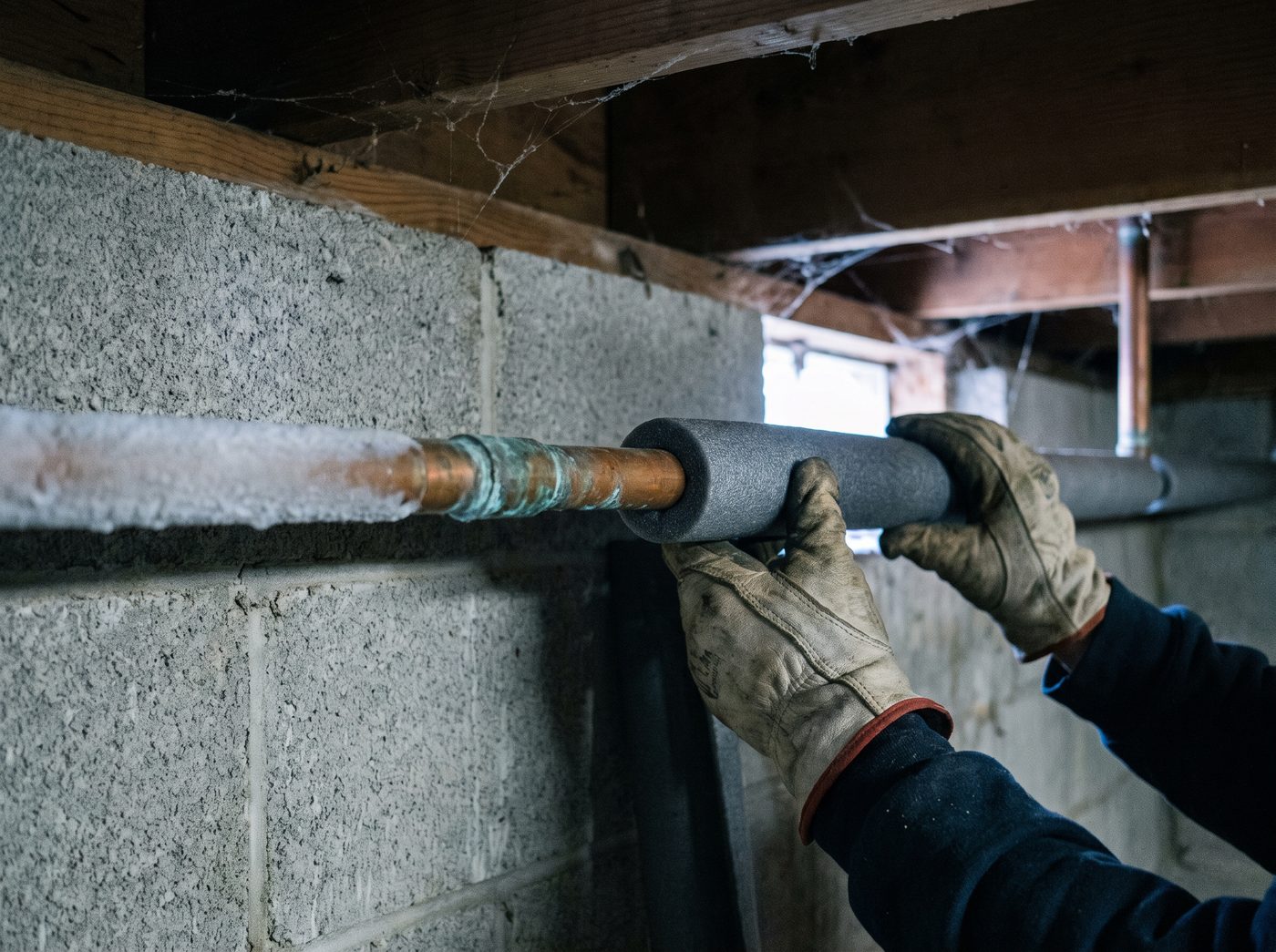
One tap dry in freezing weather, with the others working, means a frozen section somewhere between the main and that fixture, almost always where the pipe runs through unheated space. Thawing it is straightforward and the two things that matter are opening the tap first and applying gentle heat rather than a flame. Most burst pipes are burst during the thaw, not the freeze.
- 01
Open the affected tap, both hot and cold
This gives the melting ice somewhere to go and tells you the instant it clears. Leave it open the whole time you are working.
- 02
Find the frozen section
Follow the pipe back from the dry tap toward the main, feeling as you go. Look at exterior walls, crawl spaces, garages and unheated basements first. Frost or condensation on the outside of a pipe, or a visible bulge, marks it.
A bulge or a split you can already see means it has failed. Shut the main off now and stop thawing: you are about to release water into the house.
- 03
Apply gentle heat, starting at the tap end
A hair dryer, a heat gun on low, hot towels, or a space heater pointed at the area. Start nearest the open tap and work back toward the frozen middle, so meltwater always has an escape route behind it.
- 04
Never use an open flame
No blowtorch, no propane heater held against pipes. It is a genuine cause of house fires every winter, it can boil water inside the pipe and split it, and on plastic pipe it simply melts through.
- 05
Keep going after it starts running
A trickle means a channel has opened, not that the ice has gone. Keep the heat on and the tap open until the flow is normal, then check the whole run for leaks while there is still pressure on it.
- 06
If you cannot find it or reach it, stop
A frozen section inside a wall or under a floor is not worth opening the building for at speed. Shut the main off, keep the house warm, and call a plumber. That is a considered decision rather than a defeat.
What it costs
| Cost | Source | |
|---|---|---|
| Hair dryer or heat gun | you already own one | |
| Pipe insulation, per length | a few dollars | |
| Burst pipe repair, per linear foot | $150 to $250 | |
| Pipe repair overall | $400 to $2,000 | |
| Class 2 water damage if it bursts | $1,500 to $5,000 |
Every figure here is published by the source named beside it. We do not average them into a number of our own.
Where to stop
Thawing an accessible pipe is homeowner work. These are not.
- Any open flame near pipes
- House fires and split pipes, both. There is no version of this that is worth the minutes it saves.
- A pipe that is already bulged or split
- Shut the main off and stop. Thawing it completes the failure and the water arrives all at once.
- Pipes inside walls, ceilings or under floors
- You cannot see what you are heating and you cannot reach a burst if it happens.
- No water anywhere in the house at all
- That points at the main service line or the meter, which is a different and often a utility problem.
Why it happened
Water expands as it freezes, but the ice does not split the pipe by pressing outward where it forms. It forms a plug, and continued freezing pushes the water between the plug and the closed tap into an ever smaller space. That trapped column is what bursts the pipe, usually at a fitting some distance from the ice. Which is exactly why the first instruction is to open the tap.
What stops it happening again
Insulate the pipes in unheated space, keep the house above about 55 degrees even when empty, and open the cupboard doors under sinks on exterior walls so room heat reaches them. In a hard freeze, a pencil-thin trickle from the most vulnerable tap costs almost nothing and moving water is far harder to freeze.
- The part
- Foam pipe insulation for every run through a crawl space, garage or exterior wall. A few dollars a length against HomeGuide’s $1,500 to $5,000 for a Class 2 event.
- How often
- Insulate before the first freeze. Disconnect and drain outside hoses in autumn. Set the thermostat no lower than 55 when the house is empty in winter.
Want the rest of the house covered?
One email a month, timed to the systems you actually have. The same kind of thing as the tablet: small, cheap, and it stops the call.
Also asked
- Should I open the tap before thawing a frozen pipe?
- Yes, and it is the most important instruction here. An open tap gives meltwater an escape route and tells you the moment it clears. A closed one traps pressure, which is what splits pipes.
- Can I use a blowtorch to thaw a pipe?
- No. It causes house fires every winter, it can boil the water inside and split the pipe, and it melts straight through plastic. Hair dryer, heat gun on low or hot towels instead.
- Water is running again but only a trickle. Is it done?
- No, a channel has opened through the ice. Keep the heat on and the tap open until flow is normal, then inspect the whole run for leaks while it is under pressure.
- Does leaving a tap dripping actually help?
- Yes, in a hard freeze on a vulnerable run. Moving water is much harder to freeze and the open tap relieves the pressure that actually bursts pipes.
- Why did my pipe burst somewhere other than where it froze?
- The ice plug pushes pressure along the trapped water toward the closed tap, and the pipe gives at the weakest point, usually a fitting. That is often somewhere warmer and well away from the freeze.