Do this now
Turn off the two shut-off valves under the sink before you touch anything, and put the plug in. Half the small parts that fall out of a faucet during this job go down the drain, and the plug is the difference between a ten minute repair and an afternoon.
Dripping faucet: it is a cartridge or a washer, and both are cheap
Updated
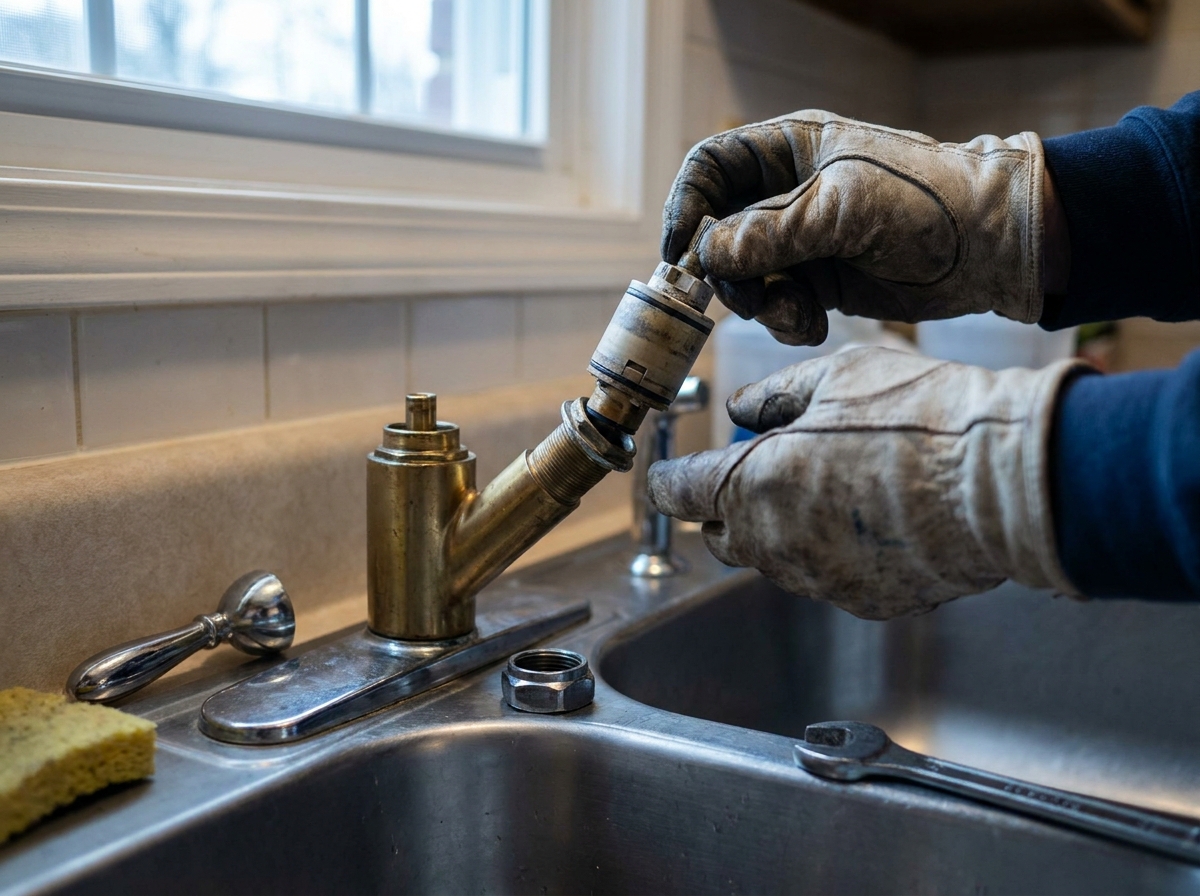
A faucet drips because a small rubber or ceramic part inside it no longer seals. Which part depends on the type: a cartridge faucet has a cartridge, a compression faucet has a rubber washer, and a ball or ceramic disc faucet has its own kit. All of them are inexpensive, all of them are sold as a kit for the brand, and none of them means the faucet needs replacing.
- 01
Shut the water off and plug the drain
Both valves under the sink, then open the tap to release the pressure and confirm it is actually off. If the isolating valves are seized, that is worth knowing before you have the faucet in pieces rather than after.
- 02
Work out which type you have
One handle that moves up and down and side to side is a cartridge or ball type. Two handles that screw down firmly are compression, and they take washers. A single handle that swings in a smooth arc with no play is usually ceramic disc.
- 03
Get the handle off
There is nearly always a small cap hiding a screw, on the top or behind the handle. Prise it gently. Underneath is a screw, and under that the retaining nut and the part you are here for.
- 04
Take the old part to buy the new one
Cartridges are brand and model specific and they look similar in the packet. Taking the old one to the counter is the difference between one trip and three. Photograph the assembly order before it comes apart.
- 05
Replace the O-rings while you are in there
They cost pennies, they are the reason for a leak at the base of the spout rather than the spout itself, and you already have it apart. Grease them with plumber silicone grease, not oil.
- 06
Reassemble and turn the water on slowly
Open the valves gradually and watch the joints for a minute. Then run it hot and cold, and check under the sink again once the pipes have warmed up, because a slow weep only shows once everything has expanded.
What it costs
| Cost | Source | |
|---|---|---|
| Faucet cartridge, part only | $10 to $80 | |
| Washer and O-ring kit | a few dollars | |
| Plumber fixing a dripping faucet | $125 to $350 | |
| Replacing the faucet entirely | $200 to $600 | |
| Plumber, per hour | $45 to $150 |
Every figure here is published by the source named beside it. We do not average them into a number of our own.
Where to stop
Swapping a cartridge, washer or O-ring is homeowner work. These are not.
- The shut-off valves under the sink will not close or leak when moved
- Old valves seize and then weep once disturbed. Replacing them means working on the supply, and you want that done properly rather than discovered at midnight.
- The drip is coming from the wall or from inside a shower valve body
- That is a valve behind tile, and getting at it is a building job as much as a plumbing one.
- The faucet body itself is cracked or the threads are stripped
- No new cartridge seals a cracked body. That is a replacement, at $200 to $600.
- Water is appearing in a cabinet or ceiling below
- A drip you can see is cheap. Water inside a cupboard or a ceiling is a different and more urgent problem than a dripping tap.
Why it happened
Every tap seals by pressing a soft part against a hard seat. The soft part wears, and hard water accelerates it by depositing scale on the seat that then abrades whatever presses against it. Nothing structural has failed; a consumable has reached the end of its life, which is why the fix is a part rather than a faucet.
What stops it happening again
Do not crank the tap shut. A compression faucet in particular seals with light pressure, and forcing it drives the washer into the seat and shortens its life considerably. If the water is hard, descaling the aerator occasionally keeps grit out of the mechanism.
- The part
- A spare cartridge for the taps you use most, kept in the drawer. When a tap starts dripping it is rarely convenient, and the part is brand specific enough that nowhere local will have it at the moment you want it.
- How often
- Clean the aerators every few months in a hard water area. Expect a cartridge or washer to last years rather than decades.
Want the rest of the house covered?
One email a month, timed to the systems you actually have. The same kind of thing as the tablet: small, cheap, and it stops the call.
Also asked
- Why does my faucet drip when it is turned off?
- The part that seals inside it has worn: a cartridge, a rubber washer or an O-ring depending on the type. It is a consumable, and it is cheap.
- How much does it cost to fix a dripping faucet?
- The part is $10 to $80 for a cartridge, or a few dollars for a washer kit. HomeGuide puts a plumber fixing a dripping faucet at $125 to $350, most of which is the call-out rather than the work.
- Is a dripping tap actually worth fixing?
- Yes, and quickly. A steady drip wastes a surprising volume over a year, and on a hot tap you are paying to heat every drop of it. It also scars the sink over time.
- How do I know which cartridge to buy?
- Take the old one with you. Cartridges are brand and model specific, they look nearly identical in the packet, and matching by eye from a photo is how people end up making three trips.
- Should I just replace the whole faucet?
- Only if the body is cracked or the threads have stripped. HomeGuide puts a full replacement at $200 to $600 against a part that usually costs under $80.