Do this now
Before ordering any part, pull the dryer out and disconnect the vent hose at the back. If lint falls out of it, you have found why the dryer stopped heating, and fitting a new part without clearing it will blow the new part too.
Dryer not heating: check the vent before you buy a heating element
Updated
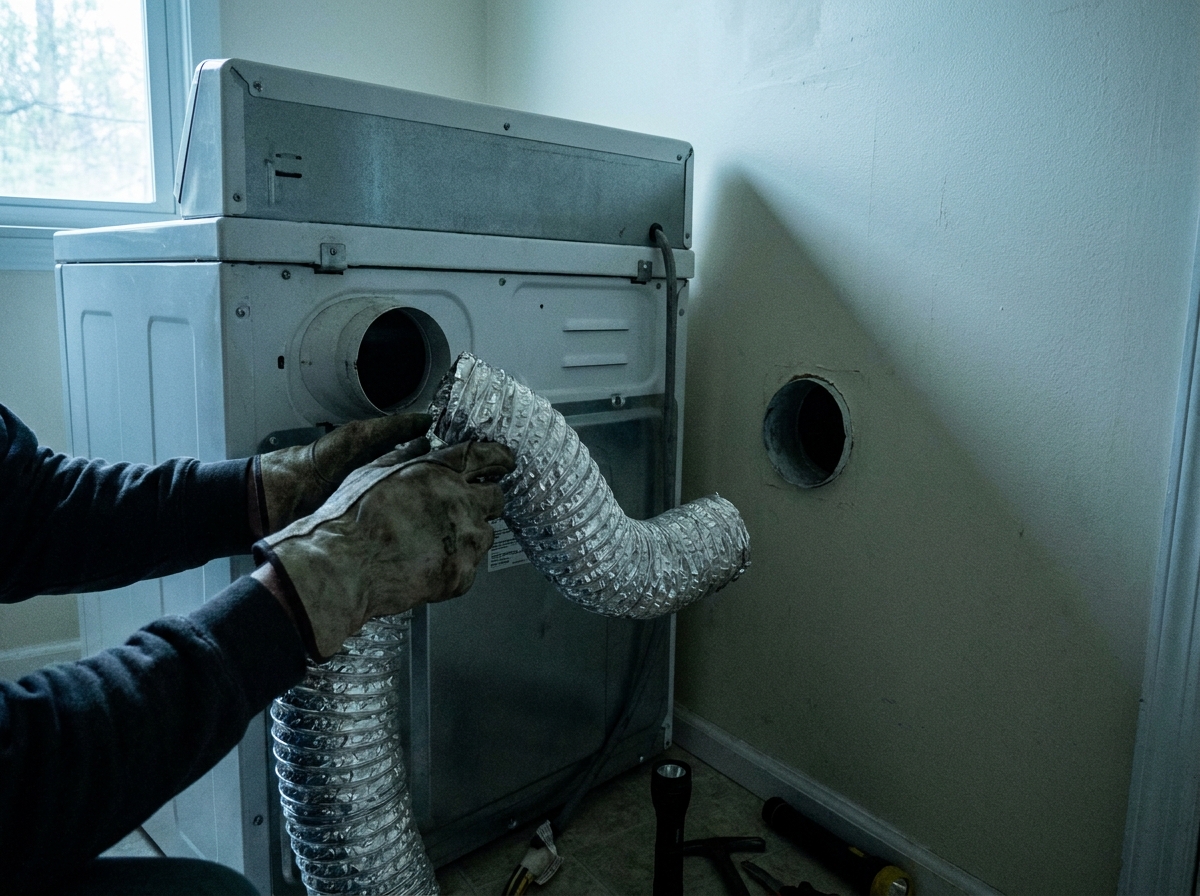
A dryer that turns but does not heat has lost its heat source, and on an electric dryer that is normally a thermal fuse, a failed heating element, or a thermostat. The thing worth knowing is that the fuse is a safety device: it blows because the machine overheated, and the usual reason it overheated is a blocked vent. Fix the part without fixing the airflow and you will be back here.
- 01
Check the obvious settings first
Air fluff or an air-dry cycle tumbles without heat by design, and it is genuinely the answer often enough to check. On a gas dryer, confirm the gas supply valve behind the machine is open.
- 02
Check the vent, the whole length of it
Disconnect the hose at the back and at the wall. Look for a compressed or kinked duct behind the machine, and check the flap on the outside of the house opens when the dryer runs. A blocked vent is the root cause behind most of the failures below.
- 03
Check both breakers on an electric dryer
Electric dryers use a 240 volt double-pole breaker. If one half trips, the motor still turns on 120 volts while the heating element gets nothing, which produces exactly this symptom. Switch it fully off and back on rather than judging by look.
Opening the panel door to reach the breaker handles is fine. Removing the cover is not, and neither is anything behind it.
- 04
Test the thermal fuse
Unplug the dryer. The fuse is a small part on the blower housing or the heat duct, depending on model. It tests as continuity: continuity means it is intact, no continuity means it has blown. They are a few dollars and they are designed to be the part that fails.
- 05
Then the heating element
A visibly broken coil is conclusive. Otherwise it is another continuity test. Elements do fail with age, but an element that fails early in a machine with a blocked vent has usually been cooked rather than worn out.
- 06
Clear the vent properly before you reassemble
This is the step that makes the repair last. A rotary brush kit down the full duct run, not just the first foot behind the machine. If the run is long or has several bends, that is where the lint is.
What it costs
| Cost | Source | |
|---|---|---|
| Thermal fuse, part only | $5 to $10, or up to $60 for OEM | |
| Thermal fuse replacement, fitted | $75 to $150 | |
| Heating element, part only | $15 to $35 generic, up to $200 OEM | |
| Heating element replacement, fitted | $150 to $350 | |
| Thermostat replacement | $100 to $300 | |
| Dryer repair, typical | $100 to $300 | |
| Professional vent cleaning | $80 to $185, averaging $130 |
Every figure here is published by the source named beside it. We do not average them into a number of our own.
Where to stop
Clearing the vent and swapping a thermal fuse are homeowner jobs. These are not.
- It is a gas dryer and the fault is not the vent
- Igniters, gas valves and flame sensors are gas work. This is the one appliance on the site where the failure mode includes carbon monoxide.
- A burning smell, or scorch marks anywhere inside
- Stop using it. Dryer fires are overwhelmingly lint fires, and a smell means it has already been hot enough to matter.
- The breaker trips again when the dryer starts
- That is a short in the element or the wiring rather than a fuse, and resetting repeatedly is the wrong response to it.
- The vent run is inside a wall or ceiling and is blocked
- Clearing a buried duct, or rerouting one that is too long, is a job with access work attached.
Why it happened
A dryer works by moving heated air through the drum and out of the house. Restrict the air and the heat has nowhere to go, so the cabinet temperature climbs until a safety device cuts the heat to stop a fire. That device is the thermal fuse, and it is one-shot by design. This is why the fuse and the blocked vent are the same fault wearing two hats, and why an appliance engineer will look at your vent first.
What stops it happening again
Clean the lint screen every load, and clear the full duct run once a year. The screen catches a fraction of what comes off the clothes; the rest is in the duct, and that is the part that both kills the heat and starts the fires.
- The part
- A rotary dryer vent brush kit, about $15 to $40, which reaches the length of the duct rather than the first foot. Rigid metal duct rather than foil concertina if you are replacing the hose: it holds its shape and traps far less.
- How often
- Lint screen every load. Full duct clean annually, or twice a year for a long run or a large household.
Want the rest of the house covered?
One email a month, timed to the systems you actually have. The same kind of thing as the tablet: small, cheap, and it stops the call.
Also asked
- Why is my dryer running but not heating?
- Most often a blown thermal fuse, then a failed heating element or thermostat. On an electric dryer, one half of the double-pole breaker tripping does exactly this too: the drum turns and the element gets nothing.
- Can I just replace the thermal fuse?
- You can, and it will blow again if you do not clear the vent. The fuse is a symptom of overheating, and the overheating is nearly always restricted airflow.
- How much does it cost to fix a dryer that will not heat?
- HomeGuide puts a thermal fuse replacement at $75 to $150 and a heating element at $150 to $350 fitted, with typical dryer repair at $100 to $300. The fuse part itself is $5 to $10.
- Is it worth repairing a dryer that will not heat?
- Usually yes. The common failures are cheap parts, and the machine is otherwise working since the drum still turns. Weigh it differently if the drum bearings are also noisy or the control board has gone.
- Why does my dryer take two cycles even though it heats?
- That is the vent rather than the heat, and it is the same root cause caught earlier. There is a separate guide for it.