Do this now
Switch it off at the wall and mop the floor dry before you do anything else. You cannot see where water is coming from in a puddle that is already there, and a kitchen floor absorbing water under the cabinets is the expensive part of this.
Dishwasher leaking: the door seal, the hose, or too much foam
Updated
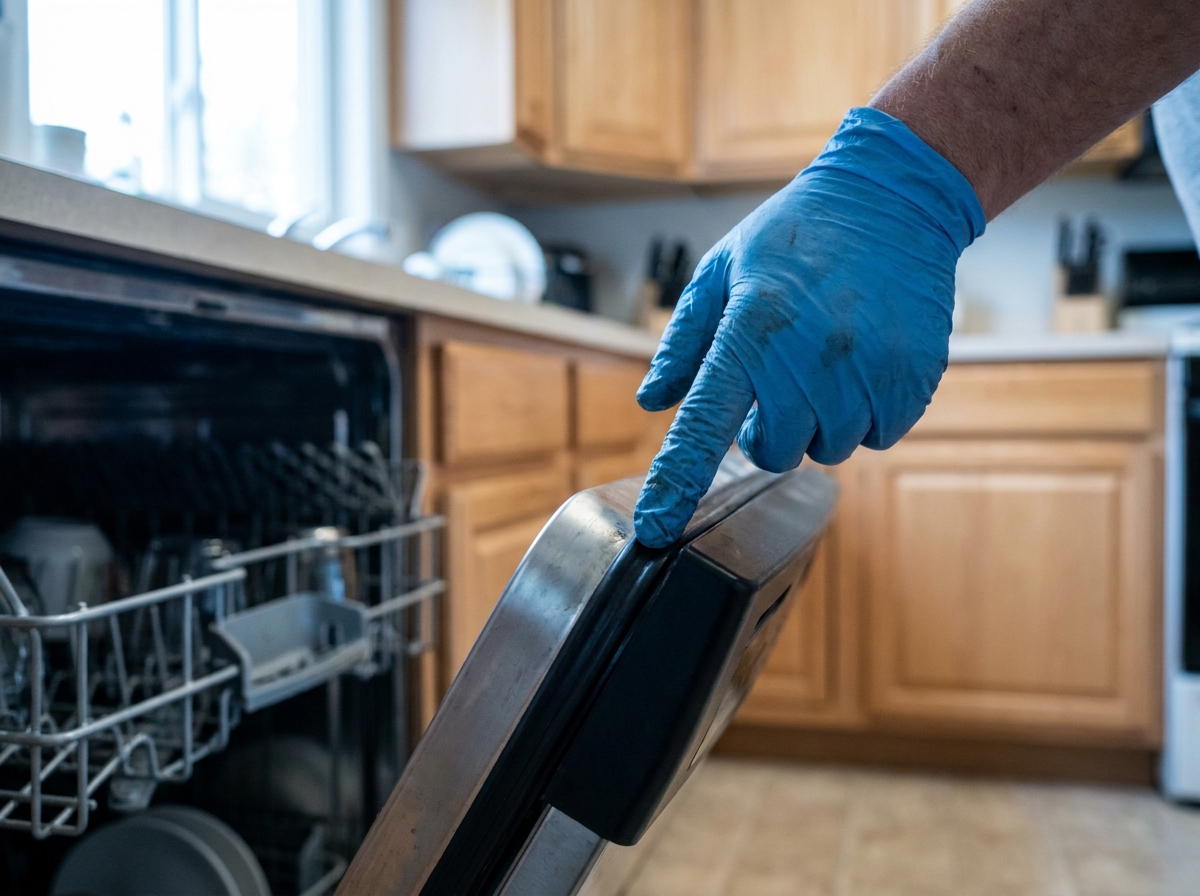
Most dishwasher leaks are one of four things: a perished door gasket, a loose or split drain hose, an overfilled or foaming machine, or the door simply not sealing because something is proud on the lower rack. Only the last two are free to fix, but the first two are inexpensive parts. Water appearing from underneath rather than the door is the one that needs more care.
- 01
Rule out foam first, because it is free
If anyone has put washing-up liquid in it, even a squirt, it will foam out of the door and it will do it again on the next cycle. Run an empty rinse with a little salt or vinegar to kill the residual foam before diagnosing anything else.
- 02
Run it and watch the door
Stand there for the fill and the first wash. Water at the bottom edge of the door is the gasket. Water at a corner only is usually the door out of alignment or a gasket that has come out of its channel at that point.
- 03
Inspect the gasket by hand
Run a finger all the way round. It should be soft and springy. Hard, cracked, flattened or with food packed into it are all failures, and the last one is cleanable rather than a replacement. They push into a channel and come out the same way.
- 04
Look underneath with a torch
Pull the kick plate off, which is usually two screws. Dry everything, run the machine, and watch. Drain hose connections and the inlet valve are the usual sources, and a hose clamp costs almost nothing.
- 05
Check nothing is blocking the door
A tall item on the bottom rack, or a handle poking through, holds the door open by a millimetre, which is plenty. This is the cause people find last and it is genuinely common.
- 06
Deal with the floor
If it has been leaking a while, the cabinet base and the flooring under the machine matter more than the machine. Pull it out and check. Water that has been sitting under a dishwasher is where the real bill lives.
What it costs
| Cost | Source | |
|---|---|---|
| Door gasket, part only | about $15 to $50 | |
| Hose clamp | a few dollars | |
| Dishwasher repair, typical | $100 to $300 | |
| Appliance repair, per hour | $50 to $125 | |
| Water damage restoration, if it has been leaking a while | $1,300 to $5,700 |
Every figure here is published by the source named beside it. We do not average them into a number of our own.
Where to stop
Gaskets, hose clamps and cleaning are homeowner work. These are not.
- Water is coming from the machine body rather than a connection
- A cracked sump or tub is not repairable in place, and it is usually the point at which replacing beats repairing.
- The subfloor or cabinet base is soft, swollen or smells
- The leak has stopped being the main problem. That is a floor repair and possibly a mould question.
- Water reaching an outlet, the machine wiring or an adjacent appliance
- Kill the circuit and stop. Water and electricity together is the failure on this site that hurts people rather than budgets.
- The inlet valve is leaking rather than a hose
- That is plumbed into the supply under pressure, so a failure there does not wait for a wash cycle.
Why it happened
A dishwasher seals a large door against a tub full of hot water many times a week, and the gasket that does it is rubber exposed to heat, detergent and food acid. It hardens on a schedule. The hoses underneath are on the same clock, and the clamps holding them relax slowly with every heat cycle. None of it is a defect; it is a set of consumables in a place nobody looks until the floor is wet.
What stops it happening again
Wipe the door gasket when you clean the kitchen and keep food out of the channel. Use dishwasher detergent only, never washing-up liquid, and load so nothing stands proud of the bottom rack. Once a year, take the kick plate off and look underneath with a torch, which is on the schedule anyway.
- The part
- Nothing to buy for the habit. A spare hose clamp is pennies and worth having.
- How often
- Wipe the gasket monthly. Look underneath annually. Clean the filter in the base every few months, which is already on the monthly list.
Want the rest of the house covered?
One email a month, timed to the systems you actually have. The same kind of thing as the tablet: small, cheap, and it stops the call.
Also asked
- Why is my dishwasher leaking from the bottom of the door?
- Almost always the door gasket, either perished or with food packed into the channel. Run a finger round it: soft and springy is good, hard or flattened is not.
- Can washing-up liquid make a dishwasher leak?
- Yes, and it is the first thing to rule out because it is free. It foams enormously and the foam comes out of the door. Run an empty rinse to clear it.
- How much does it cost to fix a leaking dishwasher?
- A gasket is roughly $15 to $50 for the part. HomeGuide puts typical dishwasher repair at $100 to $300, with appliance labour at $50 to $125 an hour.
- Is a leaking dishwasher worth repairing?
- For a gasket or a hose, easily. For a cracked tub or sump it usually is not, and that is the point where a new machine is the cheaper answer.
- How do I know if the leak has damaged the floor?
- Pull the machine out and look. Soft or swollen cabinet base, lifted flooring, or a musty smell all mean it has been going longer than you thought.