Do this now
Turn the system off at the thermostat and at the breaker. A condenser humming with a stalled fan is a compressor cooking itself, and every minute counts against a part that costs thousands rather than hundreds.
AC outdoor fan not spinning: usually the capacitor, and do not touch it
Updated
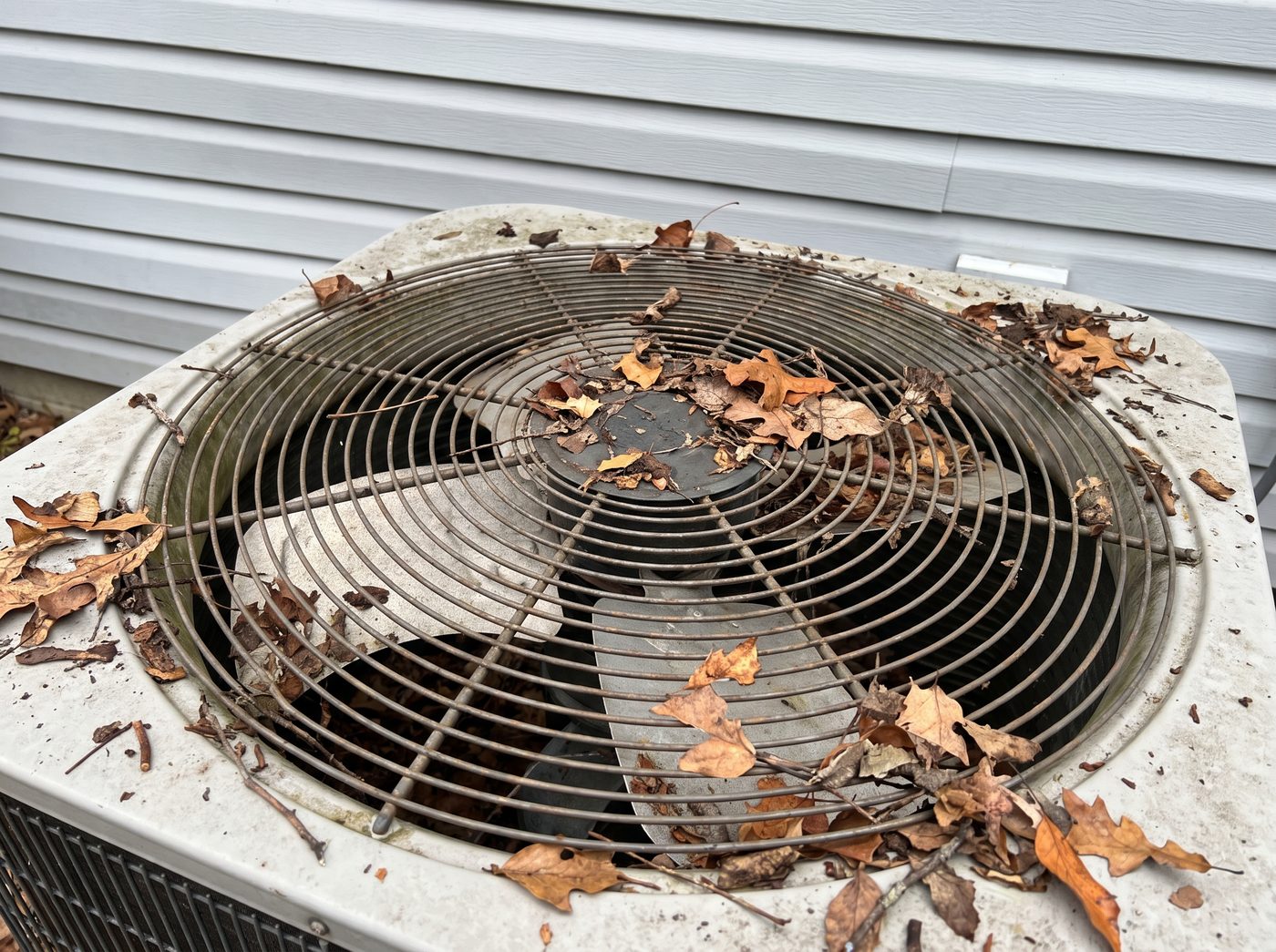
A hum with no fan movement is the signature of a failed run capacitor. The capacitor provides the kick that gets the motor turning; without it the motor sits there drawing current and going nowhere. It is a cheap part and a common failure. It is also the one component in a home air conditioner that can genuinely hurt you, because it stores a charge after the power is off.
- 01
Shut it down properly
Thermostat off, then the breaker, then the outdoor disconnect box beside the unit if there is one. Leaving it humming is what turns a $100 to $250 part into a compressor.
- 02
Rule out the obvious
Look through the top grille for a branch, a plastic bag or a bird’s nest jamming the blades. With the power off, turn the fan by hand: it should spin freely and coast. Stiff or gritty means the motor bearings, not the capacitor.
- 03
Understand the stick test before you use it
Power on briefly, push the blades through a turn with a long wooden stick through the grille, and if the fan then keeps running you have confirmed a failed capacitor. It is a diagnosis, not a repair: it will fail again on the next start, and each start in that condition stresses the compressor.
Wood, never metal, never a hand, never anything you are holding near the blade path. And shut it down again straight after. If any of that feels wrong, skip this step: it tells you what a technician will tell you in ten minutes.
- 04
Check the breaker and disconnect
A tripped breaker or a pulled disconnect explains a dead unit but not a humming one. Reset once. If it trips again, stop: something is drawing current it should not.
- 05
Clear the unit while you are there
Leaves and debris on the grille and packed into the fins make the whole system work harder, and heat is what kills capacitors. It is the only part of this you can safely do something about.
- 06
Call it in
Say the words "humming, fan not turning, I suspect the capacitor". It is a twenty-minute job with a cheap part for someone with a meter and a discharge tool, and knowing the likely fault stops you being sold a compressor.
What it costs
| Cost | Source | |
|---|---|---|
| Capacitor replacement | $100 to $250 | |
| Service call to diagnose | $75 to $200 | |
| Condenser fan motor | $200 to $700 out of warranty $100 to $300 under warranty | |
| AC repair overall | $150 to $650, averaging $360 |
Every figure here is published by the source named beside it. We do not average them into a number of our own.
Where to stop
This is the shortest list on the site and it has one item that genuinely matters.
- The capacitor itself
- It holds a charge after the power is off and discharges through whatever completes the circuit. Technicians short it deliberately with an insulated tool before touching it. This is not caution about difficulty.
- Anything inside the electrical panel of the unit
- Contactor, wiring and terminals sit at line voltage and the disconnect does not always kill everything you would expect.
- Running it while it hums to "see if it starts"
- A stalled motor draws locked-rotor current. That is what damages the compressor, and the compressor is the expensive half of the system.
- Refrigerant, as always
- EPA Section 608 certification is required to buy or handle it.
Why it happened
Capacitors are electrolytic components sitting in a metal box outside, in the sun, in the heat their own system generates. They degrade with heat and time, and they fail most often on the hottest days because that is when they are hottest and working hardest. It is the most predictable failure in home air conditioning and it is why every technician carries spares in summer.
What stops it happening again
Heat is what kills them, so anything that lets the unit shed heat helps: two feet clear all round, fins rinsed, no shrubbery grown across it. An annual service will also test the capacitor and flag one that is drifting out of tolerance before it strands you in August.
- The part
- Nothing you fit yourself. The relevant spend is the annual service, where the capacitor gets measured rather than waited on.
- How often
- Clear two feet around the condenser each spring. Rinse the fins once a season. Annual service before the cooling season, not during it.
Want the rest of the house covered?
One email a month, timed to the systems you actually have. The same kind of thing as the tablet: small, cheap, and it stops the call.
Also asked
- Why is my AC outside unit humming but the fan is not turning?
- Almost always a failed run capacitor. The motor is energised but has no starting kick, so it sits drawing current. Shut it off, because that state is what damages the compressor.
- Can I start the fan with a stick?
- It will usually confirm the diagnosis, and it fixes nothing. The fan will fail to start again next cycle, and every stalled start stresses the compressor. Use wood, never metal, and shut it down straight after.
- Can I replace an AC capacitor myself?
- It is the one part on this site we tell you not to touch. It stores a charge after the power is off, and technicians discharge it deliberately with an insulated tool before going near it.
- How much does an AC capacitor cost to replace?
- HomeGuide puts capacitor replacement at $100 to $250, with a diagnostic call at $75 to $200 that is usually credited against the repair.
- Is it the capacitor or the fan motor?
- With the power off, turn the blades by hand. Free and coasting points at the capacitor. Stiff or gritty points at the motor bearings, which HomeGuide puts at $200 to $700 out of warranty.